What Makes a DeFi Strategy Actually Sustainable?
--
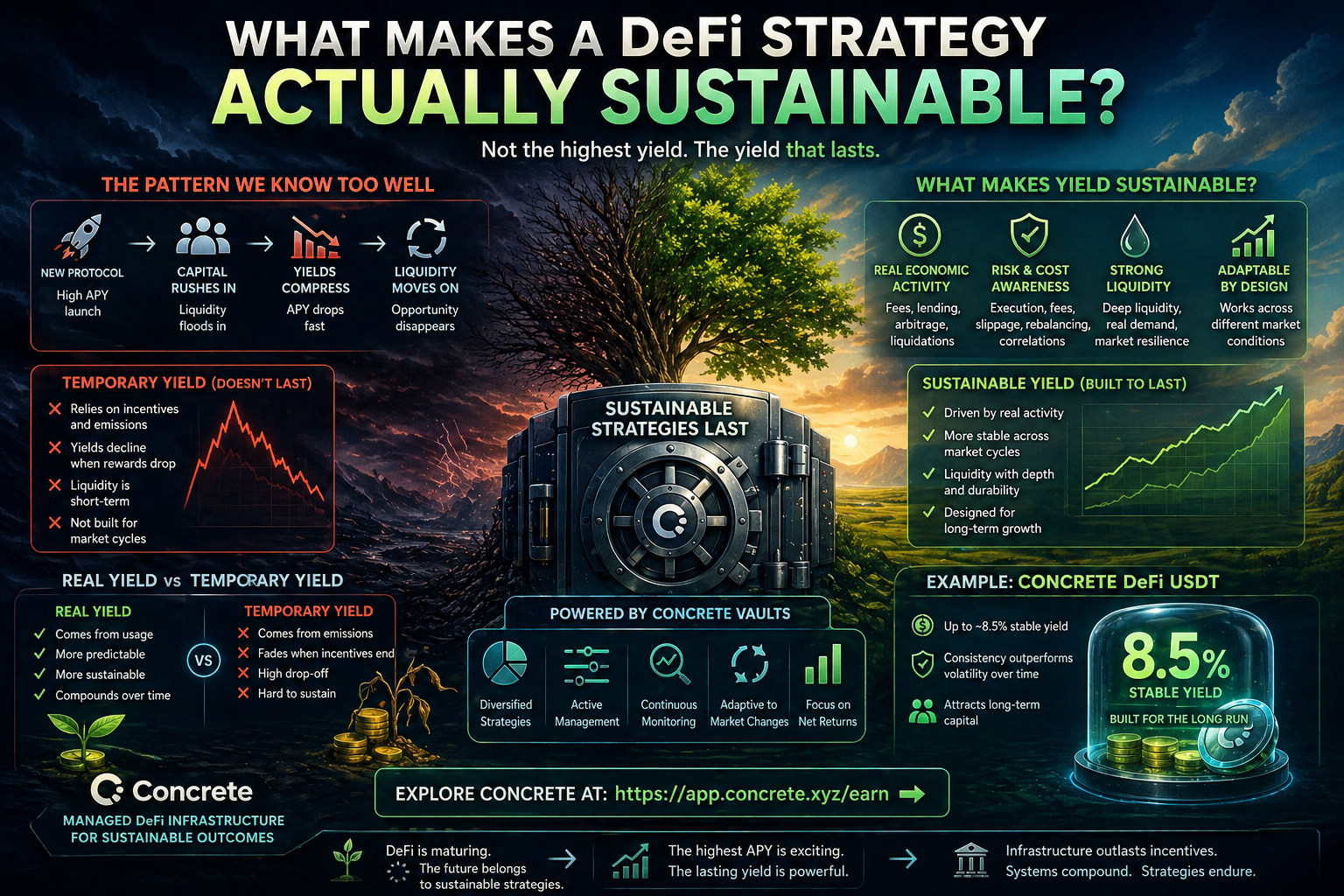
DeFi has a pattern most of us know too well.
A new protocol launches.
APYs look insane.
Capital rushes in.
For a brief moment, it feels like free money.
Then reality sets in.
Yields compress.
Liquidity rotates out.
The opportunity disappears.
And the cycle repeats.
So the real question isn’t: what yields the most today?
It’s: what actually lasts?
The Pattern: Why Most DeFi Strategies Fade
DeFi moves fast — but not always forward.
High APYs are often designed to attract attention, not to endure. Incentives bootstrap liquidity, but they rarely sustain it. Once emissions slow down or capital saturates the opportunity, returns decline.
This creates a loop:
- Launch → hype → inflows
- Saturation → declining yield
- Exit → capital rotation
Most strategies don’t fail because they’re poorly designed.
They fail because they were never meant to last.
Defining “Sustainable” in DeFi
A sustainable DeFi strategy isn’t about peak performance — it’s about durability.
It should:
- Generate consistent returns over time
- Avoid dependence on short-term incentives
- Remain viable across different market conditions
This is the difference between headline APY and risk-adjusted yield.
Sustainability means surviving volatility, not just benefiting from it.
Real Yield vs Temporary Yield
Not all yield is created equal.
Some comes from real economic activity:
- Trading fees
- Lending interest
- Arbitrage inefficiencies
Other yield comes from token emissions and incentives.
Here’s the key distinction:
Temporary yield:
- Driven by rewards programs
- Declines as emissions reduce
- Attracts mercenary capital
Real yield:
- Backed by actual usage
- More stable over time
- Scales with demand
A strategy built on emissions is renting attention.
A strategy built on real activity is capturing value.
Liquidity, Market Conditions, and Adaptability
Sustainability doesn’t exist in isolation — it depends on the environment.
Key factors include:
- Liquidity depth
- User demand
- Market volatility
- Strategy-specific conditions
Some DeFi strategies only work in bull markets.
Others only thrive in volatility.
The strongest strategies adapt.
They don’t rely on perfect conditions — they adjust to changing ones.
The Hidden Costs That Erode Yield
Many strategies look great on paper — but degrade in practice.
Why?
Because of overlooked costs:
- Execution fees
- Slippage
- Rebalancing overhead
- Changing correlations between assets
A 20% APY can quietly become 5% net yield once these factors are included.
Sustainable yield is always net yield.
Anything else is marketing.
Designing Better DeFi Strategies
If sustainability is the goal, strategy design must evolve.
That means:
- Diversifying across multiple yield sources
- Continuously monitoring performance
- Adapting allocations dynamically
- Prioritizing consistency over spikes
This is where DeFi shifts from opportunistic trading to managed DeFi systems.
It’s no longer about chasing the next farm.
It’s about building resilient capital flows.
The Role of DeFi Vaults
This is exactly where DeFi vaults come in.
Well-designed vaults aim to:
- Aggregate multiple strategies
- Optimize for sustainable yield
- Actively manage risk
- Reduce reliance on emissions
They treat capital as something to preserve and grow — not just deploy.
This is the foundation of institutional DeFi.
How Concrete Vaults Approach Sustainability
Concrete vaults are built with this philosophy at the core.
Instead of chasing the highest APY, they:
- Focus on sustainable yield sources
- Actively manage onchain capital
- Adapt strategies based on market conditions
- Optimize for long-term performance
This is managed DeFi — where systems, not speculation, drive returns.
A Real Example: Concrete DeFi USDT
Take Concrete DeFi USDT as an example.
It offers:
- ~8.5% stable yield
- Exposure to more consistent strategies
- Lower reliance on volatile incentives
At first glance, it may seem less exciting than high-APY farms.
But over time, consistency wins.
Stable, predictable returns:
- Attract long-term capital
- Reduce risk exposure
- Compound more effectively
This is what risk-adjusted yield looks like in practice.
The Bigger Shift in DeFi
DeFi is maturing.
The space is moving:
- From short-term yield chasing
- Toward long-term capital strategies
The future won’t be defined by:
- The highest APY
- The fastest gains
It will be defined by:
- Sustainable yield
- Durable infrastructure
- Strategies that survive cycles
Because in the end, the best DeFi strategies aren’t the ones that perform for a week —
They’re the ones that are still standing years later.
🚨 Explore Concrete at: https://app.concrete.xyz/earn 🚨