What Makes a DeFi Strategy Actually Sustainable?
--
We’ve all seen the pattern.
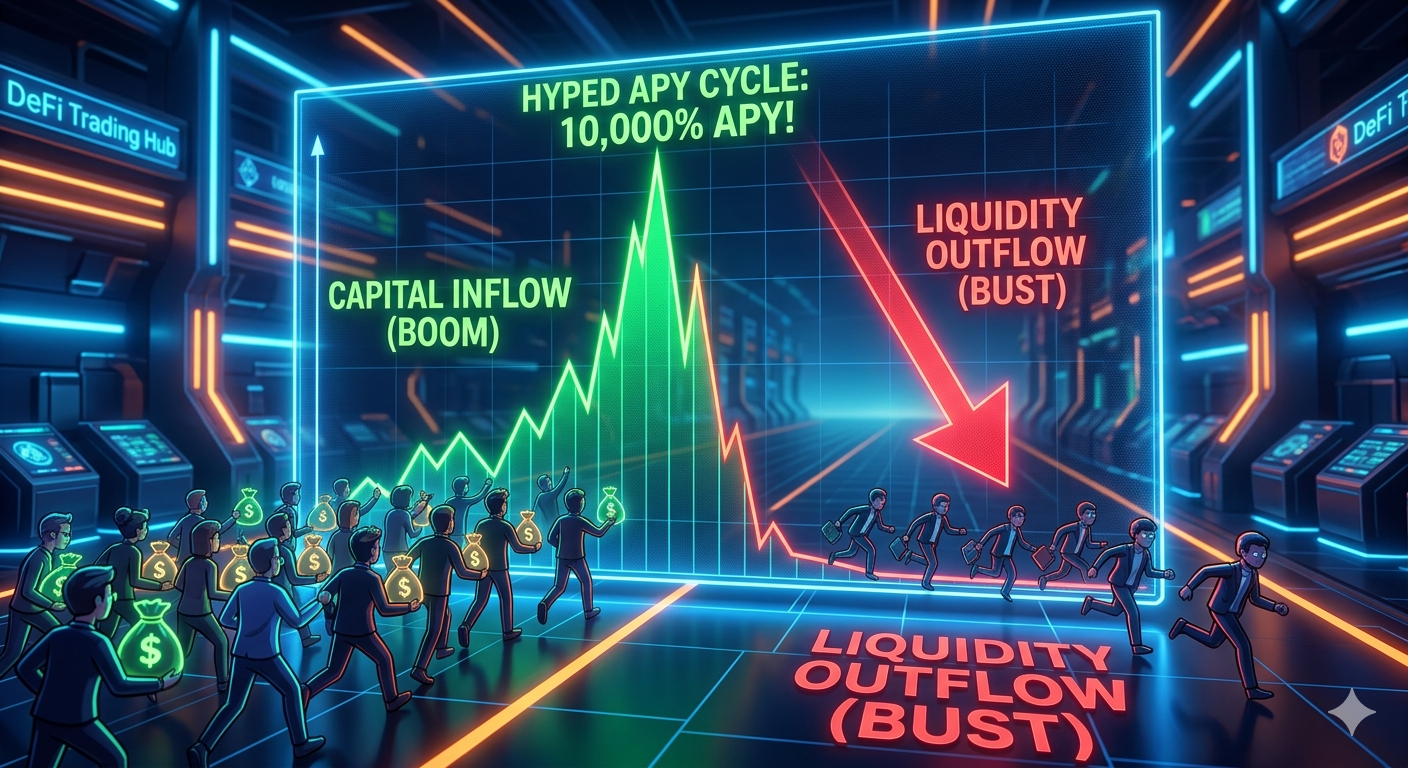
New protocols launch with high APY. Capital rushes in. Twitter explodes with “wen lambo?” Then, quietly — or sometimes not so quietly — yields compress. Liquidity rotates elsewhere. The next shiny object appears. Repeat.
This cycle has played out hundreds of times across DeFi.
So here’s the key question: Why do most strategies fade so quickly?
It’s not because the people building them are evil. It’s because most so-called “yield” isn’t real. It’s subsidized by token emissions, propped up by temporary incentives, or dependent on a single unsustainable mechanic. When that crutch disappears, so does the yield.
This week, we want the community to explore a deeper idea: In mature financial systems, the best strategies aren’t the ones that perform for a week — but the ones that survive across market cycles.
That brings us to the real question: What makes a DeFi strategy actually sustainable?
2️⃣ Define What “Sustainable” Means
Let’s break down the idea of sustainability in simple terms.
A sustainable strategy should:
- Generate consistent returns over time — not just a one-week spike. Think steady, reliable yield, not a lottery ticket.
- Not depend entirely on incentives — if the protocol turns off its governance token rewards tomorrow, does the yield disappear? If yes, it’s not sustainable.
- Remain viable across different market conditions — bull, bear, crab, high volatility, low volume. A durable strategy adapts; it doesn’t break.
This is about durability, not just performance. A strategy that returns 50% one month and -30% the next is not durable. A strategy that returns 5% every month, with managed downside, is far more valuable.
So when we talk about sustainable yield, we mean yield you can reasonably expect to exist six months, a year, or longer — not yield that requires constant hunting, hopping, and hoping.
The best DeFi strategies don’t chase the highest number. They chase the highest risk-adjusted yield — the return you actually keep after accounting for volatility, drawdowns, and tail risks.
That’s why DeFi vaults designed for durability — like Concrete vaults — focus on diversified, actively managed exposures. They don’t bet the farm on one liquidity pool or one incentive program. They allocate onchain capital across multiple sources of real yield, rebalancing as conditions change.
This is the essence of managed DeFi: professionals monitoring and adjusting positions so that you don’t have to. And it’s exactly what institutional DeFi demands — transparency, risk controls, and consistent, auditable performance.
Explore Concrete at: https://app.concrete.xyz/earn 🚨
The Illusion of High APY
If you chase raw percentage points, you will get wrecked. The highest APY is often a trap — a liquidity mining furnace that burns late entrants.
Sustainable yield looks different. It comes from real economic activity: trading fees, lending spreads, options premiums, or arbitrage. If you can’t trace the yield back to a genuine payer, it’s likely not sustainable.
What Separates Short-Term Hype from Long-Term Durability?
After watching multiple market cycles, a few traits stand out.
1. Real, Persistent Demand
Is someone actually paying for the service? Liquidity providers earn fees because traders need to swap. Lenders earn interest because borrowers need capital. The most resilient DeFi vaults tap into recurring demand — not temporary token giveaways.
2. Risk-Adjusted Yield Over Raw APY
High yield often hides high risk. Impermanent loss, oracle manipulation, smart contract bugs — all can wipe out months of gains in minutes.
A sustainable strategy prioritizes risk-adjusted yield — the return you keep after accounting for volatility, drawdowns, and tail risks. That means diversification, conservative leverage, battle-tested protocols, and real-time monitoring.
3. Adaptability Across Market Conditions
No single strategy works forever. In bull markets, leveraged longs thrive. In bear markets, basis trades and funding rates flip.
Durable DeFi strategies evolve. They rotate between lending, staking, market-making, and hedging based on volatility and liquidity. Static strategies die; dynamic ones survive.
4. Capital Efficiency with Safety Buffers
Some protocols chase extreme capital efficiency — rehypothecating collateral multiple times. One small price move and the house collapses.
Sustainable strategies leave room for error. They understand that onchain capital needs buffers, not just optimization.
The Role of Managed DeFi and Concrete Vaults
This is where managed DeFi changes the game.
Retail users chasing yield face three problems: lack of time to monitor dozens of opportunities, lack of expertise to assess risk-adjusted yield, and lack of infrastructure to rebalance efficiently.
Concrete vaults solve this. They offer professionally managed, actively rebalanced strategies. Instead of guessing which yield source will last, users deposit onchain capital into vaults that dynamically allocate across the most resilient opportunities — while monitoring risk in real time.
Concrete vaults are a prime example of sustainable design:
- They aggregate yield from multiple underlying protocols (lending, perps, options)
- They adjust allocations based on changing market conditions
- They prioritize risk-adjusted yield over headline APY
- They are built for institutional DeFi standards transparent, audited, and non-custodial
This isn’t theoretical. Managed DeFi is already proving that strategies can survive drawdowns, volatility spikes, and fee compression because they aren’t betting on a single narrative or token.
Why Do Most Opportunities Disappear?
Let’s be honest. Most yield opportunities vanish because they were never real to begin with.
- Incentive token mines → users sell, price crashes → yield evaporates
- Unbalanced liquidity pools → no traders → fees drop to zero
- Leveraged loops → small correction causes liquidation cascade → strategy fails
- Bridged asset farms → bridge gets hacked or depegged → principal lost
The only DeFi strategies that persist are anchored to fundamentals: organic fees, borrower demand, and structural market inefficiencies that don’t depend on continuous subsidy.
3️⃣ Compare Real Yield vs Temporary Yield
Not all yield is created equal. Understanding the difference between real yield and temporary yield is the single most important skill for long-term success.
Yield from real activity comes from:
- Trading fees — people actually swapping assets on a DEX
- Lending interest — borrowers paying to access capital
- Arbitrage profits — bots competing to correct price inefficiencies
- Options premiums — market participants paying for downside protection
This yield is earned, not printed. It exists because someone, somewhere, is willing to pay for a financial service. Even if the protocol removed all token rewards, this activity would continue — because the demand is real.
Yield from emissions or incentives comes from:
- Liquidity mining rewards paid in a protocol’s governance token
- “Farm” tokens with no underlying demand
- Ponzi-like structures where new deposits pay old depositors
Emissions-driven yield often declines sometimes catastrophically because:
- Token price drops as farmers sell immediately
- More capital enters, diluting rewards per dollar
- The protocol eventually runs out of treasury or investor patience
Real economic activity, on the other hand, is more stable. Trading volume fluctuates, but it doesn’t go to zero overnight. Lending demand exists regardless of token price. Arbitrage opportunities persist as long as markets are inefficient.
So when you evaluate DeFi vaults, ask: Is this vault harvesting real yield from underlying activity, or is it just stacking incentive tokens and hoping the price holds?
Concrete vaults focus on the former. They route onchain capital into protocols where yield is generated by actual users not by token printers. That’s why they can deliver sustainable yield even when the latest “incentive farm” has collapsed.
In managed DeFi, the best managers don’t just chase APY they actively distinguish between real and temporary yield, rotating away from emission-heavy strategies before they fall apart.
4️⃣ Highlight the Role of Liquidity & Market Conditions
Now let’s talk about something that even experienced users overlook: sustainability depends heavily on liquidity depth and market conditions.
A strategy that works beautifully in a high-volume, low-volatility environment can implode when the market flips. So how do liquidity and market conditions affect DeFi strategies?
Liquidity depth matters because:
- Shallow pools mean even small trades cause massive slippage
- Yield from trading fees becomes unreliable it spikes when a whale trades, then flatlines
- Exiting a position can be costly or even impossible during panic
User activity drives real yield. A lending protocol with few borrowers will have near-zero interest rates. A DEX with low trading volume generates negligible fees. Strategies that depend on consistent activity not just TVL are more durable.
Market volatility is a double-edged sword:
- High volatility increases trading fees and options premiums — good for some strategies
- But it also increases impermanent loss, liquidation risk, and oracle divergence
- A sustainable strategy doesn’t just survive high volatility; it can even benefit from it without taking on excessive risk
Demand for the underlying strategy is the ultimate test. Does anyone actually want the service you’re providing? For example:
- A basis trade on perp funding rates works only while funding rates are positive — that requires leveraged long demand
- A put-selling strategy works only when there’s demand for downside protection
- A market-making strategy works only when traders are actively swapping
Some strategies only work in specific conditions. Leveraged long staking works in a bull market but gets liquidated in a bear market. Yield farming on a new DEX works while incentives are high but collapses when the farm ends. These are conditional strategies not sustainable ones.
Others adapt. The most durable DeFi vaults are designed to change as conditions change. When volatility spikes, they might reduce leverage or rotate into options strategies. When liquidity dries up, they might move capital into lending or stables. When user activity shifts between protocols, they follow the activity.
That’s the core of managed DeFi: continuously monitoring liquidity depth, user activity, volatility, and underlying demand then reallocating onchain capital to where risk-adjusted yield is most attractive given current conditions.
Concrete vaults exemplify this adaptive approach. Instead of hardcoding a single strategy, they actively manage allocations across a basket of underlying protocols. When one yield source weakens, the vault automatically shifts capital to stronger opportunities. This is how you achieve sustainable yield across market cycles not by picking the right strategy once, but by managing it continuously.
For institutional DeFi, this adaptability is non-negotiable. Institutions cannot afford to manually rotate between farms every week. They need vaults that do the adaptation for them, with clear risk parameters and transparent execution.
5️⃣ Introduce Risk & Cost Awareness
Now let’s bring in the often-overlooked side of sustainability: costs and frictions.
A strategy might look incredibly strong on paper — backtests show 15% APY, low drawdowns, smooth returns. But once you deploy real onchain capital, the hidden costs start eating away at profits. Over time, these frictions can turn a winning strategy into a losing one.
Here’s what most yield chasers ignore:
Execution costs — Every trade, deposit, withdrawal, or rebalance costs gas. On Ethereum mainnet during congestion, a single complex transaction can cost 50–50–200. If a strategy rebalances weekly, that’s thousands of dollars in gas per year. For smaller accounts, these costs can completely erase yield.
Rebalancing friction — Active DeFi strategies need to move capital between opportunities. But rebalancing isn’t free. You pay gas, you pay spread, you may incur slippage. A vault that rebalances too aggressively will bleed value. One that rebalances too slowly will miss opportunities. The optimal frequency depends on market conditions and getting it wrong destroys risk-adjusted yield.
Slippage — Large deposits or withdrawals can move prices against you. If a vault manages millions in onchain capital, entering a position might push up the price of the asset you’re buying or push down the price of what you’re selling. This is especially painful in illiquid strategies like exotic LP pairs or small lending markets. The advertised APY assumes you get filled at mid price. In reality, you don’t.
Changing correlations Many yield strategies rely on correlations between assets. A basis trade assumes futures and spot prices converge. A delta neutral LP strategy assumes the two tokens move together. But correlations break during crises. When they do, what looked like a low-risk strategy can suddenly suffer massive losses. This isn’t captured in standard risk metrics.
Time horizon mismatch Some strategies require long lockups (e.g., staking for 90 days) to earn yield. But if market conditions change and you need to exit early, you forfeit rewards or pay penalties. A sustainable strategy aligns lockup periods with your liquidity needs or avoids long lockups entirely.
The result: A vault that shows 12% gross APY might deliver only 8% net after costs and slippage. Worse, if those costs are variable gas spikes, rebalancing becomes expensive the net yield becomes unpredictable.
This is where managed DeFi and Concrete vaults differentiate themselves.
First, Concrete vaults batch transactions and optimize gas usage, reducing execution costs per user. Instead of every individual paying full gas, the vault spreads costs across all depositors.
Second, they actively manage rebalancing frequency. They don’t rebalance on a fixed schedule they rebalance when the expected benefit exceeds the cost. This sounds simple, but it requires sophisticated simulation and real-time gas monitoring.
Third, they consider slippage and liquidity depth before entering positions. A vault might skip a seemingly attractive yield opportunity if the pool is too shallow to absorb the vault’s capital without moving prices.
Fourth, they stress-test for correlation breakdowns. A truly durable vault doesn’t just assume correlations hold it models what happens if they break, and it holds hedges or reduces exposure accordingly.
For institutional DeFi, these cost and risk awareness are mandatory. Institutions don’t just look at headline APY. They demand full cost accounting: net risk-adjusted yield after gas, slippage, rebalancing overhead, and correlation risk. Without this, a strategy is not investable.
So when you evaluate any DeFi vault not just Concrete vaults ask: What’s the net return after all costs? How often do you rebalance, and how much does that cost? What happens to my capital when correlations break?
If the answer is vague or missing, that’s a red flag. Sustainable yield requires brutally honest cost and risk awareness — not just optimistic backtests.
6️⃣ Connect This to Better Strategy Design
Everything we’ve covered so far — real vs temporary yield, liquidity and market conditions, hidden costs and risks points to a fundamental shift in how we should think about building DeFi strategies.
The old way: Find the highest APY, deposit, hope, repeat.
The sustainable way: Design systems that survive.
Here’s what better strategy design looks like in practice.
Diversification across strategies No single yield source is bulletproof. Lending rates compress. Trading volumes drop. Basis trades invert. A sustainable vault doesn’t rely on any single leg. It spreads onchain capital across uncorrelated opportunities: some in lending, some in market-making, some in options, some in staking. When one underperforms, the others carry the portfolio. This is how you achieve sustainable yield — not by picking one winner, but by building a portfolio of resilient sources.
Continuous monitoring Markets change fast. A strategy that was low-risk yesterday can become high-risk today. That’s why passive, set-and-forget vaults are dangerous. Better design includes 24/7 real-time monitoring of on-chain metrics: pool depth, borrow utilization, funding rates, volatility indices, oracle health. When a metric crosses a threshold, the system alerts or automatically adjusts.
Adapting to market changes Monitoring is useless without action. Sustainable DeFi vaults have clear rules for rotation. If lending utilization drops below 20%, move capital elsewhere. If funding rates turn negative, close the basis trade. If volatility spikes beyond a range, reduce leverage or hedge. This isn’t about timing the market it’s about responding to conditions systematically.
Focusing on net returns, not headline APY Any vault can advertise “up to 15% APY.” But what matters is what you actually earn after gas, slippage, and management fees. Better strategy design optimizes for net risk-adjusted yield. That might mean trading less frequently to save on gas, or avoiding shallow pools even if their advertised yield is higher. It means being honest about costs and building them into the model.
This is where DeFi starts to look more like systems, not just opportunities. Instead of asking “Which farm is paying the most this week?” we start asking “How do we build a system that consistently captures value from DeFi’s underlying economic activity, while managing for downside?”
That’s exactly what managed DeFi and Concrete vaults represent. Concrete vaults are not just a set of strategies they are a systematic framework for:
- Diversifying across yield sources
- Continuously monitoring market conditions
- Adapting allocations without manual intervention
- Reporting net returns transparently
For institutional DeFi, this systems-thinking approach is essential. Institutions don’t want to gamble on a single strategy; they want a reliable, auditable system that produces sustainable yield over years, not days. That means rigorous backtesting, live monitoring, stress-testing against historical crises, and clear operational procedures.
The shift from “opportunity hunting” to “system design” is the single biggest sign of DeFi’s maturation. And it’s the only path to strategies that actually last.
7️⃣ Connect to Concrete Vaults
Now let’s bring this full circle to Concrete vaults — because theory is useful, but execution is everything.
Concrete vaults are not just another set of DeFi vaults chasing the highest temporary APY. They are purpose-built around the principles we’ve discussed:
- Prioritizing sustainable yield sources — Every strategy within Concrete vaults starts with the question: “Is this yield coming from real economic activity or temporary incentives?” The vaults actively filter out emission-heavy farms, loyalty points schemes, and other short-lived yield sources. Instead, they focus on lending yields, perp funding rates, options premiums, and DEX trading fees revenue that persists even after token rewards dry up.
- Managing capital across strategies — Concrete vaults don’t pick one winner. They allocate onchain capital across multiple, uncorrelated DeFi strategies simultaneously. This diversification smooths returns and reduces drawdown risk. When one strategy underperforms, others compensate. Over time, this produces higher risk-adjusted yield than any single strategy alone.
- Adapting to changing conditions — Markets evolve. A strategy that works in low volatility fails in high volatility. Concrete vaults continuously monitor liquidity depth, user activity, volatility, and correlation regimes. When conditions shift, the vault rebalances automatically — moving capital from weakening opportunities to strengthening ones. This isn’t manual “yield farming hopping”; it’s systematic, data-driven adaptation.
- Reducing reliance on short-term incentives — Many vaults boost their APY with temporary token rewards or farm points. Concrete vaults take a different approach. While they may occasionally capture incentive yield when it’s genuinely additive, the core design does not depend on it. The goal is sustainable yield that remains attractive even after all temporary programs end. This makes Concrete vaults durable across market cycles, not just during liquidity mining seasons.
But it goes deeper than that.
Concrete vaults are designed to focus on durability, not just peak yield. That means:
- Net return engineering — They optimize for what you actually keep after gas, slippage, and rebalancing costs, not theoretical gross APY.
- Risk guardrails — Circuit breakers, position limits, and automated deleveraging prevent catastrophic losses during black-swan events.
- Transparent reporting — Every deposit can track real-time performance, costs, and allocations. No black boxes.
- Institutional-grade infrastructure Multi-sig controls, audit trails, and compliance-friendly design make Concrete vaults suitable for institutional DeFi capital that requires fiduciary standards.
The result is a managed DeFi experience where you don’t have to become a professional yield farmer or a risk analyst. You simply deposit onchain capital into Concrete vaults, and the system works to generate sustainable yield adapting, diversifying, and managing costs on your behalf.
This is the practical answer to the question we opened with: “What makes a DeFi strategy actually sustainable?”
Sustainable strategies are not magical. They are engineered. They start with real yield sources, add diversification, bake in adaptability, account for costs, and continuously monitor risk. Concrete vaults put that engineering into practice.
8️⃣ Use Concrete DeFi USDT as an Example
Let’s ground all of this in a real, live product: Concrete DeFi USDT.
Concrete DeFi USDT is a DeFi vault designed to generate stable, sustainable yield on USDT deposits. At the time of writing, it offers up to ~8.5% APY on stablecoin capital.
Now, 8.5% might not make headlines. It’s not the 500% APY you see on some degens’ Telegram groups. But that’s exactly the point.
Sustainable yield often looks less exciting but it’s more reliable.
Here’s why Concrete DeFi USDT exemplifies everything we’ve discussed:
Real yield sources The vault does not rely on emissions or governance token printing. Instead, it allocates onchain capital across a diversified set of proven yield opportunities: lending on Aave and Compound, providing liquidity on stablecoin pools (like USDT/USDC), and capturing basis trades between spot and perp markets. Every source of yield comes from real user activity borrowing, swapping, hedging.
Stability over volatility A volatile strategy might deliver 20% one month and -10% the next. Over time, the risk-adjusted yield can actually be lower than a steady 8.5%. Concrete DeFi USDT prioritizes consistency. The vault actively manages risk to avoid large drawdowns. The result is a yield stream that compounds predictablywhich is far more valuable for long-term capital planning than a rollercoaster.
Adaptability baked in The vault doesn’t just pick a strategy and hope. Its underlying managed DeFi engine continuously monitors lending utilization, stablepool depth, funding rates, and volatility. If conditions change say, lending rates drop below 3% the vault reallocates to more attractive opportunities. If funding rates turn negative, it exits basis trades. This adaptability ensures the vault remains resilient across bull, bear, and sideways markets.
Cost-aware design Because Concrete vaults batch transactions and optimize rebalancing frequency, the net yield to depositors is maximized. Gas costs, slippage, and management fees are all accounted for transparently. What you see is what you keep.
Institutional-grade stability For institutional DeFi players, 8.5% stable yield is extremely attractive. It’s competitive with traditional private credit, but with full on-chain transparency, instant settlement, and non-custodial security. Institutions don’t want lottery tickets; they want reliable, monitorable returns. Concrete DeFi USDT delivers exactly that.
Here’s the key insight: sustainable yield compounds. A vault that delivers 8.5% consistently for five years will vastly outperform a strategy that spikes to 30% for three months then collapses to 0%. Slow and steady doesn’t just win the race it wins the marathon.
Concrete DeFi USDT is not trying to be the highest APY vault on the market. It’s trying to be the one that still exists and still pays yield five years from now. That’s what sustainable yield actually looks like in practice.
And it works. Capital that understands risk-adjusted yield is already flowing into Concrete vaults because consistency, transparency, and durability matter more than a headline number.
9️⃣ Close With the Bigger Shift
We’ve covered a lot: real yield vs temporary incentives, liquidity and market conditions, hidden costs like gas and slippage, diversification, continuous monitoring, and how Concrete vaults put all of this into practice with examples like Concrete DeFi USDT.
But none of this matters unless we zoom out.
Here’s the bigger shift happening right now in DeFi:
DeFi is moving from short-term yield chasing toward long-term capital strategies.
For years, the dominant mindset was “find the highest APY, dump in, get out before the crash.” That worked for some until it didn’t. The bear market of 2022–2023 wiped out countless farmers who thought they were early but were actually exit liquidity.
Now, a new mindset is emerging. One that asks: What happens after the incentives dry up? What happens when volatility drops? What happens when the next black swan hits?
Sustainability will matter more than peak returns. The institutions entering DeFi asset managers, family offices, pension funds don’t care about a one-week 1,000% APY. They care about risk-adjusted yield that compounds predictably over years. They care about vaults that don’t blow up. They care about transparency, audits, and real-time monitoring.
Infrastructure will outlast incentives. The protocols that survive will not be the ones with the loudest marketing or the highest temporary yields. They will be the ones that build durable managed DeFi rails systems that aggregate onchain capital, diversify across DeFi strategies, adapt to changing conditions, and deliver sustainable yield without relying on printed tokens.
Concrete vaults are built for this future. They are not a gamble; they are infrastructure. They turn the chaotic, fragmented world of DeFi yield into a system that works day after day, cycle after cycle.
The future of DeFi won’t be defined by the highest APY.
It will be defined by the strategies that last.
Explore Concrete at: https://app.concrete.xyz/earn 🚨
How Should Capital Think About Long-Term Yield?
Stop asking “What’s the highest APY right now?”
Start asking:
- Where does this yield come from?
- What happens to yield if volume drops 80%?
- Is my risk-adjusted yield being monitored daily?
- Can the strategy adapt without me doing anything?
- What are the real costs — gas, slippage, rebalancing — eating into my returns?
- Is this a single bet or a diversified system?
- Would I rather have 8.5% for five years or 20% for three months?
For individuals, that means embracing DeFi vaults that do the heavy lifting like Concrete vaults rather than chasing every new farm.
For institutions, it means demanding transparency, auditability, and stress-tested metrics. Institutional DeFi is not about higher returns; it’s about reliable, monitorable, and compliant access to sustainable yield.
The Bottom Line
DeFi is maturing. The days of infinite, risk-free, triple-digit APY are over — if they ever existed. What remains is a real market with real fees, real borrowers, and real opportunities for those who understand risk-adjusted yield.
The most sustainable yield doesn’t come from the loudest tweet or the highest number on a dashboard. It comes from thoughtful design, active management, and a focus on long-term survival rather than short-term extraction.
Concrete vaults represent that shift: from gambling on APYs to investing in durable, managed DeFi strategies that stand the test of time. Concrete DeFi USDT is a living example of this philosophy offering stable, reliable yield that compounds quietly while others chase the next farm.
So the next time someone promises you 500% APY, ask them one question:
“Will this still exist next year?”
If the answer makes you uncomfortable, you already know what to do.
Ready to explore strategies built to last?
Explore Concrete at: https://app.concrete.xyz/earn