What Is Quantitative Trading and Which Models to Use
 DeepTradeX8 min read·Just now
--
Meta Description: Discover quantitative trading fundamentals and proven mathematical models used by institutional traders. Learn mean reversion, momentum, arbitrage, and AI-powered strategies driving the $25 billion quant trading market in 2026.
Understanding Quantitative Trading
Quantitative trading is an approach that uses mathematical models, statistical analysis, and algorithmic execution to identify and exploit market inefficiencies — a systematic method replacing emotional decision-making with data-driven precision.[1] Unlike discretionary traders who rely on intuition and market feel, quantitative traders (often called “quants”) develop explicit rules tested against historical data before risking capital.
The algorithmic trading market reached $25.04 billion in 2026 and is projected to grow to $44.34 billion by 2030 at a 15.4% compound annual growth rate, driven by increasing institutional adoption and technological advances in machine learning.[2] This explosive growth reflects a fundamental shift in how markets operate — from human-dominated trading floors to algorithm-powered execution networks processing millions of decisions per second.
DeepTradeX exemplifies modern quantitative trading infrastructure, combining AI-assisted intelligence with millisecond execution speeds. Their platform processes $1.16 billion in trading volume with 298 active strategies achieving a 92.47% average ROI through systematic quantitative approaches.[3] What distinguishes successful quant trading is not just mathematical sophistication, but robust implementation connecting theory to execution.
For traders considering quantitative methods, understanding the core models and their applications determines whether you build profitable systems or join the majority who abandon algorithmic approaches after initial failures.
The Core Components of Quantitative Trading
Effective quantitative trading systems integrate three essential elements:
Data Collection and Processing: Quantitative models consume vast datasets — price histories, volume patterns, order book dynamics, fundamental metrics, and alternative data sources like social sentiment or satellite imagery. The quality and timeliness of input data directly determines model effectiveness.
Mathematical Models and Strategy Logic: This is where statistical analysis, probability theory, and machine learning combine to identify tradable patterns. Models range from simple moving average crossovers to sophisticated neural networks processing hundreds of features simultaneously.
Automated Execution Systems: Once models generate signals, execution infrastructure must place orders rapidly with minimal slippage. DeepTradeX’s high-frequency trading engine with hardware acceleration delivers the execution speed quantitative strategies require, bridging the gap between theoretical signals and realized profits.
The quantitative investment market is projected to reach approximately $150 billion by 2028, reflecting institutional recognition that systematic approaches outperform discretionary trading over extended periods.[4]
Model 1: Mean Reversion Strategies
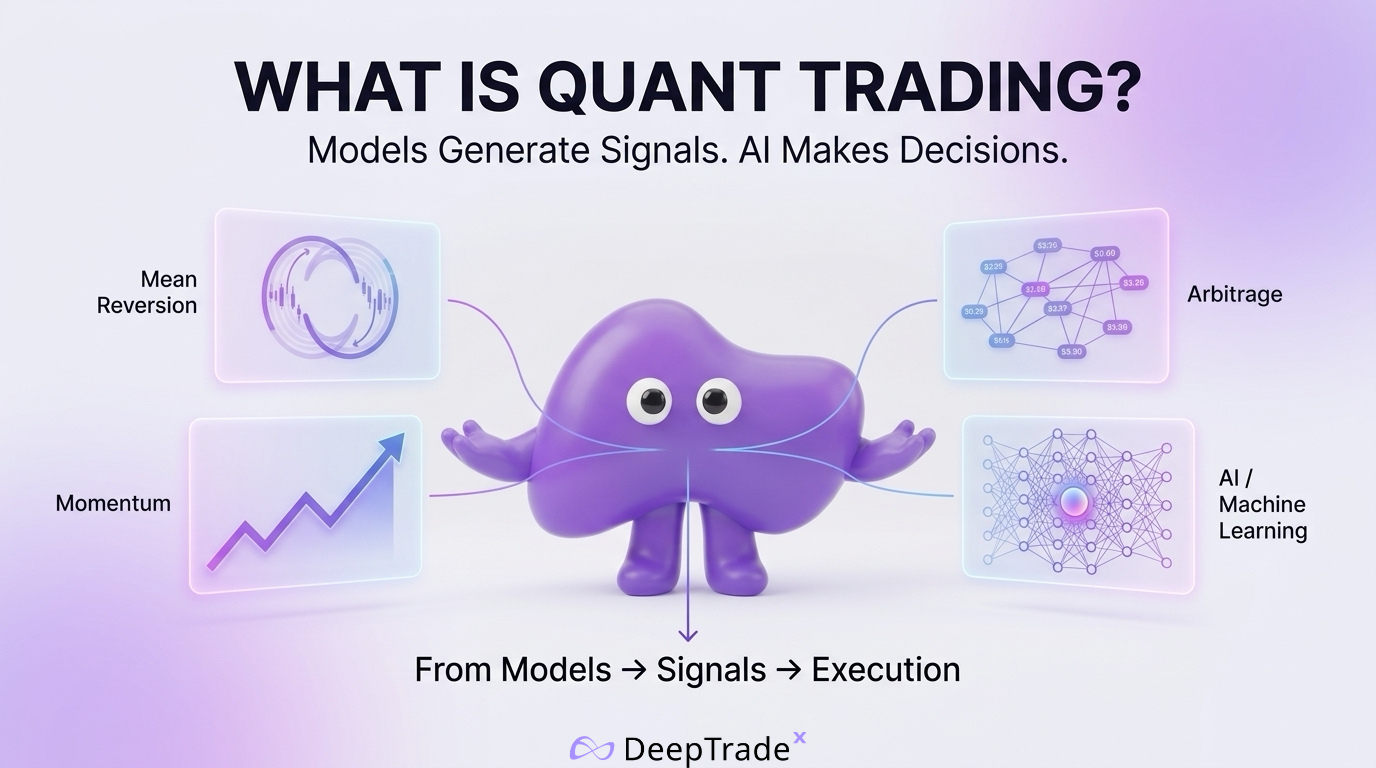
Mean reversion is a statistical approach based on the principle that asset prices and returns eventually revert to their long-term average — creating profitable opportunities when prices deviate significantly from historical norms.[5]
The mathematical foundation assumes temporary price dislocations correct themselves over time. When Bitcoin trades two standard deviations below its 30-day moving average, mean reversion models predict regression toward the mean, generating buy signals. Conversely, extreme moves above the mean trigger sell signals.
Common mean reversion implementations:
Pairs trading: Identify correlated assets (ETH/BTC, for example), and trade the spread when correlation temporarily breaks down
Statistical arbitrage: Create market-neutral portfolios profiting regardless of overall market direction by simultaneously buying undervalued and selling overvalued assets
Bollinger Band strategies: Trade extremes where price touches outer bands representing statistical standard deviations
DeepTradeX’s advanced backtesting capability — validating strategies against 10 years of tick-level data — allows traders to determine optimal parameters for mean reversion models before live deployment. Historical testing reveals which timeframes and deviation thresholds produce consistent edge.
Advantages: Works well in range-bound markets; generates frequent trading opportunities; risk-defined (positions close when mean reverts)
Limitations: Fails during trending markets where “deviations” persist; requires careful position sizing to survive extended dislocations; vulnerable to structural breaks that permanently shift means
Model 2: Momentum and Trend Following
Momentum strategies capitalize on the observation that assets exhibiting strong recent performance tend to continue moving in the same direction — the opposite of mean reversion philosophy.[6]
These models identify established trends and maintain positions while momentum persists. The core insight is that information diffuses gradually through markets — once a move begins, subsequent participants amplify the initial direction before eventual exhaustion.
Common momentum implementations:
Moving average crossovers: Enter long positions when short-term averages cross above long-term averages (indicating upward momentum); exit when the relationship reverses
Breakout systems: Buy when price exceeds recent highs (resistance breaks); short when price falls below recent lows (support breaks)
Relative strength strategies: Rotate capital toward strongest performers within a universe of assets
Professional traders often combine momentum and mean reversion approaches to exploit strengths of both strategies while diversifying risk.[7] DeepTradeX’s AI-assisted strategy generator allows building hybrid models that automatically shift between mean reversion during consolidations and momentum following during trends.
Advantages: Captures large sustained moves; psychologically easier (buying strength rather than weakness); works across timeframes and markets
Limitations: Generates frequent false signals during choppy conditions; suffers drawdowns during trend reversals; requires strict risk management to cut losing positions quickly
Model 3: Statistical Arbitrage
Statistical arbitrage creates market-neutral portfolios designed to profit regardless of overall market direction by exploiting temporary mispricings between related assets.[8]
These sophisticated strategies identify relationships that should hold based on economic fundamentals or historical correlation, then trade deviations from expected relationships. When the relationship normalizes, the arbitrage position profits.
Common statistical arbitrage approaches:
Index arbitrage: Exploit pricing differences between index futures and underlying constituent stocks
Cross-exchange arbitrage: Buy assets on exchanges where they’re underpriced while simultaneously selling on exchanges where they’re overpriced
Carry trades: Borrow low-interest-rate currencies to invest in high-interest-rate currencies, profiting from the differential
The model requires minimal directional market risk exposure — gains come from convergence of mispriced relationships rather than market movements. However, execution speed is critical; pricing discrepancies often last milliseconds before other algorithms eliminate them.
DeepTradeX’s millisecond execution infrastructure with hardware acceleration provides the speed statistical arbitrage demands. Their seamless integration across multiple exchanges enables rapid execution of simultaneous long/short positions before arbitrage opportunities disappear.
Advantages: Market-neutral (reduced exposure to broad market moves); mathematically rigorous; multiple simultaneous opportunities
Limitations: Requires significant capital (arbitrage spreads are small); demands ultra-low latency execution; vulnerable to correlation breakdowns during crises
Model 4: Machine Learning and AI-Powered Models
Modern quantitative trading increasingly incorporates machine learning algorithms — particularly neural networks — that identify complex non-linear patterns traditional statistical models miss.[9]
These adaptive models learn from data rather than relying on predetermined mathematical relationships. As markets evolve, machine learning systems update their understanding, potentially maintaining edge that static models lose over time.
Common machine learning implementations:
LSTM (Long Short-Term Memory) networks: Specialized neural networks for time series prediction, capturing temporal dependencies in price sequences
Random forest algorithms: Ensemble methods combining multiple decision trees to improve prediction accuracy and reduce overfitting
Reinforcement learning: Algorithms that learn optimal trading policies through trial and error, maximizing long-term rewards rather than single-step predictions
Deep neural networks: Multi-layer networks processing hundreds of features to predict price movements or classify market regimes
DeepTradeX has pioneered AI integration in retail trading platforms through large models specifically trained for quantitative trading with continuous learning capabilities. Their AI-powered intelligence processes market data in real-time, suggesting strategy adjustments based on changing market conditions.
Advantages: Adapts to changing market dynamics; processes complex multi-dimensional data; discovers patterns humans might miss
Limitations: Requires extensive training data; prone to overfitting (learning noise rather than signal); difficult to interpret why models make specific predictions; computationally intensive
A comprehensive survey on AI in quantitative trading reveals that while traditional statistical methods remain foundational, machine learning increasingly supplements classical approaches, particularly for alpha strategy development.[10]
Choosing the Right Model for Your Strategy
No single model dominates all market conditions. Successful quantitative trading often combines multiple approaches:
DeepTradeX’s no-code strategy builder allows traders to prototype different quantitative models without programming expertise, then validate approaches through advanced backtesting before committing capital. This dramatically reduces the traditional barrier to entry that restricted quantitative trading to institutions with dedicated research teams.
Building Your Quantitative Trading System
Implementing quantitative strategies follows a structured process:
- Strategy Research and Development: Define your hypothesis — what market inefficiency will you exploit? Research whether historical data supports your thesis.
- 2. Backtesting and Validation: Test your model against out-of-sample data to verify it produces consistent edge. DeepTradeX’s platform provides 10 years of tick-level data for rigorous validation.
- 3. Risk Management Integration: Define position sizing rules, stop-loss levels, and maximum drawdown thresholds. Test risk management separately — feed deliberately bad data to verify protections trigger correctly.
- 4. Paper Trading: Deploy your strategy with simulated capital to verify real-time execution matches backtest expectations.
- 5. Live Deployment at Small Scale: Start with minimal position sizes, gradually scaling as confidence builds through demonstrated performance.
- 6. Monitoring and Refinement: Track key performance metrics — Sharpe ratio, maximum drawdown, win rate. When performance degrades, investigate whether market conditions changed or implementation issues emerged.
DeepTradeX’s Model Context Protocol ensures transparent, auditable trading — every algorithmic decision is logged, enabling systematic performance analysis and continuous improvement.
The Future of Quantitative Trading
The convergence of artificial intelligence, big data, and blockchain infrastructure is transforming quantitative trading. We’re moving toward environments where:
Hybrid human-AI collaboration replaces purely algorithmic or purely discretionary approaches
Alternative data sources (satellite imagery, social sentiment, transaction flows) supplement traditional price/volume data
Cross-asset strategies seamlessly trade stocks, crypto, futures, and options from unified platforms
Democratized quant tools make institutional-grade strategies accessible to retail traders
DeepTradeX represents this evolution through its skill tokenization model, converting successful quantitative strategies into blockchain-based tradable assets. This creates new markets for trading intelligence itself — quantitative models become digital assets generating returns beyond their direct trading profits.
For traders in 2026, quantitative approaches are no longer optional luxuries reserved for hedge funds. The tools, infrastructure, and educational resources now exist for anyone willing to embrace systematic, data-driven trading.
References
[1] FxPro, “What Is Quantitative Trading? Definition, Strategies & Real-World Examples,” 2026. “Quantitative trading uses numerical data, mathematical models, and algorithms to identify and execute trades”. https://www.fxpro.com/help-section/education/beginners/articles/what-is-quantitative-trading-definition-strategies-real-world-examples
[2] Research and Markets, “Algorithmic Trading Market Report 2026,” 2026. “Market valued at $25.04B in 2026, projected to reach $44.34B by 2030, growing at 15.4% CAGR”. https://www.researchandmarkets.com/reports/5939167/algorithmic-trading-market-report
[3] DeepTradeX, “AI-Assisted Trading-powered Cryptocurrency Trading Platform,” 2026. “Platform processes $1.16B volume with 298 active strategies achieving 92.47% ROI through AI-powered quantitative approaches”. https://deeptradex.ai
[4] LinkedIn, “Quantitative Investment Market Trends: Size & Insights,” 2026. “Global quantitative investment market projected to reach approximately $150 billion by 2028”. https://www.linkedin.com/pulse/quantitative-investment-market-trends-size-insights-9rxfc/
[5] Interactive Brokers, “Mean Reversion Strategies: Introduction, Trading, Strategies and More,” 2026. “Financial theory suggesting that asset prices and historical returns eventually revert to their long-term mean”. https://www.interactivebrokers.com/campus/ibkr-quant-news/mean-reversion-strategies-introduction-trading-strategies-and-more-part-i/
[6] Sahm Capital, “Wall Street Quantitative Trading Strategies: 8 Classic Systems,” 2025. “Representative strategies include Trend Following, Mean Reversion, Breakout, and Momentum”. https://www.sahmcapital.com/news/content/wall-street-quantitative-trading-strategies-8-classic-systems-to-build-your-own-quantitative-trading-framework-2025-10-29
[7] Hudson Thames, “Dynamically Combining Mean Reversion and Momentum Investment Strategies,” 2026. “Diversified arbitrage approach combines strategies to exploit strengths of both”. https://hudsonthames.org/dynamically-combining-mean-reversion-and-momentum-investment-strategies/
[8] Investopedia, “Quantitative Investment Strategies: Models, Algorithms,” 2026. “Statistical arbitrage creates market-neutral portfolios profiting regardless of market direction”. https://www.investopedia.com/articles/trading/09/quant-strategies.asp
[9] ScienceDirect, “Deep Learning for Algorithmic Trading: A Systematic Review,” 2025. “Deep learning models excel at identifying complex, non-linear patterns traditional methods miss”. https://www.sciencedirect.com/science/article/pii/S2590005625000177
[10] arXiv, “From Deep Learning to LLMs: A Survey of AI in Quantitative Trading,” 2025. “Comprehensive exploration of how AI contributes to quantitative investment pipeline”. https://arxiv.org/html/2503.21422v1