What Is A Two-Phase Prop Firm Challenge? — FundingRock
 Charlie Hunter3 min read·Just now
--
Learn how two-phase prop firm challenges work. Understand profit targets, drawdown limits, and what it takes to pass both phases and earn a funded account.
What Is A Two-Phase Prop Firm Challenge?
Most two-phase prop firm challenges follow the same structure. You first pass two evaluation phases. Only then do you receive funded capital.
However, the differences between firms show up in the details. Profit targets change from firm to firm, maximum daily loss thresholds vary, overall drawdown limits differ, and evaluation periods run for different lengths of time. Some firms offer refundable fees, others do not, and leverage also ranges widely.
In other words, the framework stays consistent, but the rules change. Once you understand this, comparing prop firms gets much easier.
What Are Two-Phase Prop Firm Challenges?
A two-phase prop firm challenge is a two-step evaluation proprietary firms use to decide whether a trader qualifies for funded capital. Traders start by purchasing a simulated account and trading under strict rules. The goal is to pass both phases and earn a funded account.
Each phase comes with defined profit targets and drawdown limits. Breaking any risk rule ends the challenge immediately. Here’s what you must know:
- Phase 1 sets a higher profit target and focuses on basic risk management.
- Phase 2 lowers the profit target and tests consistency over time.
Only after both phases are completed does the firm provide real capital. The evaluation process filters out traders and aligns risk between both sides. Results must also be repeatable before real capital enters the picture.
How Do Two-Phase Evaluations Work?
Most firms follow a nearly identical process. Traders start on a demo account, try to reach a profit target, and stay inside daily and overall loss limits. Passing Phase 1 unlocks Phase 2, and completing both leads to a funded account where traders keep most of the profits.
Let’s use FundingRock as an example.
Phase 1 is the initial evaluation. It tests profitability and risk control at the same time. Traders are evaluated on execution, consistency, and discipline.
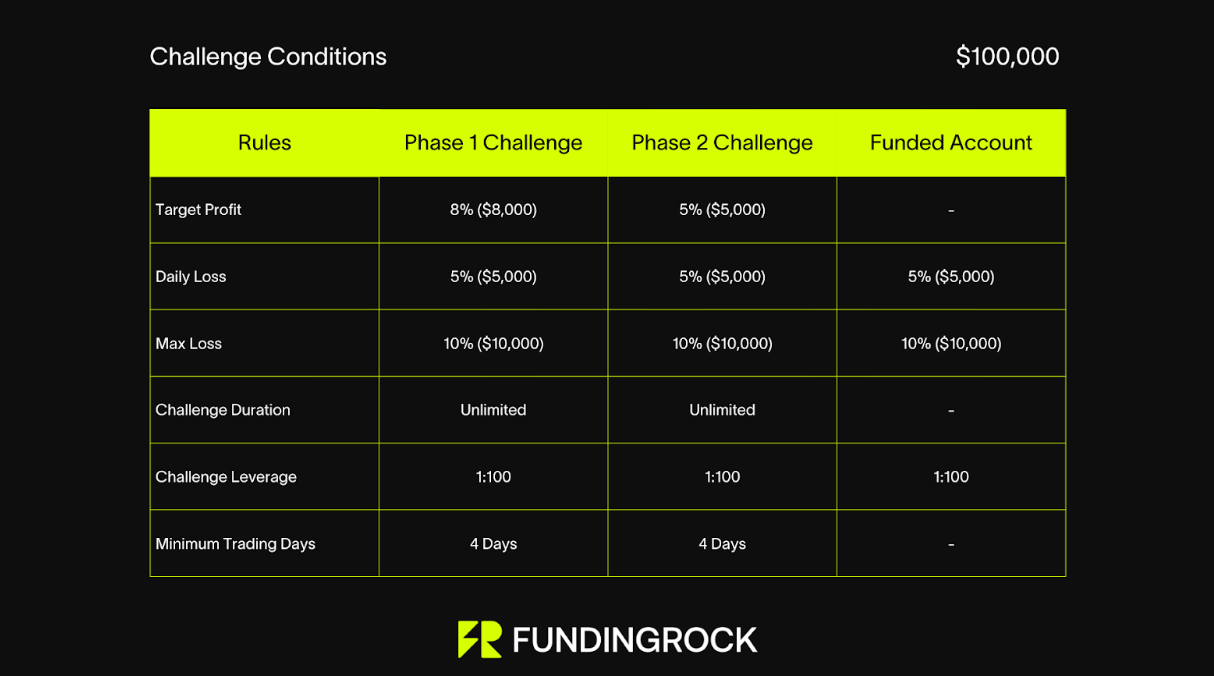
Specifically, FundingRock requires: an 8% profit target based on the starting balance, at least 4 separate trading days, a maximum total loss of 10%, and a maximum daily loss of 5%.
Take, for example, a $100,000 account.
- The profit target equals $8,000
- The maximum total loss equals $10,000
- The maximum daily loss equals $5,000
Reaching Phase 2 means earning $8,000 across at least four days without violating any loss limits.
Phase 2 is the verification phase. It confirms your Phase 1 performance wasn’t luck. The profit target drops, but consistency becomes the priority.
To pass Phase 2, traders must: reach a 5% profit target, trade on at least 4 separate days unless the No Minimum Trading Days add-on is purchased, and keep losses under 5% per day and under 10% total.
Using the same $100,000 account as an example:
- The profit target equals $5,000
- The maximum total loss stays at $10,000
- The maximum daily loss remains $5,000
Once you meet all the requirements, your funded account arrives within 12 to 14 hours, and from there, you can start earning real payouts.
Conclusion
Two-phase prop firm challenges come down to one simple idea. Prove you can make money first, prove you can repeat it next, then receive capital.
Almost every firm follows this structure. Profit targets, drawdown limits, leverage, fees, and evaluation timelines change, but the foundation stays the same.
In summary, two-phase challenges exist to protect firms and reward disciplined traders. Learn the framework, respect the risk limits, and treat both phases like the professional evaluations they are.
Traders who approach these challenges with patience and consistency place themselves in position for funded accounts and steady payouts. Ultimately, understanding the system gives you the edge.