What Happens Behind a Trade Execution
 Darkex Global3 min read·Just now
--
From the user’s perspective, trading feels immediate. A decision is made, a button is clicked, and within seconds the order appears as executed, reinforced by an interface that transmite controle e precisão.
But execution is not defined by what is visible on the surface, it is defined by everything that happens between the request and the result, in a space so short it is almost imperceptible, yet complex enough to determine whether that trade truly reflects the market or just a simplified version of it.
The Path an Order Takes
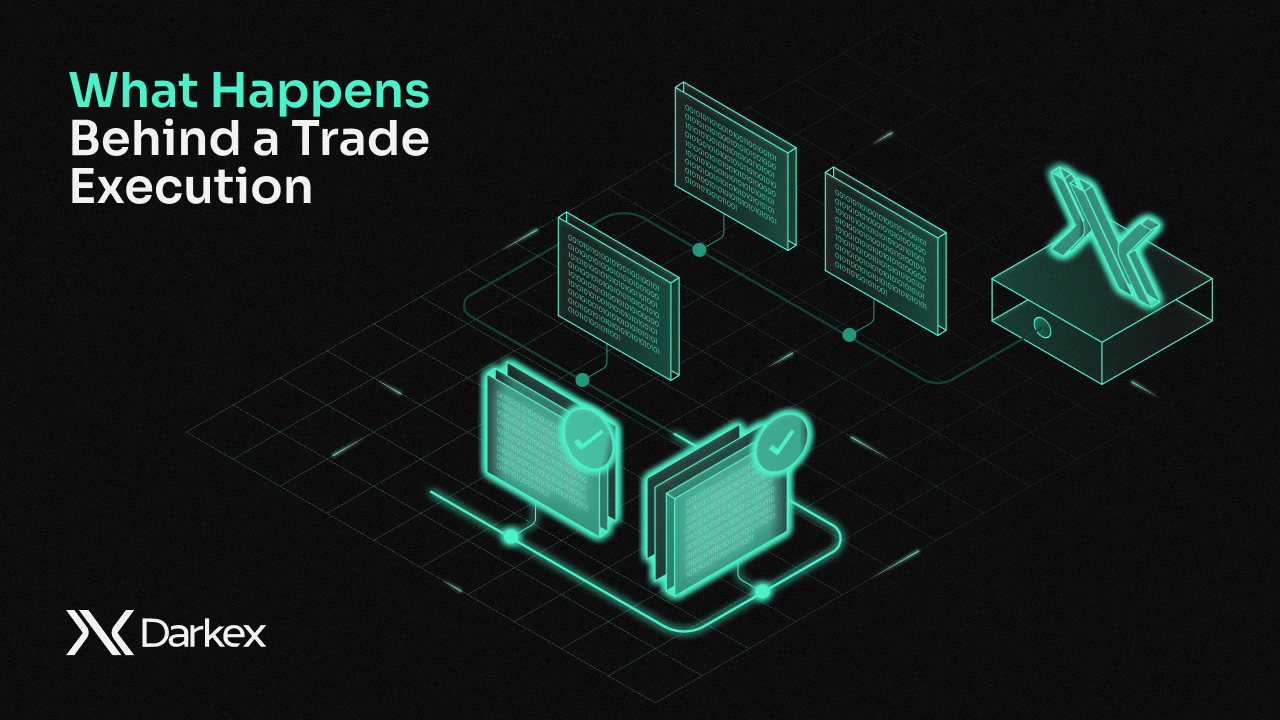
Every order begins as an intention, but it only becomes real after passing through multiple layers of infrastructure that operate simultaneously. Routing systems decide where the order is sent, matching engines determine how it interacts with available liquidity, and additional layers such as external providers and risk controls influence whether the execution can proceed and under what conditions.
This process is not linear, and it is not static, which means price, timing, and fill quality are constantly being shaped in real time. That is why two platforms displaying the same price can still deliver entirely different outcomes once the trade is executed.
When Liquidity Becomes Visible
Liquidity is often treated as something stable, almost guaranteed, but in practice it behaves more like a moving structure that expands in calm conditions and fragments when volatility increases. As this happens, execution becomes more selective, orders may be filled in parts, prices can shift between submission and confirmation, and slippage stops being an exception and starts becoming part of the experience.
What many interpret as inefficiency is, in reality, the market revealing its true structure, and the difference lies in how effectively a platform is able to navigate that shift without distorting the outcome.
Infrastructure Under Pressure
The real test of any trading platform is not how it performs when everything is stable, but how it behaves when conditions change and pressure builds across the system. Moments of volatility, sudden changes in liquidity, and spikes in demand expose whether the underlying infrastructure is resilient or simply optimized for ideal scenarios.
At this level, speed alone loses meaning, because without strong systems supporting it, speed can simply accelerate inconsistency instead of improving execution quality. What matters is whether the platform can maintain alignment with the market even when the market itself becomes unstable.
Closing the Gap Between Expectation and Reality
One of the most underestimated risks in trading is the gap between what the user expects to happen and what actually happens once the order is executed. This gap is shaped entirely by how the platform processes information, accesses liquidity, and responds to real-time conditions.
Strong infrastructure reduces this distance, delivering results that remain close to the original intent, while weaker systems tend to amplify distortions that accumulate over time and affect performance in ways that are not always immediately visible.
At Darkex, we believe execution should not be treated as a visual confirmation, but as a reflection of real market conditions supported by systems designed to operate consistently across different scenarios. Because in trading, what happens behind the execution is what ultimately defines the result.