What Drives Log Volume Inside the Same Block Range?
 Prema2 min read·Just now
--
In a previous post, I compared two 5-block ranges.
- One returned ~12.9k logs (Range A)
- The other ~1.7k logs (Range B)
Same size. Very different output.
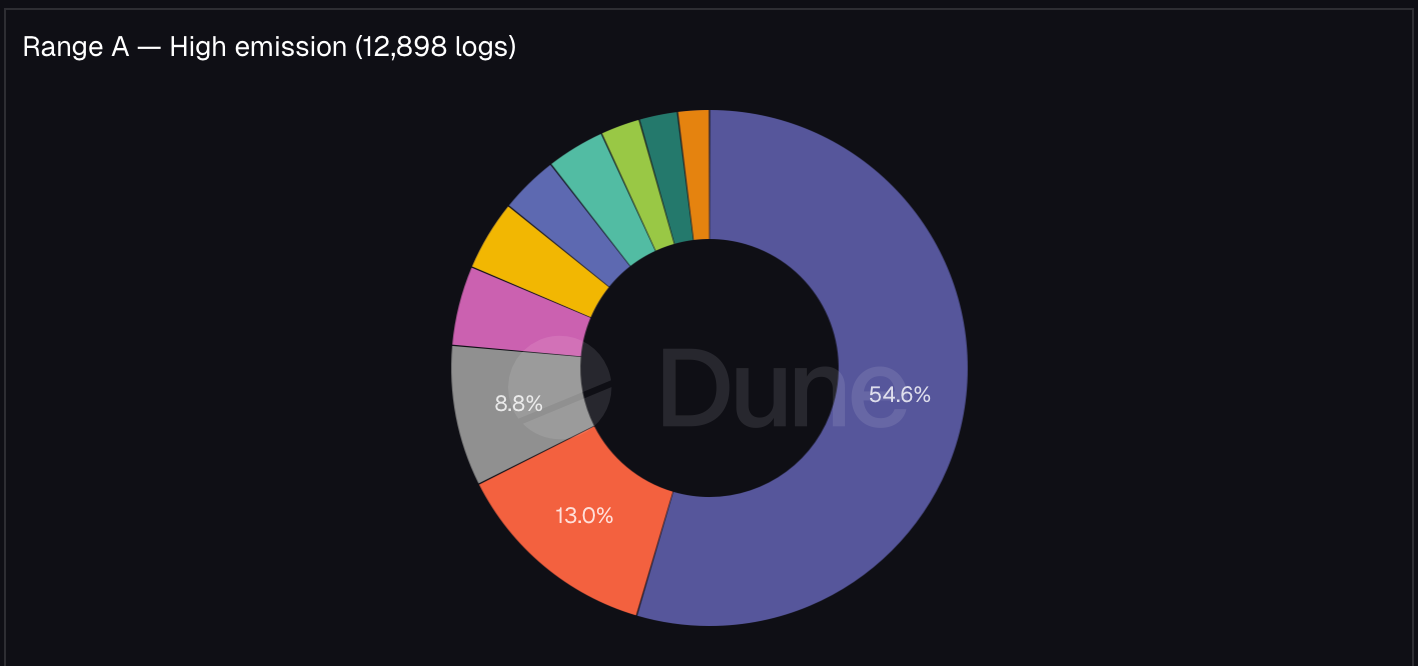
In Range A, a single transaction accounted for ~6,000 logs. In Range B, logs were more evenly distributed, with WETH as the largest share.
What actually drives this difference?
To answer it, I looked inside the transaction responsible for 54.6% of logs in Range A.
What I expected
At first glance, high log volume suggests:
- more transactions
- more users
- more overall activity
What I found
- 3 transactions
- 1 sender
- each producing ~2,000
Transferevents
Breaking it down
Each transaction:
- called the same contract
- emitted a large number of logs
- distributed tokens to many unique addresses
So the ~6,000 logs in that range weren’t coming from many users.
They came from:
one actor → one contract → repeated emission
Why this matters
From the execution side, this is small:
- a few transactions
- a single function pattern
But from the data side, it expands:
- thousands of log entries
- larger RPC responses
- more rows to index and query
The gap
This is where the mismatch becomes visible:
execution is compact
data is expansive
That difference propagates through the stack:
- nodes return larger payloads
- indexers process more data
- analytics surfaces show higher “activity”
Takeaway
Log volume is not driven by block range alone. It is shaped by how contracts emit events within those blocks.
What looks like activity is often just emission, scaled through the system.
A small number of transactions can generate disproportionately large volumes of data.