
What Actually Happens When You Skip Bitcoin Mixing
--
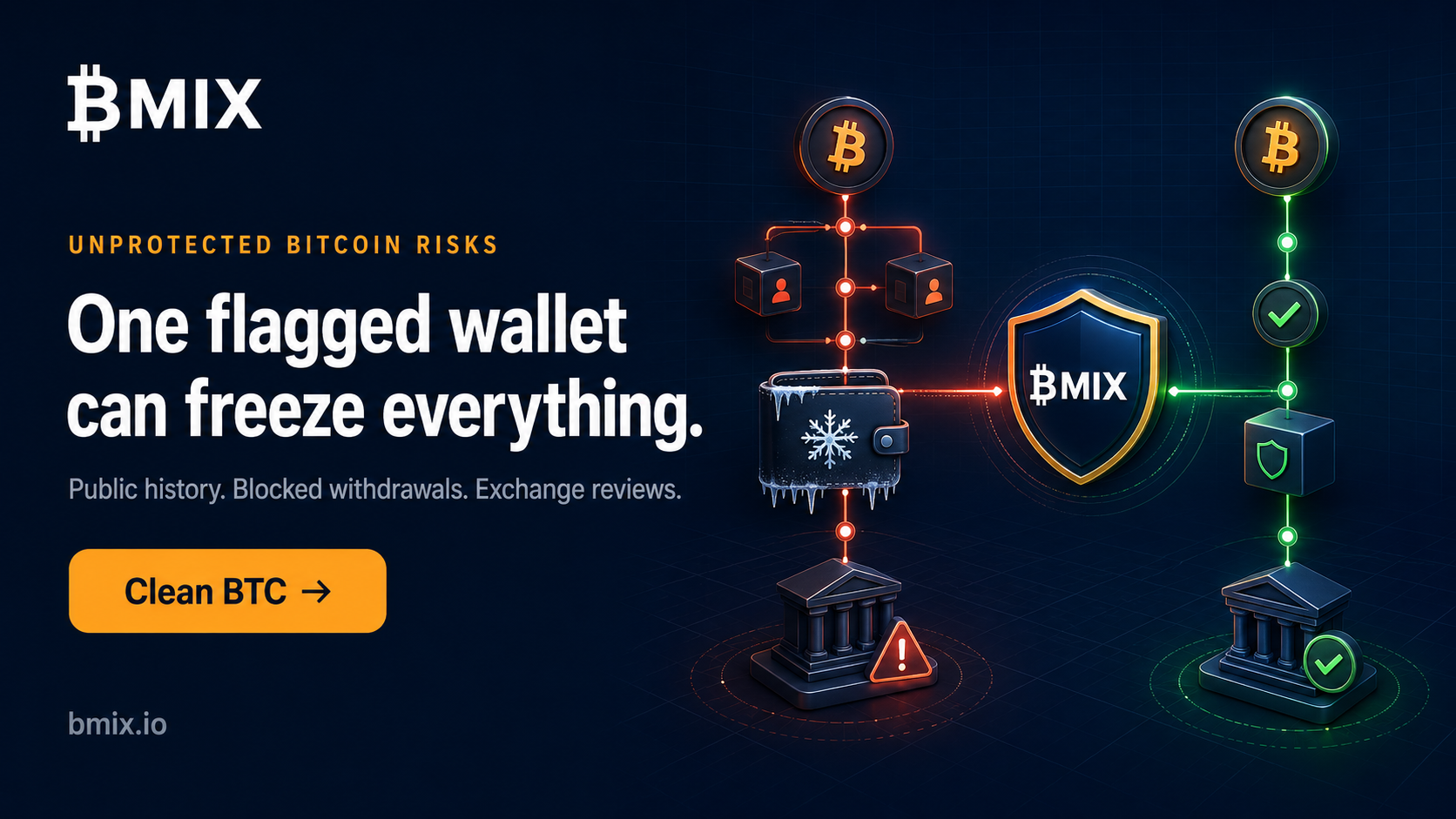
A Bitcoin withdrawal clears successfully, but a few hours later the exchange account enters review mode. Withdrawals stop working. Additional verification gets requested. Support replies become slower. Eventually the wallet activity itself becomes the issue.
This scenario is becoming increasingly common as blockchain analytics expands across the crypto industry.
The biggest misconception about Bitcoin is that it provides natural anonymity. In reality, Bitcoin operates on a fully public ledger where every transaction remains permanently visible. Once wallet activity becomes associated with an identity, exchange account, or behavioral pattern, that history can continue expanding indefinitely through blockchain analysis systems.
These are the real unprotected Bitcoin risks many users only discover after problems begin.
Blockchain Surveillance Has Become an Industry
Modern crypto surveillance is no longer limited to law enforcement investigations. Entire commercial ecosystems now sell transaction tracing tools to exchanges, compliance departments, and institutional monitoring systems.
These systems analyze:
- Wallet clusters
- Transaction timing
- Output structures
- Exchange interactions
- Behavioral patterns
- Historical transaction relationships
This process allows analytics systems to reconstruct large portions of wallet history.
The result is a growing number of Bitcoin wallet flagged exchange events where accounts enter automated compliance pipelines.
Users often experience:
- Delayed withdrawals
- Frozen transfers
- Manual reviews
- Increased AML checks
- Temporary account restrictions
Sometimes the trigger is not criminal activity at all. It may simply be exposure to previously flagged transaction paths.
Why Public Wallet History Matters
Unlike traditional banking systems, Bitcoin transactions remain permanently accessible to anyone.
A Bitcoin address exposed publicly can continue leaking behavioral information long after the original transaction occurred.
This creates several long-term problems:
Wallet Clustering
Blockchain systems group addresses believed to belong to the same user.
Even when separate wallets are used, transaction behavior often reconnects them.
Temporal Analysis
Repeated timing patterns help surveillance systems identify relationships between inputs and outputs.
Equal-Amount Analysis
Matching transaction structures may reveal possible transfer links.
Trait Analysis
Behavioral fingerprints can expose transaction ownership even when addresses change.
Over time, these systems create detailed blockchain identity graphs.
Why Basic Privacy Habits Often Fail
Many users assume simple wallet separation solves the issue.
Common approaches include:
- Creating new wallets
- Splitting transactions manually
- Using different exchanges
- Rotating addresses
However, modern Bitcoin chain analysis systems are specifically designed to reconnect fragmented activity.
As surveillance systems improve, old transactions become easier to analyze retroactively.
Privacy mistakes made years ago may still create exposure today.
This is why financial privacy Bitcoin discussions increasingly focus on structural transaction separation rather than cosmetic wallet changes.
How ₿MIX Handles Bitcoin Anonymization Differently
₿MIX positions itself as a next-generation Bitcoin mixer and anonymizer.
The core difference lies in coin replacement rather than transactional recycling.
According to the platform, user Bitcoin is completely replaced with clean coins sourced from independent investors on global exchanges including Binance, OKX, Coinbase, and Bybit.
This removes direct blockchain continuity between deposited and returned funds.
Returned coins pass AML checks and contain no traces of mixer usage.
The platform also implements several operational privacy protections:
- No registration
- No KYC
- No tracking
- No logs
- Encrypted operational data
- Auto-deletion after completion
Unlike standard transaction pools, ₿MIX focuses heavily on resistance against:
- Equal-amount analysis
- Trait analysis
- Cluster analysis
Why Timing Randomization Matters
One overlooked privacy issue is transaction timing.
If funds return immediately after deposit, blockchain systems can attempt temporal correlation between inputs and outputs.
₿MIX randomizes processing time between 1 and 6 hours specifically to reduce deanonymization risks associated with timing analysis.
This creates less predictable transaction relationships on-chain.
For additional separation, users may specify one or two unrelated return addresses.
The system distributes unrelated clean coins between addresses randomly, increasing cluster analysis resistance further.
The Role of PGP Guarantee Letters
Trust remains one of the biggest concerns for privacy services.
₿MIX addresses this using PGP-signed guarantee letters issued for each transaction.
The guarantee letter acts as the only confirmation of obligations and verifies that the deposit address originated from the official service infrastructure.
This mechanism provides cryptographic verification rather than relying solely on website trust.
The Growing Importance of Transaction Hygiene
The crypto industry increasingly treats transaction history as a compliance signal.
This means Bitcoin privacy is no longer only about anonymity. It directly affects usability.
A wallet connected to problematic transaction history may eventually trigger operational restrictions even for innocent users.
That changes how privacy should be viewed.
Financial hygiene now includes blockchain hygiene.
Users who ignore transaction exposure may eventually face:
- Exchange restrictions
- Delayed settlements
- Increased compliance scrutiny
- Permanent wallet traceability
Conclusion
Bitcoin remains transparent by design. Every transaction contributes to a permanent public record that becomes easier to analyze as surveillance systems improve.
For users seeking stronger financial privacy, avoiding blockchain exposure requires more than simply creating new wallets.
₿MIX approaches the problem through complete coin replacement using exchange-sourced clean BTC, randomized processing, optional multi-address outputs, encrypted operations, and PGP-backed guarantees.
Privacy systems are no longer niche tools. For many Bitcoin users, they are becoming operational necessities.