Web3: The Internet Is Quietly Rewriting Its Own Rules
For most of its history, the internet has gone through clear phases.
 Udbhav Writes4 min read·Just now
--
The first phase was simple.
Websites were mostly static pages.
People read information but rarely interacted with it.
This era is often called Web1.
Then came the second phase.
Social media platforms, online marketplaces, and streaming services transformed the internet into a place where people could create, share, and collaborate.
This became Web2.
But Web2 also created something unexpected.
A handful of companies began controlling most of the digital world.
They owned the platforms.
They controlled the data.
They defined the rules of online interaction.
Now, a new idea is emerging — one that challenges how the internet works.
It’s called Web3.
And its goal is simple but radical:
To build an internet where users control their own digital assets, identities, and interactions.
The problem Web3 is trying to solve
The modern internet is incredibly powerful.
But it has a structural issue.
Most digital activity happens inside centralized platforms.
Think about how many aspects of life are tied to a few large services.
Social networks store personal data.
Streaming platforms control digital media.
Marketplaces manage online commerce.
Cloud services host vast portions of the internet.
These platforms provide convenience, but they also concentrate power.
Users create the content.
But platforms own the infrastructure.
Web3 proposes a different model.
Instead of centralized ownership, digital systems could be governed by decentralized networks.
The core idea behind Web3
Web3 is built on blockchain technology and decentralized protocols.
Instead of relying on central companies to manage systems, Web3 applications operate on networks maintained by distributed participants.
This means that data, transactions, and ownership records can exist independently of a single organization.
Users interact with these systems through digital wallets rather than traditional accounts.
A wallet becomes a universal login that allows users to access multiple applications while maintaining control over their assets.
In theory, this structure shifts power away from centralized platforms and toward individual users.
Digital ownership becomes possible
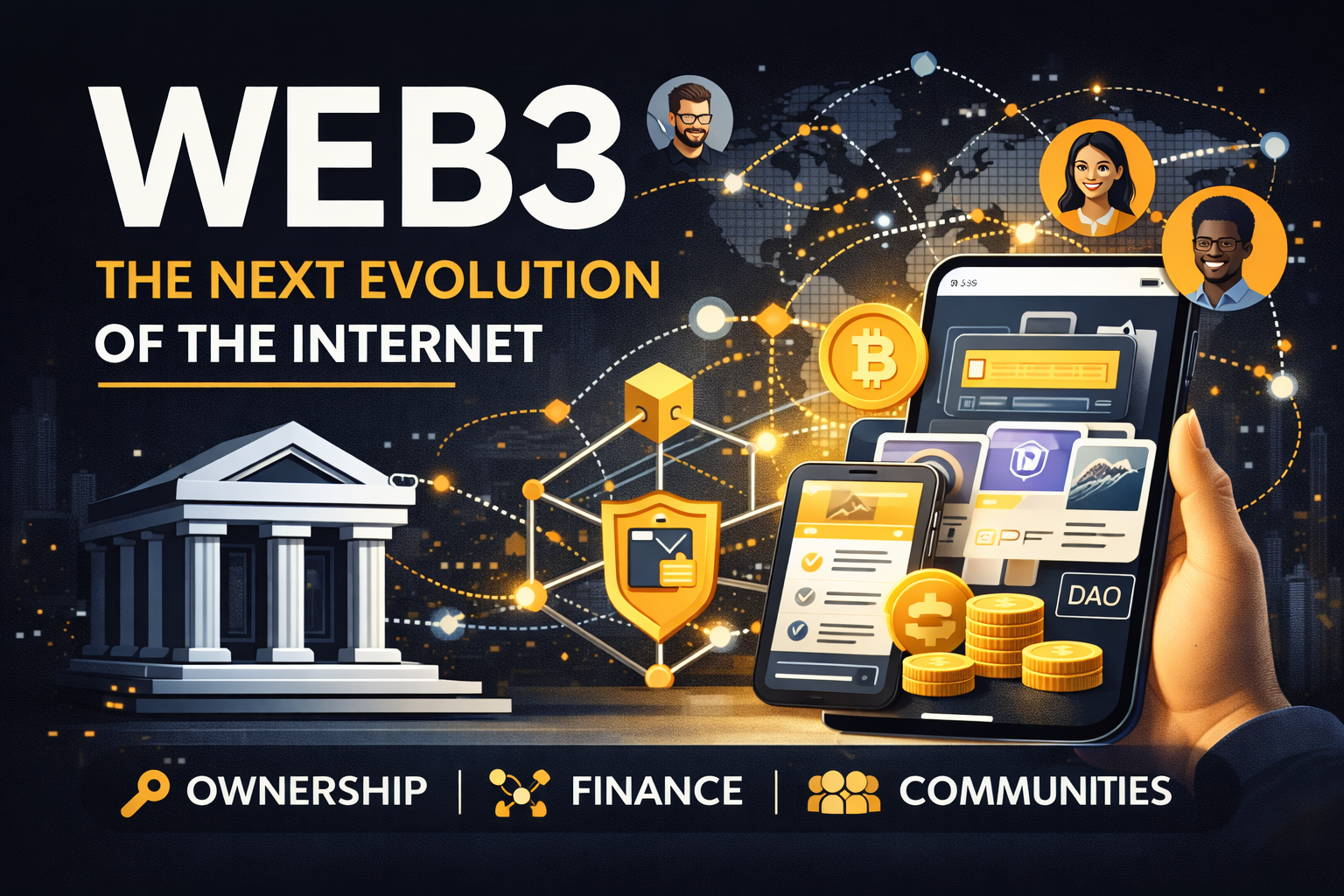
One of the most interesting aspects of Web3 is the concept of true digital ownership.
In traditional Web2 systems, users rarely own their digital assets.
For example:
Content on social media platforms is stored within the platform’s infrastructure.
In-game items exist inside centralized databases.
Digital purchases are often tied to specific platforms.
Web3 introduces the possibility of owning digital assets directly.
Through technologies like tokens and NFTs, digital objects can exist independently of any single platform.
This means assets could move across different applications and ecosystems.
Ownership becomes portable.
Decentralized finance and the financial layer of Web3
Another major component of Web3 is decentralized finance (DeFi).
Traditional financial services rely heavily on intermediaries.
Banks manage deposits.
Payment networks process transactions.
Investment firms manage portfolios.
DeFi applications attempt to recreate many of these services using blockchain-based protocols.
Smart contracts automate financial operations such as:
Lending
Borrowing
Trading
Asset management
These systems operate through code rather than centralized institutions.
While still evolving, they demonstrate how financial infrastructure could function in decentralized environments.
Communities and governance
Web3 also introduces new ways for online communities to organize themselves.
Many Web3 projects use governance tokens that allow participants to vote on decisions affecting the project.
These decentralized governance structures are often called DAOs (Decentralized Autonomous Organizations).
In theory, DAOs allow communities to collectively manage digital ecosystems.
Members can propose changes, vote on upgrades, and allocate resources.
This model attempts to combine technology with collaborative decision-making.
The challenges facing Web3
Despite its ambitious vision, Web3 is still in an early stage of development.
Several challenges remain.
Scalability
Blockchain networks must handle large numbers of transactions efficiently.
Many systems are still improving their performance capabilities.
User experience
Interacting with decentralized applications can sometimes be complex for new users.
Improving usability is essential for broader adoption.
Regulation
Governments are still determining how decentralized technologies should be regulated.
Balancing innovation with consumer protection remains a key issue.
Security
Because Web3 applications often involve financial assets, security vulnerabilities can lead to significant losses.
Developers must design systems carefully to prevent exploits.
The evolving role of Web3
Some people see Web3 as the next major evolution of the internet.
Others view it as a niche technological experiment.
The reality may lie somewhere in between.
Certain aspects of Web3 may reshape how digital systems operate.
Others may evolve into hybrid models that combine decentralized technologies with traditional platforms.
What makes Web3 fascinating is not just the technology itself, but the philosophical question it raises:
Who should control the digital world?
Centralized companies?
Or distributed communities?
The bigger picture
The internet has always been shaped by shifts in how information, ownership, and power are distributed.
Web1 democratized access to information.
Web2 democratized content creation.
Web3 aims to democratize ownership and control.
Whether that vision fully materializes remains uncertain.
But the conversation itself is important.
Because as digital systems become more deeply integrated into everyday life, the question of who controls them becomes increasingly significant.
Final thought
Technological revolutions rarely happen overnight.
They unfold gradually, through experimentation and iteration.
Web3 is still part of that process.
Some projects will fail.
Some ideas will evolve.
But the underlying ambition — to build a more open and decentralized internet — continues to inspire developers, entrepreneurs, and communities around the world.
And if the history of technology teaches us anything, it’s that the most transformative ideas often begin as experiments.
Web3 may still be one of those experiments.
But it’s one that could reshape how the internet works in the decades ahead.