Web3 + Agentic AI: An Innovation Force Multiplier for Travel & Hospitality
--
How two converging technologies are about to reshape how we supply, distribute, book, pay, and experience travel — and why the window to act is now
— -
Every major industry shift starts the same way — someone notices two forces colliding before everyone else does.
We saw it with Mobile. Then Social. Then Cloud. Each wave reshaped travel and hospitality in ways that seemed theoretical until they suddenly became table stakes. The companies that moved early captured outsized value. The ones that waited played catch-up for years.
Right now, I’m watching the next convergence unfold in real time. And it’s bigger than any of those previous waves.
Web3 + Agentic AI
Separately, each is a significant shift. Together, they’re an innovation force multiplier. And the travel and hospitality industry is sitting squarely at the epicenter of both.
I recently keynoted this thesis at the 2026 HFTP Executive Vendor Summit’s Investment Program, and the responses convinced me this deserves a wider audience. So here’s the full picture — the building blocks, the convergence, and what it means for operators, investors, and anyone building in travel today.
It’s Already Happening — You Just Might Not Have Noticed
Before I get into the technology, let me make one thing clear: this is not theoretical. Web3 is already live in travel, often hidden behind familiar user experiences — which is exactly how it should be.
Four active startups. Four different use cases. All generating real revenue today.
Dtravel is a P2P home-sharing platform where bookings are managed by smart contracts, reducing fees by ~20% and ensuring instant payouts to hosts. Think Airbnb — but without Airbnb taking the cut.
TravelX started by creating new business models in aviation via tokenization. Today it’s effectively an Aviation Revenue Management System. Flybondi became the first airline to tokenize 100% of its inventory through TravelX, followed by VivaAerobus and Air Europa.
UpTrip is changing the loyalty and rewards game. And here’s what makes it particularly interesting — it wasn’t built by a startup. Uptrip was internally developed by Lufthansa Innovation Hub in collaboration with its loyalty partner Miles & More. A great example of inside-out corporate innovation.
Sleap.io is making online hotel booking more efficient and equitable, eliminating the 15–30% OTA commission drain that has quietly become the industry’s most accepted inefficiency.
The common thread across all four? Utilities and efficiencies — built on Web3 infrastructure, delivered through familiar user experiences. No crypto jargon at checkout. No complicated wallet management required. Just better economics and better experiences underneath the hood.
— -
First, Let’s Orient: The Evolution of the Web
To understand where we’re going, it helps to understand the arc of where we’ve been.
Web 1.0 was read-only. Static websites. Online payments were nearly non-existent and we were still deciding whether it was safe to type our credit cards into a browser. In travel, this meant hotel websites, online brochures, and the earliest OTAs offering basic search and booking.
Web 2.0 brought interaction — and centralization. Platforms like Airbnb, TripAdvisor, and the major OTAs became the dominant distribution layer. “If the product is free, you are the product” defined the era. We willingly traded privacy for convenience, and the platforms built billion-dollar businesses on the data we gave them.
Web 3.0 is taking us into the Ownership Era. Read-write-own. Empowering users with ownership of their data and digital assets. Moving away from centralized platform control toward direct peer-to-peer value exchange — where the guest owns the relationship, not the intermediary.
One protocol worth noting at this layer: x402 — an open payment standard developed by Coinbase that enables instant, automatic digital payments over HTTP. It allows both human users and AI agents to pay for digital services without complex authentication. It revives the HTTP 402 “Payment Required” status code that early developers had the foresight to build into the web’s architecture decades ago. Genius, in hindsight.
The Web3 Building Blocks — What They Actually Do in Travel
Let me walk through the core technologies — not as abstract concepts, but through the lens of what they mean for travel and hospitality operators.
Blockchain: Trust by Design, Not by Policy
At its core, blockchain is a decentralized digital ledger. Think of it like a shared notebook maintained by thousands of computers simultaneously. Everyone can see what’s written in it, but no single person can erase or alter an entry without network consensus. **That’s what makes it trustworthy by design — not by policy.**
The tension most people don’t talk about is the **Blockchain Trilemma** — the challenge of optimizing three things at once: Decentralization, Security, and Scalability. You can nail two, but the third always creates friction.
Bitcoin is highly decentralized and secure — but it processes only 5–7 transactions per second at Layer 1. For context, Visa handles around 2,000 TPS. That gap used to be blockchain’s Achilles heel.
Layer 2 solutions — like the Lightning Network — solve exactly that. We’re now talking millions, potentially billions of transactions per second, at near-zero cost.
Why does this matter for travel? Because the moment blockchain can match or exceed traditional payment rails on speed and cost, every argument against using it for booking, settlement, and distribution evaporates. We’re not just close to that moment — **we’re there.**
One company worth watching specifically for travel: Camino Network, a dedicated Layer 1 blockchain built by Chain4Travel with an ecosystem of travel suppliers and technology providers that is growing fast. Their Messenger solution is, frankly, what IATA wishes NDC could be.
Digital Wallets: Your New Guest Profile
Here’s a reframe that changed how I think about guest identity: your wallet is not just a container for money. It’s a collection of tokens, NFTs, and booking history. It’s a fingerprint.
One of the most valuable assets in hospitality is the brand-guest relationship. Right now, that relationship sits on a fragile foundation — passwords, loyalty numbers, and centralized databases that are one breach away from a liability event.
The digital wallet changes that entirely. Think of it not as a place to hold crypto, but as a portable, self-sovereign profile and tokenized asset vault. Every stay, every flight, every preference — verified on chain, owned by the traveler, shared only with their consent.
What does this unlock in practice?
- A VIP lounge privilege that auto-activates for guests holding a specific loyalty NFT in their wallet
- A rate or upgrade that auto-applies because the wallet confirms loyalty status — no promo code, no front desk negotiation
- An AI agent that books on the guest’s behalf because the hotel’s system recognizes and trusts the wallet signature
The guest gets a seamless, deeply personal experience. Operators get a verified, actionable profile — without the liability of storing it.
Go checkout the Insumer Model for a deeper dive on this.
Self-Sovereign Identity (SSI): You Own Your Data
We’ve all experienced the friction of digital identity. Remembering passwords, resetting credentials, re-entering your details every time you book with a new provider. It’s not just annoying — it’s a structural vulnerability.
Traditional identity systems have one fundamental flaw: someone else owns your data. Whether it’s Google, your bank, or your hotel’s PMS — you’re a guest in their system, not the owner of your own information.
Self-Sovereign Identity flips that entirely. With SSI, your credentials live in your own digital wallet. You decide what to share, with whom, and for how long. Verification happens cryptographically — no middleman required.
In hospitality, this means a returning guest checks in without presenting an ID, re-entering loyalty details, or filling out paper forms. Their SSI credential proves who they are, their status, and their preferences — in seconds, without ever exposing the underlying data.
It’s a shift from ”trust me, I’m who I say I am” to cryptographic proof. From fragile secrets to verifiable truth. And it doesn’t just benefit travelers — it removes the liability of holding sensitive personal data from operators entirely.
Zero-Knowledge Proofs (ZKP): Verify Everything, Expose Nothing
Where SSI handles identity and profile ownership, ZKP is the authentication and verification layer.
A zero-knowledge proof is a cryptographic method that lets someone prove a statement is true — without revealing the underlying data. Think of it like a bouncer checking a wristband. They don’t need to see your name, address, and birthday. The wristband is proof enough.
In practice: a guest’s wallet presents a single proof — ”this person holds Elite status.” Your system verifies it. The upgrade is granted. No personal data seen. No personal data stored.
Applications extend well beyond check-in. Membership verification for lounge access. Corporate rate eligibility confirmation. Visa status at international properties. All verified. Nothing stored.
In a world where data breaches are a *when*, not an *if* — ZKP isn’t just good privacy practice. It’s a competitive moat.
Learn more from the 2 leading innovators in this space TravlrID, and Neoke.
NFTs: It’s Tech, Not Just JPEGs of Cats and Monkeys
Non-fungible tokens get an unfair reputation. Strip away the hype and what you have is a unique digital asset on chain that certifies ownership, provenance, and authenticity. In travel, that has enormous utility.
We’ve spent decades training travelers to think of bookings as disposable. You buy a ticket, you fly, it’s gone. You book a room, you check out, the transaction ends. The only residual value is some loyalty points that may expire or get quietly devalued.
NFTs fundamentally change that value equation. When a booking is tokenized as an NFT, it becomes a transferable, tradeable digital asset. Can’t make your flight? Instead of forfeiting or paying a change fee, you list it on a secondary market. The supplier earns a royalty on the resale. The new buyer gets a fair price. Everyone wins.
AirBaltic proved this isn’t theoretical. Their Planies NFT program augments their loyalty program — when launched in October 2022, 2,300 NFTs were issued in under two months, with over a million loyalty points distributed. Holders receive utility ranging from upgrade vouchers to exclusive early access. It’s an additional gear in the earn-and-burn engine — one that creates genuine asset value rather than expiring points.
TravelX took it further — enabling Flybondi to be the first airline to tokenize 100% of its inventory, followed by VivaAerobus and Air Europa.
For hotels, the opportunity is equally compelling. Tokenized room nights that guests can gift, resell, or trade. Limited-edition NFT memberships that unlock experiences no OTA can replicate or undercut.
Smart Contracts: The Back Office That Runs Itself
Every hotel runs on contracts. Linen suppliers, F&B vendors, housekeeping services, distribution partners. Hundreds of agreements across dozens of departments — each requiring negotiation, paperwork, approval chains, and manual reconciliation. It’s slow, expensive, and error-prone.
Smart contracts automate all of that. A smart contract is a self-executing program on the blockchain. When pre-defined conditions are met, it executes automatically — no emails, no approval loops, no invoice chasing.
Here’s a practical example: a hotel chain orders supplies across 50 properties. Each property triggers an order event. Delivery confirmation automatically releases payment. The entire cycle — from order to settlement — happens in seconds. Every step is recorded immutably on chain. No *”my spreadsheet says one thing, yours says another.”* The contract is the single source of truth.
The result? Lower costs, faster settlements, and supplier relationships built on transparency rather than blind trust. For a multi-property group, that’s millions in recovered margin annually.
Stablecoins: The Payment Rail of the Agentic Economy
Every time a guest swipes a card at your property, you’re paying a 2–3% toll to Visa or Mastercard. On thin hospitality margins, that’s not a rounding error. For a $50M revenue property, that’s up to $1.5M annually handed to a payment network that adds no direct value to the guest experience.
Stablecoins change that calculus. Unlike volatile cryptocurrencies, stablecoins like USDT by Tether and USDC by Circle are pegged to the dollar. They settle instantly and move across borders without conversion fees. And they’re now fully legitimate — the GENIUS Act gave dollar-backed stablecoins a clear federal framework in the U.S. when signed into law in July 2025.
For hospitality, the opportunity is multi-dimensional: lower transaction costs by bypassing card network fees entirely, real-time supplier settlements eliminating net-30 payment cycles, yield on reserves by investing the float in short-term treasuries, and a proprietary stablecoin that doubles as a loyalty and data layer — capturing insights that today flow to card networks. Think Walmart or Amazon building their own digital currency. Now imagine what a major hotel brand or airline could do with the same model.
But here’s the dimension that most people miss: **stablecoins aren’t just a payment upgrade for humans. They’re the only payment rail that AI agents can actually use.**
Credit cards require human authentication — there’s no cardholder to verify an AI agent. Volatile crypto introduces pricing risk that breaks the economics. Stablecoins are machine-native, price-stable, instant, and programmable. Purpose-built for autonomous transactions.
The guest experience doesn’t change. The economics do — dramatically.
Dive deeper via my previous post on Stablecoins in Travel
The Convergence: Why Web3 + Agentic AI = Force Multiplier
Now that we’ve covered the building blocks, let’s talk about why they matter together.
An AI agent without Web3 infrastructure is like a brilliant employee with no bank account, no ID, and no authority to sign anything. They can advise. They can recommend. But they can’t transact.
Web3 solves that across 3 critical dimensions:
Wallets give the agent identity and authority. When a guest’s AI agent approaches a hotel’s booking system, the wallet is its credential — cryptographically proving who it represents and what it’s authorized to do. No username. No password. No human in the loop.
Smart contracts give the agent a rulebook it can execute against autonomously. If the room is available, if the price meets the guest’s parameters, if the cancellation policy is acceptable — the contract executes. No approval chain. No email thread. No friction. 24x7x365, even when you’re asleep.
Stablecoins give the agent a payment rail it can actually use. Machine-native, price-stable, instant settlement — purpose-built for autonomous transactions.
Together, these three technologies transform an AI agent from a recommendation engine into an autonomous actor capable of touching the entire traveler’s journey. That’s not incremental improvement. That’s a fundamentally different kind of system. That’s the innovation multiplier.
Let’s make it concrete. A business traveler’s AI agent detects a travel disruption. It autonomously searches available inventory, verifies the traveler’s preferences and corporate rate eligibility via their wallet, negotiates terms through a smart contract, and executes payment via stablecoin — all rebooked in seconds, with zero human intervention on either side.
Operational efficiency. Hyper-personalization. Frictionless experience. These have been the north stars of travel innovation for years. The Web3 + AI convergence is the first architecture that can actually deliver all three simultaneously, at scale.
— -
## The Same Trip. Two Completely Different Worlds.
Here’s where it all comes together into one picture. On the left is the journey your guests take today. It works. But it’s slow, expensive, and riddled with friction — for them and for you.
Every capability on the right side of that table exists today in some form — many of them already more mature in financial services than in travel.
The gap isn’t technology. It’s deployment.
— -
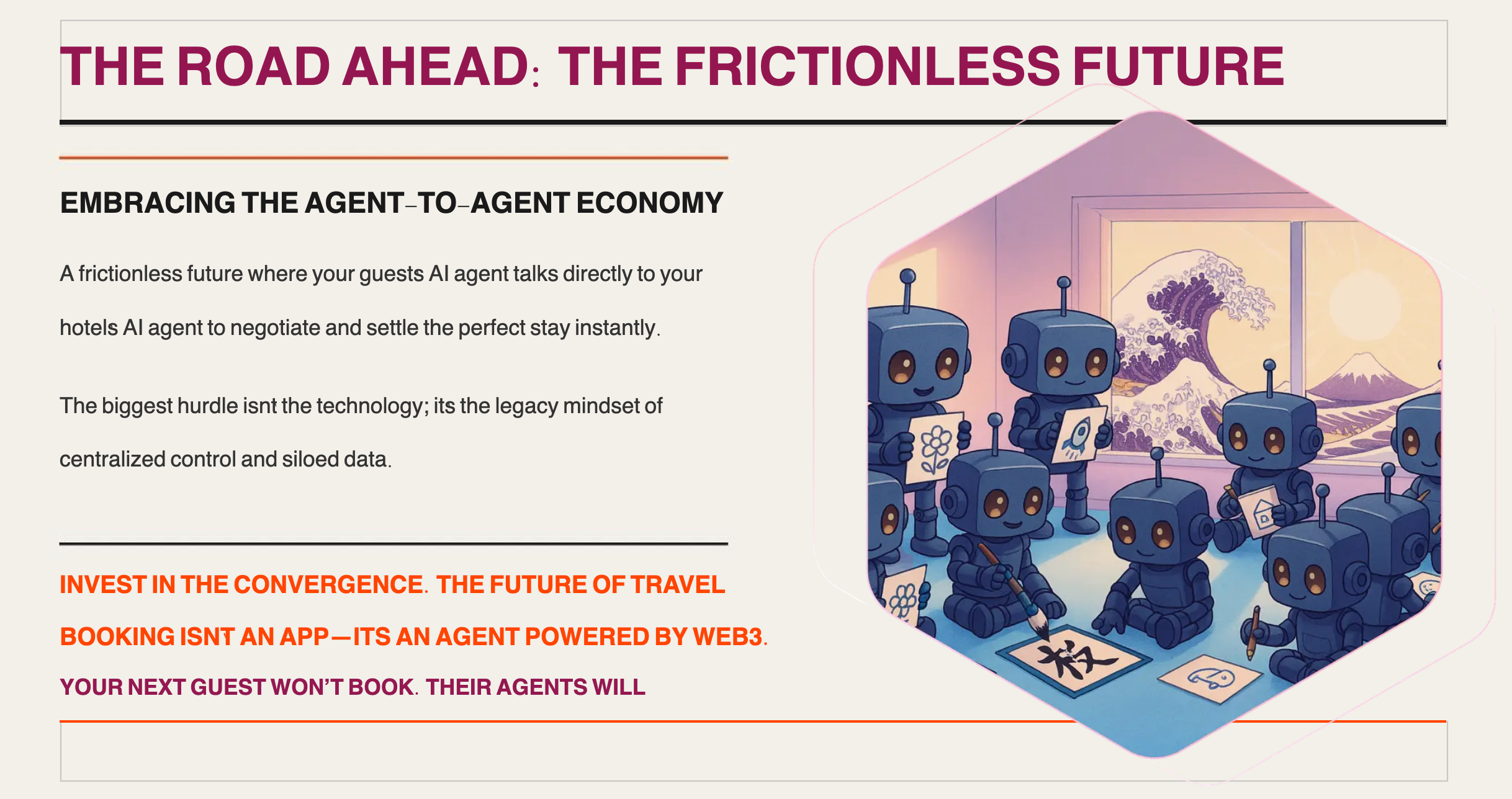
The Road Ahead: The Frictionless Future
We’re moving toward a world where the next guest may never visit an OTA, never fill out a form, and never wait on hold.
Their AI agent does all of it. It knows their preferences, their budget, their schedule. It engages directly with the hotel’s AI agent, executes the booking via smart contract, and settles payment via stablecoin.
That’s the agent-to-agent economy, powered by Web3. And it’s closer than most people realize.
Legacy systems built around centralized control and siloed data will simply be invisible to agentic travelers. If your rates, availability, and inventory aren’t machine-readable, and your identity systems aren’t interoperable — you don’t exist in that economy.
The brands that will win aren’t necessarily the largest. They’re the ones that make themselves discoverable, trustworthy, and transactable at machine speed.
Where I’m Placing My Bets
Let me be direct about where I see the highest-conviction opportunities right now.
Travel-native infrastructure. Just as the early internet needed TCP/IP before anyone could build Expedia, the agentic Web3 economy needs purpose-built rails. Blockchains like Camino Network, identity and wallet protocols designed for hospitality, and payment orchestration solutions like x402 that let AI agents transact — these are foundational bets with asymmetric upside. The plumbing is being laid right now.
The agentic AI + Web3 convergence layer. The companies building trust and transaction infrastructure for agent-to-agent commerce are building what I believe will become the next generation of distribution. The OTA didn’t exist until the web did. The agentic booking platform won’t exist until Web3 does. We’re in the TCP/IP moment of that stack.
Operator enablement tools. Not every hotel will build their own blockchain — just like not every hotel built their own booking engine. But every hotel will need tools: smart contract procurement platforms, NFT loyalty infrastructure, stablecoin payment rails. This is where near-term ROI lives, and where I’m seeing the most actionable early-stage deals right now.
The infrastructure investment window for Web3 in travel mirrors where cloud computing was in 2008. The category isn’t hypothetical. The technology is proven. The regulatory clarity is arriving. The question is who’s early enough to capture the upside.
SO, What Are the Challenges & Headwinds?
I’d be doing you a disservice if I didn’t address the friction points honestly. This convergence is real and inevitable — but that doesn’t mean the path is straight.
Legacy infrastructure and adoption lag. The hospitality industry runs on some of the oldest technology stacks in any consumer-facing sector. PMS platforms, GDS connections, channel managers — these systems weren’t designed to be Web3-interoperable, and retrofitting them is neither fast nor cheap. Smaller independent hotels and regional airlines face a particularly steep climb. The risk isn’t that Web3 doesn’t work — it’s that adoption widens the gap between well-resourced brands and everyone else.
Wallet UX is still a barrier. For the agentic Web3 vision to reach mainstream travelers, the wallet experience needs to become invisible. Right now, it’s still too complex for most consumers. The good news: players like Apple, PayPal, Venmo, and CashApp are the most likely drivers of mass wallet adoption in the near term — not crypto-native apps. When the wallet is just another tab in your iPhone, this barrier largely dissolves. AI agents may also sidestep this entirely by managing the wallet layer on the user’s behalf. But we’re not fully there yet.
Regulatory patchwork across markets. The GENIUS Act brought meaningful clarity to stablecoins in the U.S. — but travel is a global industry. The regulatory environment for digital assets varies dramatically across the EU, Asia-Pacific, and emerging markets. Companies building cross-border travel payment infrastructure on stablecoins need to navigate a patchwork of rules that are still being written. MiCA in Europe provides a framework, but implementation timelines and local nuances add complexity for any operator thinking globally.
The interoperability problem. Web3’s promise of open, composable infrastructure is real — but the reality today is still fragmented. Multiple blockchains, competing wallet standards, and inconsistent identity protocols mean that the “one wallet, every provider” vision requires significant industry coordination. Travel has a long history of standards battles. Getting competing suppliers, OTAs, and technology providers to align on shared infrastructure won’t happen overnight.
Consumer trust and education. A meaningful segment of travelers still associate Web3 with crypto scams, NFT speculation, and complexity. Travel brands that adopt these technologies early will need to make the value exchange crystal clear — and invisible. The best implementations won’t mention blockchain at all. They’ll just feel faster, cheaper, and more personal. That’s the bar: technology that earns trust by disappearing. Nobody hyped up HTTP, FTP, SMTP, etc back in the days.
Smart contract risk. Code is law in Web3 — which is powerful, but also unforgiving. A bug in a smart contract governing supplier payments or guest credentials can have real financial and reputational consequences. The industry will need mature auditing standards, insurance frameworks, and failsafe mechanisms before smart contracts can govern mission-critical hospitality operations at scale.
None of these are insurmountable. They’re the normal friction of an early-stage infrastructure shift — the same headwinds that faced cloud computing in 2006, mobile payments in 2010, and API-first distribution in 2014. The companies that navigated those transitions early didn’t wait for every friction point to be resolved. They built while the road was still being paved.
The question for travel operators and investors isn’t whether to wait until it’s perfect. It’s how to move smartly while the window is open.
A Final Thought
In my previous post on Stablecoins in Travel, I closed with: The holy grail of travel may just be paid by AI agents using stablecoins.
After presenting this thesis to travel executives and investors at HFTP, I’m more convinced than ever — and I’d extend it:
The holy grail of travel will be delivered by AI agents, verified by Web3 identity, settled by stablecoins, and governed by smart contracts. And the traveler won’t know or care how any of it works — they’ll just experience a trip that feels like it was designed entirely for them.
The frictionless future isn’t coming. It’s being deployed right now.
— -
Mike Sung is a Partner & Co-Founder at Tectris.vc, co-host of Travel Around the Block, and a Web3 Travel Accelerator, Advisor & Investor. He has spent his entire career in Travel & Hospitality — from hotel operations to hospitality technology to advising early-stage startups and supporting innovation strategies across hotels, airlines, and airports.