We Just Anchored the First Confidential AI Attestation on Base Mainnet
--
NeurolixAttestation.sol is live on Base L2. Here’s what it means — and what comes next.
Neurolix Protocol · May 15, 2026
There is a specific moment in every infrastructure project when it stops being a proof of concept and becomes a protocol.
For Neurolix, that moment happened yesterday.
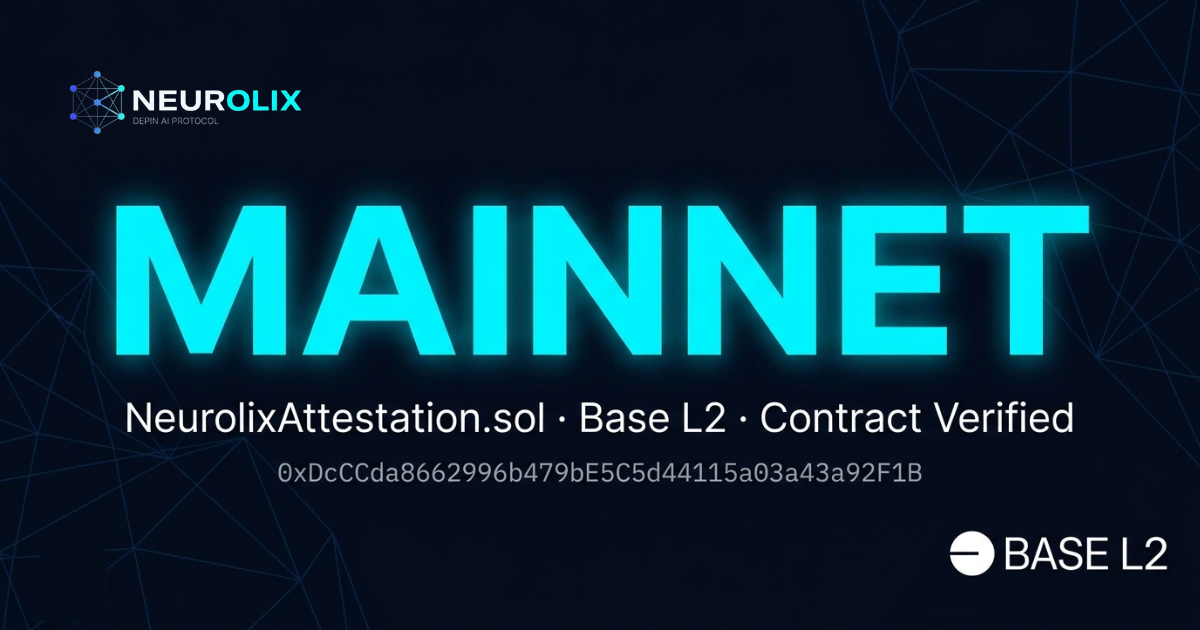
NeurolixAttestation.sol — the on-chain registry at the core of our confidential AI compute architecture — is now live on Base mainnet.
Contract: 0xDcCCda8662996b479bE5C5d44115a03a43a92F1B Transaction: verifiable on Blockscout
This is not a marketing announcement. It is a technical milestone with a specific meaning — and it is worth explaining precisely what changed, and what did not.
What NeurolixAttestation.sol Actually Does
The contract has one job: register cryptographic commitment hashes from confidential AI compute sessions permanently on-chain.
When an AI workload runs inside a hardware-secured Trusted Execution Environment — AMD SEV, Intel TDX, or AWS Nitro — it produces two independent proofs:
- A hardware attestation token signed by the cloud provider, certifying the enclave was active
- A commitment hash — a SHA-256 fingerprint of the computation itself: model identity, input, output, timestamp
The commitment hash is what gets anchored. Once registered, it is immutable. No one — not Neurolix, not the cloud provider, not the node operator — can alter or delete it.
The result is a permanent, publicly verifiable audit trail: this computation happened, inside this enclave, at this time, and produced this output.
For regulated industries — healthcare, finance, biotech, legal — this is the primitive they have been missing. Not a promise of privacy. Cryptographic proof of it, anchored on a public blockchain.
Why Mainnet Matters
The proof of concept ran on Base Sepolia testnet. Testnet is where you validate architecture. It costs nothing, it proves nothing to the outside world, and sophisticated observers know exactly what it means: you built something that works in a sandbox.
Mainnet is different.
Deploying on Base mainnet means:
- Real economic cost — gas on Base L2 is minimal, but the deployment is a real transaction on a live network with real value
- Permanent record — the contract address
0xDcCCda8662996b479bE5C5d44115a03a43a92F1Bexists on Base forever, regardless of what happens to Neurolix as an organization - Institutional credibility — enterprise buyers and infrastructure investors evaluate mainnet deployments differently than testnet. “Deployed on Base” means something. “Deployed on Base Sepolia” means you are still experimenting.
- Composability — other protocols, developers, and enterprise integrators can now build against a stable, permanent contract address on a live network
This is the line between a project and a protocol.
What We Deployed — and What We Did Not
Precision matters here.
What is live on Base mainnet today is NeurolixAttestation.sol — the attestation registry. This is the contract that anchors commitment hashes from confidential AI sessions. It is intentionally minimal: no tokens, no governance, no upgradeability. One function that matters: registerAttestation().
What is not yet on mainnet: the full six-contract economic suite — OLIXToken, NodeRegistry, NeurolixGovernor, VotingEscrow, ProtocolVault. These are at v4 of internal development, with three documented security issues that are mainnet blockers. They go live after Phase 1 hardening and external audit.
This sequencing is intentional. The attestation registry is the foundational primitive — the layer everything else depends on. Deploying it first, standalone, on mainnet establishes the on-chain anchor before the economic layer is added on top.
Build the foundation. Then build the house.
The Architecture It Enables
With the attestation contract live on Base mainnet, the full Neurolix loop now runs on production infrastructure:
Every enterprise that runs a workload through Neurolix Protocol gets a transaction hash on Base mainnet as their audit artifact. That hash is their proof — to regulators, to auditors, to their own compliance team — that the computation occurred inside a hardware-enforced boundary.
What Comes Next
Phase 1 — Hardening & Multi-Cloud Three documented security issues resolved. External smart contract audit. Azure Confidential Computing and AWS Nitro Enclaves integrated as additional attestation sources.
Phase 2 — Full Mainnet Launch The complete six-contract economic suite deployed on Base mainnet. NodeRegistry live. First node operators onboarded. The protocol becomes operational, not just anchored.
Phase 3 — GPU Confidential Compute NVIDIA H100 with TEE-IO support. AMD MI300X confidential mode. Production-grade LLM inference — Llama 70B, Mixtral, Claude-class models — running inside hardware enclaves at scale.
Phase 4 — Enterprise Pilot Program First regulated-sector partners. Closed beta. Commercial agreements in healthcare, finance, and biotech.
Phase 5 — General Availability Open network. Permissionless node onboarding. Public SDK.
The Thesis, Unchanged
78% of enterprises cite data privacy as the primary barrier to AI adoption, according to the Cisco AI Readiness Index 2025. The sectors sitting on the most valuable data in the world — hospitals, banks, law firms, genomics labs — cannot use modern AI because public cloud infrastructure offers no cryptographic proof of confidentiality.
Neurolix Protocol is building the infrastructure layer that closes that gap: hardware-enforced privacy, cryptographic attestation per session, permanent on-chain audit trail.
The attestation registry is live on Base mainnet.
The protocol is being built.
If you work in regulated AI, confidential computing, or DePIN infrastructure — this is the build worth following. New milestones published as they ship.
Explore the Protocol:
Neurolix Protocol - Confidential AI Compute Infrastructure
Neurolix Protocol is a DePIN infrastructure for confidential AI compute on regulated data. Hardware-enforced privacy in…
neurolixprotocol.com
Stay Connected:
- X (Twitter): Neurolix Protocol
- Build Log: Follow this Medium publication for weekly technical deep-dives.
- Daily Updates: Turn notifications ON on X to follow our progress.
Transparency & Trust:
- On-chain: View our latest deployment on Base Mainnet.
- Contact: Reach out via DMs on X if you work in regulated AI — our inbox is open for builders and researchers.
Built by @BartLee99
Disclaimer: This article is for informational and technical purposes only. Neurolix Protocol is in active development. NeurolixAttestation.sol is the first contract in a multi-contract suite; the full protocol is not yet deployed. Please conduct your own research.