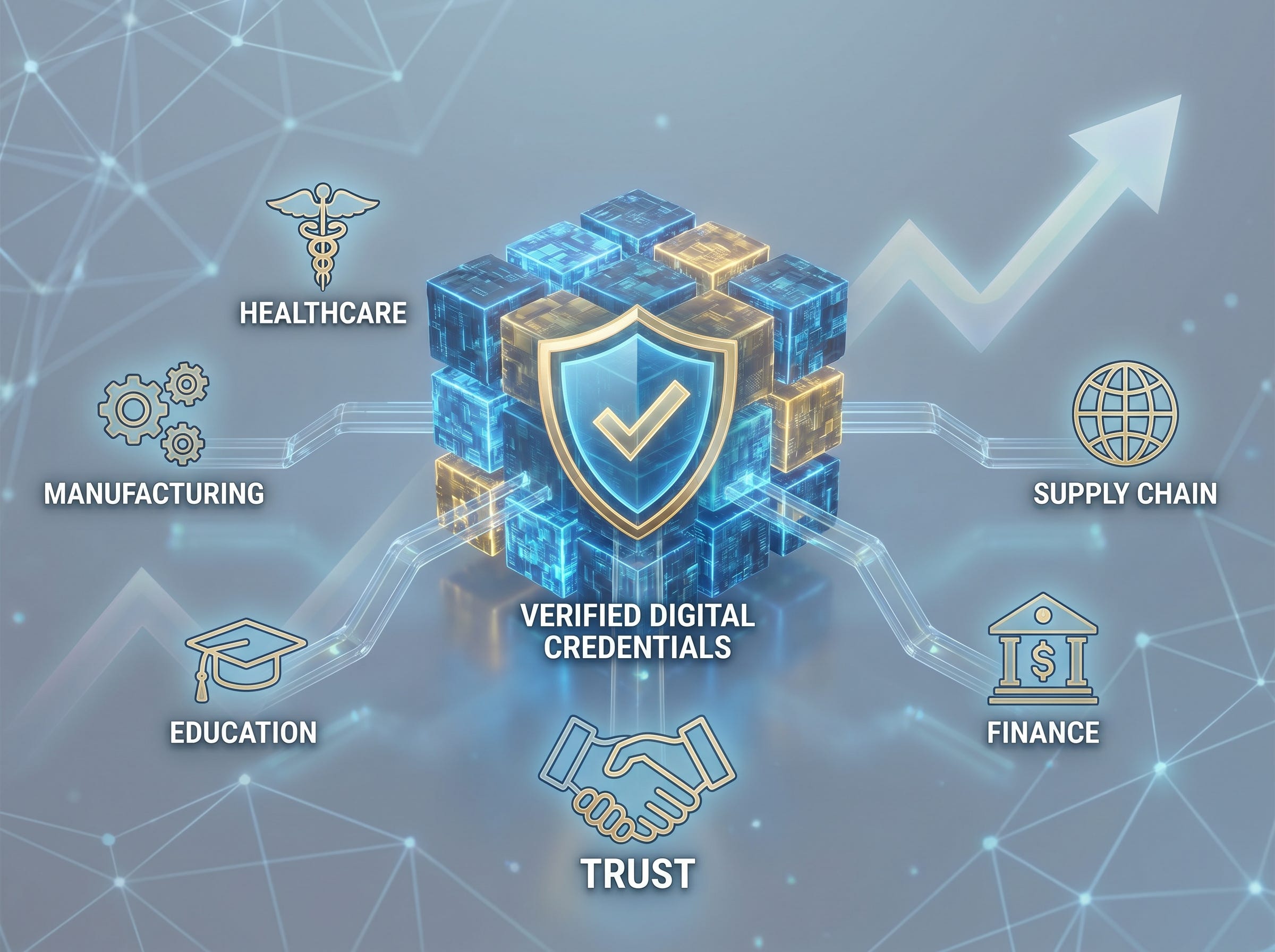
Verified Digital Credentials Creating Confidence Across Industries
 Everycred4 min read·Just now
--
Trust has become one of the most valuable assets in the digital world. Whether someone is applying for a job, enrolling in a course, accessing government services, or proving a professional license, organizations need a reliable way to confirm that information is real.
This is where verified digital credentials are creating a major shift.
Instead of relying only on paper certificates, scanned documents, or manual verification, industries are moving toward digital credentials that can be issued, shared, and verified securely. These credentials help reduce fraud, speed up decision-making, and build confidence between people, institutions, and businesses.
What Are Verified Digital Credentials?
Verified digital credentials are secure digital records that prove a person’s qualification, identity, achievement, membership, license, or authorization. They can be issued by schools, universities, employers, government agencies, certification bodies, and other trusted organizations.
Unlike traditional paper-based records, digital credentials can be checked quickly and accurately. A verifier can confirm whether the credential is authentic, valid, and issued by a trusted source.
Examples of verified digital credentials include:
- Digital certificates
- Digital badges
- Digital ID cards
- Academic records
- Professional licenses
- Employee credentials
- Training certifications
- Membership proof
- Government-issued credentials
These credentials are designed to make proof easier to manage and harder to fake.
Why Industries Need Better Credential Verification
Many organizations still depend on manual credential checks. This can involve phone calls, emails, uploaded PDFs, physical copies, or third-party verification processes. While these methods may work, they often take time and leave room for mistakes.
Manual verification can create several challenges:
- Slow onboarding
- Higher administrative workload
- Risk of forged documents
- Inconsistent verification processes
- Poor record visibility
- Delayed approvals
- Compliance concerns
Verified digital credentials solve many of these problems by making verification faster, more transparent, and more reliable.
Building Confidence in Education
Education is one of the strongest use cases for verified digital credentials. Schools, colleges, universities, and training providers can issue digital certificates and digital badges to students and learners.
Instead of waiting for manual transcript verification, employers or institutions can instantly verify academic achievements. This helps students share their qualifications with confidence and helps employers make faster hiring decisions.
Digital badges are also useful for short courses, workshops, skill programs, and professional learning. They allow learners to showcase verified skills across online platforms and career profiles.
Improving Trust in Employment
Hiring teams often need to verify education, certifications, work experience, and professional skills. Traditional background checks can be slow and costly.
Verified credentials help employers confirm candidate information more efficiently. A candidate can share verified proof of qualifications, and the employer can validate the information without long manual processes.
This improves trust in hiring and reduces the risk of fake resumes, false certifications, or misleading claims.
For employees, verified digital credentials can also support internal training records, role-based access, and career growth.
Supporting Healthcare and Professional Licensing
In healthcare and regulated industries, trust is critical. Organizations must verify licenses, certifications, training records, and professional qualifications before allowing someone to perform sensitive work.
Verified digital credentials can help hospitals, clinics, licensing boards, and professional bodies confirm that a person is properly qualified.
This supports safer operations, stronger compliance, and better protection for patients, clients, and communities.
Strengthening Digital Government Services
Governments are also adopting digital credentials to modernize public services. Digital ID cards, permits, licenses, certificates, and citizen records can be issued and verified digitally.
This supports digital government transformation by reducing paperwork and improving access to services.
With verified digital credentials, citizens can prove eligibility, identity, or authorization more easily. Government agencies can also reduce fraud, improve service delivery, and create more efficient administrative systems.
Reducing Fraud With Blockchain Credentials
Blockchain credentials add another layer of security to digital verification. By using blockchain-based systems, credentials can become more tamper-resistant and easier to authenticate.
Blockchain identity verification helps confirm that a credential has not been altered and was issued by a trusted authority.
This is especially valuable in industries where document fraud can cause serious problems, such as education, employment, finance, healthcare, and government services.
The Role of Digital Trust Platforms
A digital trust platform helps organizations issue, manage, and verify credentials securely. It brings together credential management, identity verification, compliance support, and secure data exchange.
A strong platform may include:
- Digital credential software
- Credential verification tools
- Digital identity verification
- Blockchain credentials
- Digital certificates
- Digital badges
- Digital ID cards
- Credential management
- Verifiable credentials
- Compliance-ready records
By using a digital trust platform, organizations can create a more reliable system for managing proof and authenticity.
Benefits Across Industries
Verified digital credentials are useful because they create trust wherever proof is needed.
Key benefits include:
- Faster verification
- Reduced document fraud
- Lower administrative workload
- Better user experience
- Stronger compliance
- Improved data security
- Easier credential sharing
- Greater confidence in decisions
From education and hiring to healthcare and government services, verified credentials make it easier to confirm information accurately.
Future of Verified Digital Credentials
As more industries move online, the demand for secure and portable proof will continue to grow. People will need trusted ways to share their qualifications, identity details, certifications, and achievements across platforms.
Verified digital credentials will play a major role in this future.
They will help organizations reduce manual work, prevent fraud, and build stronger digital trust. They will also give individuals more control over how they share their verified information.
Final Thoughts
Verified digital credentials are changing how industries manage trust. They make proof easier to issue, easier to share, and easier to verify.
For organizations, they reduce risk and improve efficiency. For individuals, they create a more reliable way to prove identity, skills, qualifications, and achievements.
As digital transformation continues, verified digital credentials will become an important foundation for secure and trusted interactions across industries.
Looking to build trust with secure digital credentials and smarter credential verification?
Connect with EveryCRED to explore digital credential solutions designed for modern industries.