
Understanding Public and Private Keys in Blockchain
 Abban Nasra3 min read·1 hour ago
--
The Foundation of Digital Ownership.
If you know this you are safe.
At the core of blockchain technology lies a powerful concept that replaces trust in institutions with trust in mathematics. This concept is built on cryptographic keys, the true gatekeepers of digital ownership.
A key in blockchain is not just a random string of characters. It is part of a mathematically linked pair known as asymmetric cryptography. These two keys, public and private, work together to secure assets, verify identity, and authorize transactions without relying on any central authority.
The Two Keys That Define Ownership
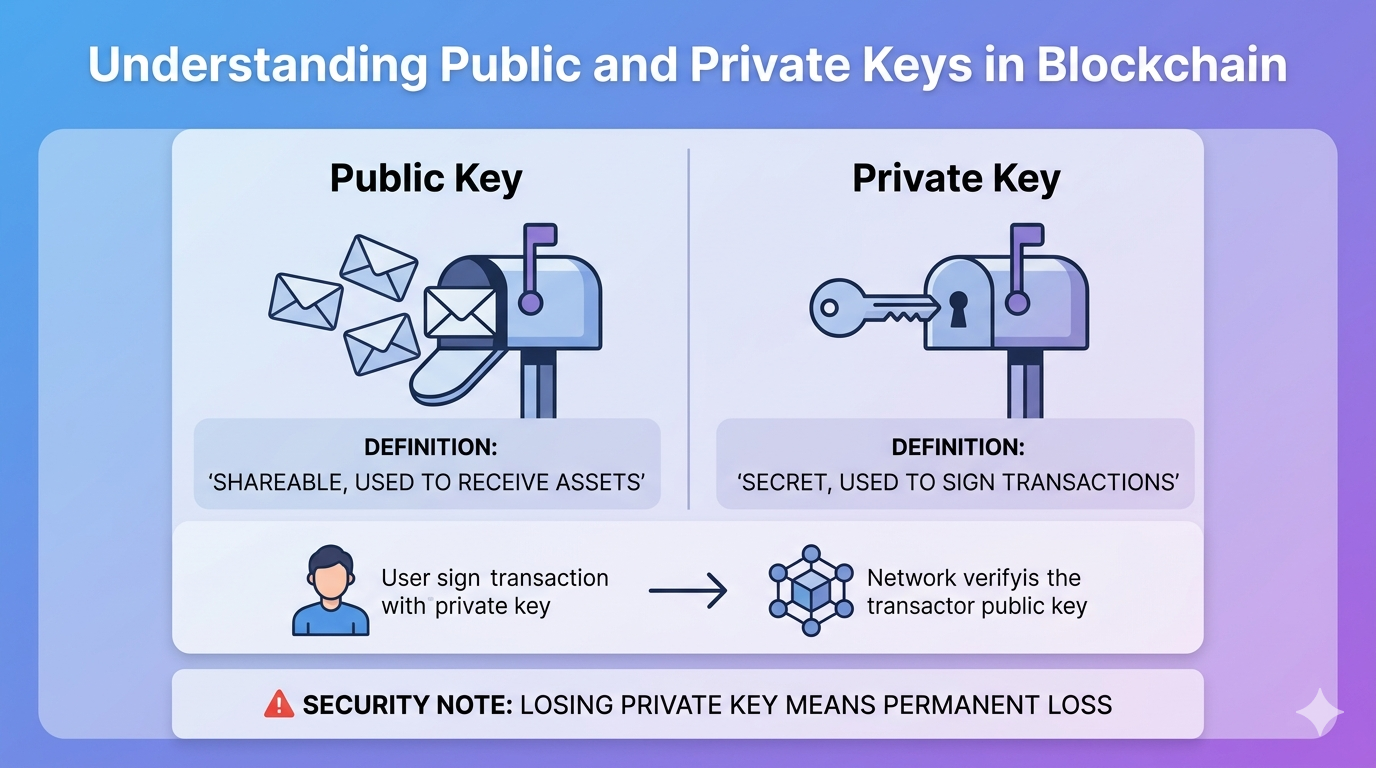
A public key can be compared to a bank account number or an email address. It is designed to be shared. Anyone can use it to send you cryptocurrency or verify that a transaction was signed by you. In most blockchains, what users actually share is a wallet address, which is a hashed or encoded version of the public key.
A private key, on the other hand, is the ultimate proof of ownership. It is a large, randomly generated number known only to the owner. This key is used to sign transactions and unlock control over digital assets. Whoever holds the private key controls the funds. There are no exceptions and no recovery systems.
A Simple Analogy.
Think of a mailbox.
The public key is like the address written on the mailbox. Anyone can see it and send letters to it.
The private key is the actual key that opens the mailbox. Only the person who holds it can access what is inside.
How These Keys Work Together.
Blockchain does not store your assets in a wallet. Instead, assets exist on a public ledger and are associated with your address.
When you want to send funds, you create a transaction message. This message is signed using your private key, producing a digital signature. The network then uses your public key to verify that the signature is valid.
This process ensures three critical things.
- First, only the owner can authorize a transaction.
- Second, transactions cannot be altered once signed.
- Third, no central authority is required to validate ownership.
Why This System Is Secure.
The security of blockchain comes from the mathematical difficulty of deriving a private key from a public key. With current technology, this is practically impossible.
This creates a system where ownership is absolute. If you have the private key, you have full control. If you lose it, access is permanently lost.
The Role of Seed Phrases.
Because private keys are complex and difficult to store, modern wallets use seed phrases. These are sets of 12 to 24 simple words that act as a master backup for your private key.
Anyone with access to this phrase can regenerate your wallet and take control of your assets.
Final Perspective.
Public and private keys are not just technical components. They are the foundation of self-sovereign finance. They remove the need for banks, redefine ownership, and place full responsibility in the hands of the user.
In blockchain, security is not enforced by institutions. It is enforced by mathematics. And your private key is the final authority.
✍️Usman Mohammed