Uncle Rwamiti and the Batteries No One Bargains For
--
What a Premium Battery Shop in Kampala Taught One Woman About Sologamy, Self-Worth, and Why Cheap Love Costs the Most
At the Battery Clarity Desk in Zzana, a man once walked in asking for the cheapest battery available.
He whispered like he was buying contraband.
“Boss… anything used? Maybe slightly tired, but still moving?”
Uncle Rwamiti looked up slowly over his glasses, sipped tea, and pointed to a sign on the wall.
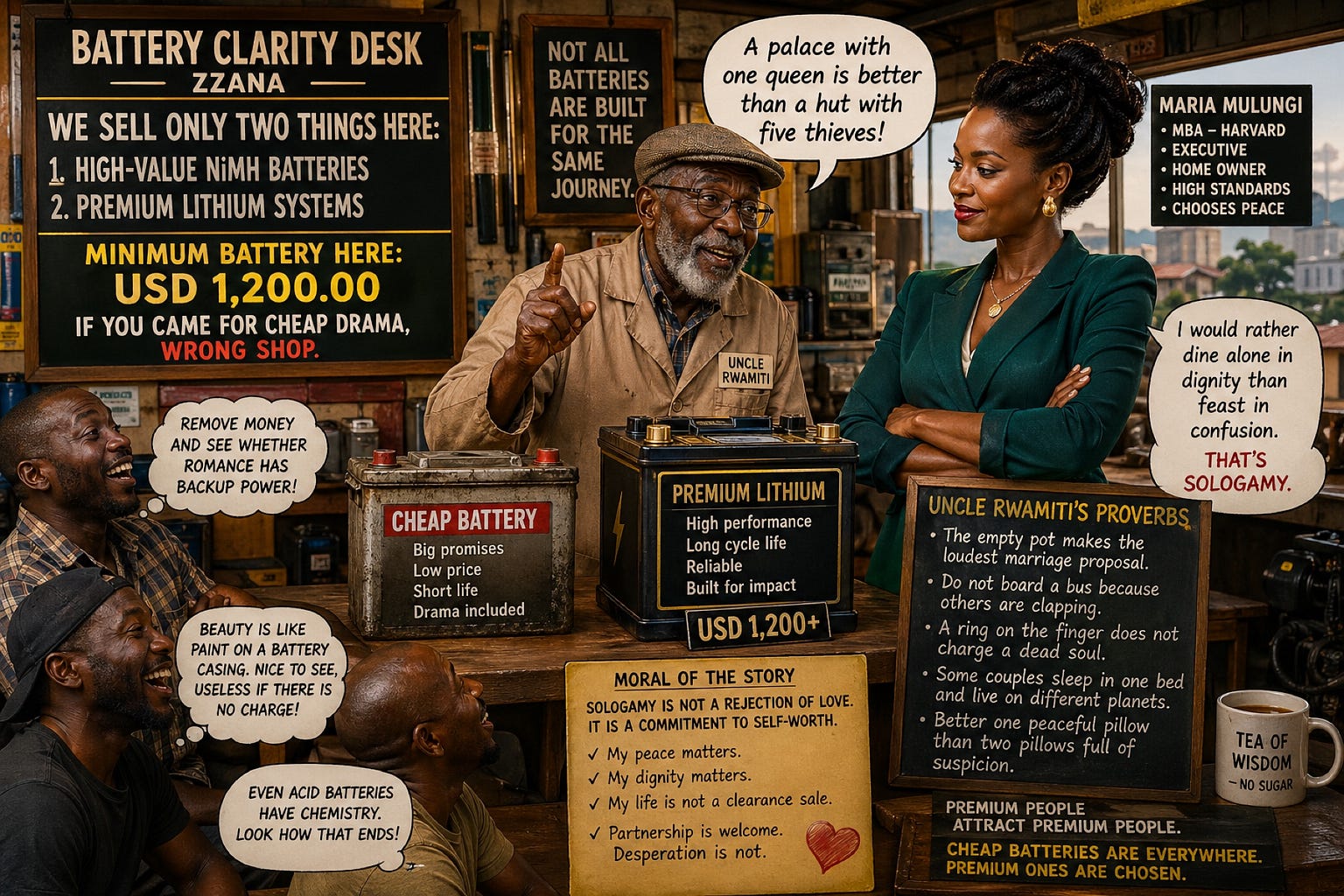
WE SELL ONLY TWO THINGS HERE
- Premium NiMH batteries
- 2. High-value lithium systems
Minimum battery price: USD 1,200.
If you came for cheap drama, wrong shop.
The customer laughed nervously.
“Old man, why only expensive batteries?”
Uncle Rwamiti smiled.
“Because serious people do not gamble with power.”
That was the day Maria Mulungi entered.
Meet Maria Mulungi
Maria was the kind of woman people admired publicly and questioned privately.
Forty-six. Elegant. Highly educated. Successful. Calm.
MBA from Harvard University.
Regional executive.
Own house in Buziga.
Travels often.
Pays her own bills.
Sleeps peacefully.
But in Kampala society, peace is suspicious if a woman enjoys it alone.
At weddings, aunties would corner her.
“So… when are we meeting the husband?”
As if a woman’s life were a delayed shipment.
At funerals:
“You need children for legacy.”
At parties:
“You are too choosy.”
Maria had dated.
One man loved her ambition until it out-earned him.
Another wanted a wife, maid, therapist, and sponsor in one package.
A third quoted scripture but borrowed money like a serial entrepreneur of confusion.
Eventually Maria made a decision many people fear:
She chose herself first.
Not because she hated men.
Not because she was bitter.
Not because no one wanted her.
Because she had finally learned the cost of counterfeit intimacy.
⸻
What Is Sologamy, Really?
Sologamy is often mocked.
People hear “self-marriage” and imagine vanity, narcissism, or loneliness with lipstick.
But at its core, sologamy means something simpler and older:
A vow not to abandon yourself.
To honour your own dignity.
To stop entering relationships where your soul must shrink to fit.
Maria did not need a wedding dress to know this.
She simply stopped treating herself as negotiable.
Uncle Rwamiti Explains Love Using Batteries
Maria asked him:
“Uncle, why do people become angry when a woman values herself?”
The workshop went silent.
Uncle tapped two batteries on the shelf.
One was cheap, flashy, and loudly advertised.
The other was heavier, tested, stable, and expensive.
He pointed to the cheap one first.
The Cheap Battery
Looks shiny.
Low price.
Big promises.
Short lifespan.
Drama included.
“That,” Uncle said, “is the lover who texts poetry but cannot keep commitments.”
The mechanics burst out laughing.
Then he tapped the premium battery.
The Premium Battery
Higher price.
Long cycle life.
Stable under pressure.
Quiet confidence.
“That,” he said, “is a person who arrives whole.”
The Joke That Broke the Room
A young mechanic shouted:
“Uncle! How do we detect fake love quickly?”
Uncle did not blink.
“Remove money and see whether romance has backup power.”
The workshop collapsed in laughter.
Another asked:
“What about chemistry?”
Uncle smiled.
“Even acid batteries have chemistry. Look how that ends.”
A third shouted:
“What about beauty?”
Uncle lifted his cup.
“Beauty is like paint on a battery casing. Nice to see. Useless if there is no charge.”
Maria’s Hard Question
She folded her arms.
“But Uncle… what if no premium person appears?”
He leaned back.
“My daughter, a palace with one queen is better than a hut with five thieves.”
Even the photocopy customers laughed.
Then he grew serious.
“Many people marry because they fear silence.
But silence is not the enemy.
Bad company is.”
He pointed to a lithium battery bank.
“This battery stores power. It does not beg for it.”
Then he pointed at Maria.
“You too must become energy storage, not emergency demand.”
The Hidden Economics of Desperation
There are people who complain that your standards are too high.
Often, what they mean is:
Your standards inconvenience their access.
Some want partnership.
Others want discounted labour.
Some want love.
Others want management, healing, financing, admiration, and housekeeping wrapped in romance.
Uncle Rwamiti put it bluntly:
“People protest premium pricing when they came hoping for clearance
Around the world, more adults are living solo longer.
Many are building careers, friendships, purpose, and peace outside traditional timelines.
Yet culture still speaks as though partnership is the only proof of adulthood.
It is not.
A ring can symbolize love.
It cannot manufacture it.
Marriage can be beautiful.
So can self-respect.
Partnership can elevate life.
So can solitude used wisely.
Uncle’s Final Proverbs
Before Maria left, he offered these:
• “Do not board a bus because others are clapping.”
• “An empty pot makes the loudest marriage proposal.”
• “A ring on the finger does not charge a dead soul.”
• “Better one peaceful pillow than two pillows full of suspicion.”
• “Cheap batteries are sold everywhere. Premium ones are sought by those who understand value.”
Then he looked directly at her.
“If someone calls you difficult, ask one question:
Difficult to love… or difficult to exploit?”
Maria Walked Out Smiling
For the first time in years, singleness felt less like waiting and more like wisdom.
She did not feel incomplete.
She felt expensive.
And somewhere behind her, a mechanic whispered:
“Uncle… do we also stock premium husbands?”
Uncle Rwamiti sipped tea.
“My son, those ones are rarer than lithium in a village kiosk.”
No one laughed louder than the married men.
Sologamy is not rejection of love.
It is rejection of self-betrayal.
And sometimes the most romantic vow a person can make is this:
I will not abandon myself just to avoid being alone.