Types of Blockchains: Public vs Private vs Hybrid (Where Each Actually Fits)
--
Not all blockchains are designed to do the same thing.
By the time most people understand transactions, wallets, and tokens, they assume there’s just “one kind” of blockchain underneath everything.
There isn’t.
The way a blockchain is structured — who can access it, who can validate it, and who controls it completely changes how it behaves.
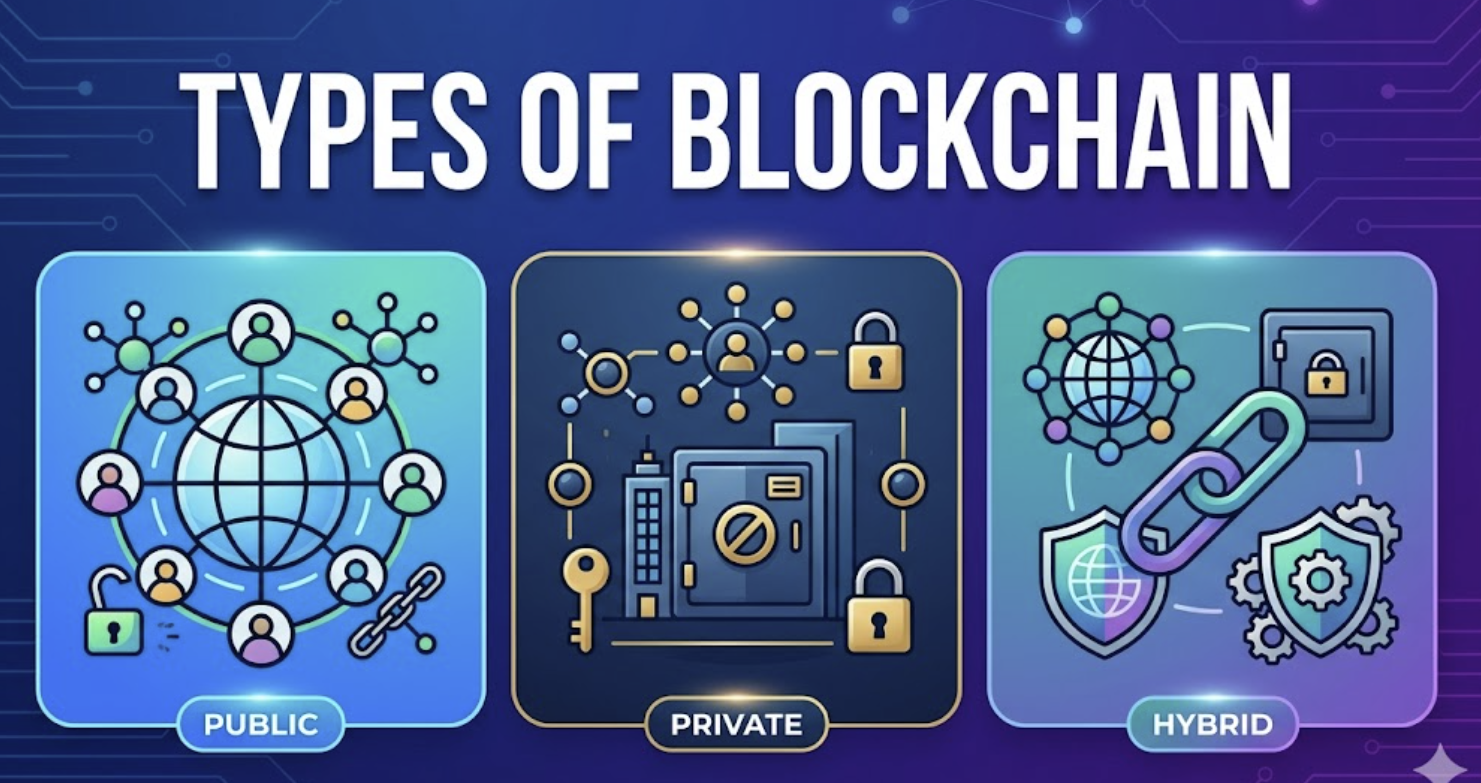
At a system level, most blockchains fall into three categories:
public, private, and hybrid.
Public Blockchains (Open Networks)
A public blockchain is fully open.
Anyone can:
- read the data
- submit transactions
- participate in validation (depending on the protocol)
Networks like Ethereum operate this way.
There’s no central authority deciding who gets access.
From a technical standpoint, this means:
- state is globally replicated
- validation is decentralized
- consensus is required across unknown participants
This design makes the system highly transparent and resistant to control.
But it also introduces constraints:
- limited throughput
- higher latency
- transaction fees due to competition for block space
Practical Example
If you’re building a global payment system where users don’t trust a central entity, a public blockchain makes sense.
Every participant can independently verify the system’s state.
No one needs permission to join.
Private Blockchains (Controlled Systems)
A private blockchain restricts access.
Only selected participants can:
- read data
- submit transactions
- validate blocks
Platforms like Hyperledger Fabric are designed for this model.
Here, the network is not open — it’s governed.
From a system design perspective:
- nodes are known and trusted
- consensus is faster (fewer participants)
- transaction costs are minimal or zero
This makes private blockchains behave more like traditional distributed systems, but with structured data integrity.
Practical Example
Imagine a supply chain system shared between:
- manufacturers
- logistics providers
- retailers
All participants are known entities.
They don’t need full decentralization — they need:
- shared visibility
- tamper-resistant records
A private blockchain fits better than a public one here.
Hybrid Blockchains (Mixed Approach)
Hybrid blockchains combine both models.
Some parts of the system are:
- open and verifiable (public layer)
Other parts are:
- restricted and controlled (private layer)
This allows systems to balance:
- transparency
- performance
- access control
Practical Example
Consider a system where:
- transaction proofs are stored on a public blockchain
- detailed data is stored privately
Users can verify that something happened (public layer),
without exposing all internal data (private layer).
This approach is increasingly common in:
- enterprise integrations
- financial systems
- scaling solutions
The Real Difference Is Not “Type” — It’s Trust Model
The classification sounds simple, but the deeper difference is this:
Who do you trust to maintain the system?
- Public blockchain → trust the protocol and network
- Private blockchain → trust the organization or consortium
- Hybrid → trust a combination of both
That decision affects everything:
- performance
- cost
- security
- usability
Why Public vs Private Is Not a Competition
There’s a tendency to frame this as:
“Public = good, Private = bad”
But technically, that doesn’t hold.
A private blockchain is not trying to replace a public one.
It’s solving a different problem.
Public systems optimize for:
- openness
- censorship resistance
- global participation
Private systems optimize for:
- speed
- control
- predictable performance
Hybrid systems attempt to bridge both.
Where Most Real Systems Are Heading
Very few production systems are purely one type.
Most are moving toward layered architectures:
- public chains for verification and settlement
- private systems for execution and data handling
This is not a compromise — it’s a practical design choice.
Because once you understand the constraints of block space, fees, and latency, it becomes clear that not everything belongs on a fully public network.
The Useful Way to Think About It
Instead of asking:
“Which blockchain is better?”
A more useful question is:
What level of trust, access, and performance does this system need?
Because the answer to that question determines the type of blockchain you choose.
And that decision is architectural — not ideological.