Transforming Virgo: From E-Money to an Agnostic E-Wallet
--
Background
Virgo started as an e-money platform focused on simple, everyday transactions — especially enabling users to make QRIS payments, transfer funds, and pay bills. While this concept is very common for other e-money apps.
The fact is, the growth of digital financial services in Indonesia has created an increasingly competitive landscape between e-money (UE) and digital banking products. Today, both serve similar core needs:
- Payments via QRIS
- Daily financial transactions
While the reality is, e-money still has a significant portion of users:
- Still avoid banking products (trust, complexity, documentation)
- Face barriers in registration
- Prefer simpler, accessible financial tools
“My money is everywhere, but not in one place.”
Objective
The goal of this project is to transform Virgo into an agnostic e-wallet — a platform that:
- Supports multiple sources of funds (banks, e-money, etc.)
- Allows users to choose their preferred payment method
- Provides backup balance options in case of insufficient funds
- Expands Virgo’s ecosystem by attracting more users and payment partners
“Virgo is not competing with banks or e-money, it is connecting them.”
Desktop Research
To validate the idea, I do a competitor analysis between Gopay and DANA.
Key Insights:
- Users prefer flexibility over loyalty to one platform
- Top-up friction is one of the biggest drop-off points
- Not many of the finance app that do agnostic because they want to keep the e-money position as the main Source of Fund
“While competitors are evolving from wallets into ecosystems, Virgo has the opportunity to design itself as an orchestration layer for seamless payment. Removing the effort for users to think about where their money is stored, and instead focusing on how they want to pay.”
How does it work?
The Binding Flow enables users to connect their source-of-funds (SoF) account to Virgo through a seamless onboarding process. Users can either start from the SoF partner (register first, then link to Virgo) or from Virgo (create wallet, register SoF via webview, then bind), with verification steps such as OTP, KYC, and PIN ensuring security. This flexible flow allows integration across platforms while maintaining a smooth and secure user experience.
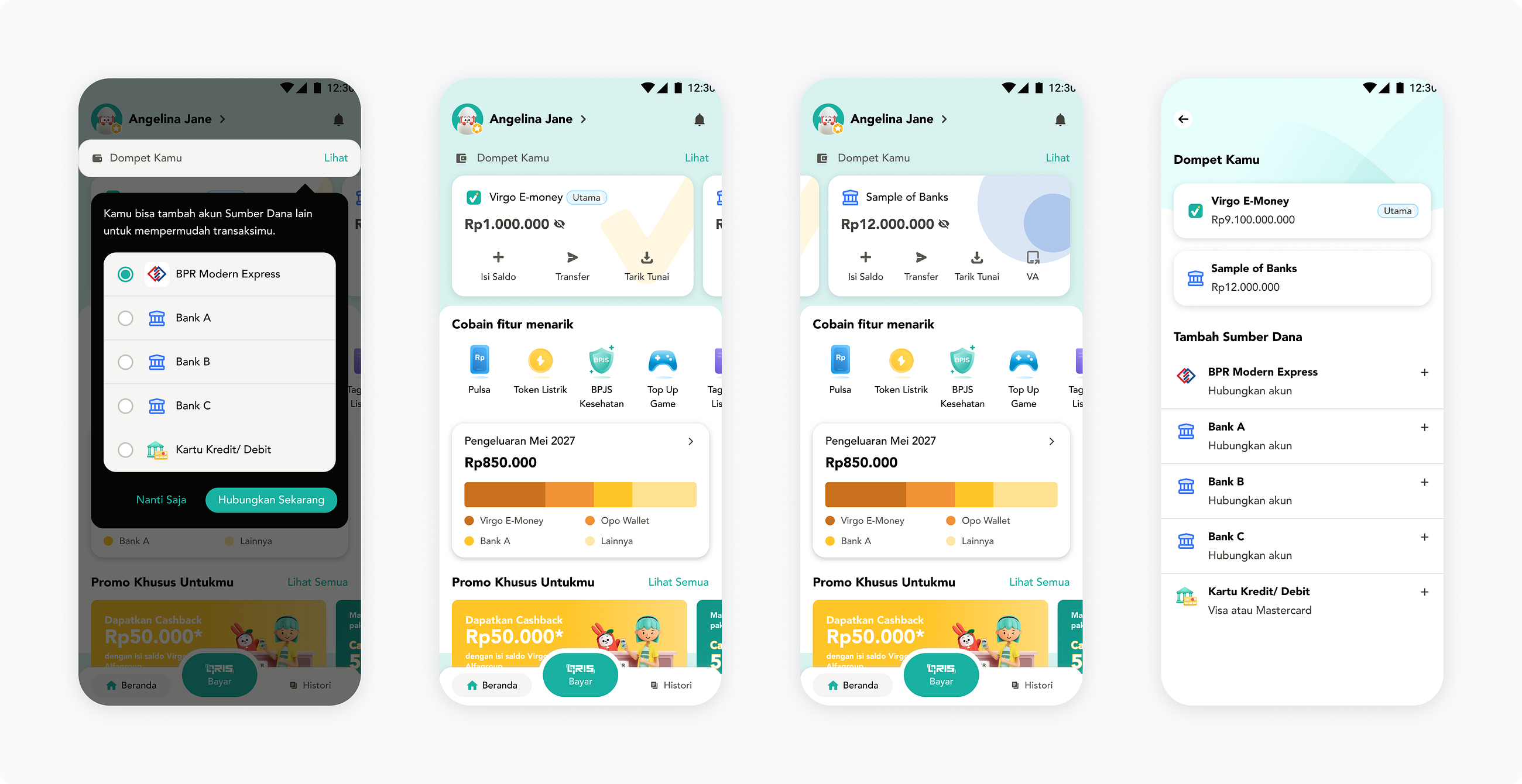
For the Payment Flow, users simply initiate any kind of transaction/ payment, their preferred source of funds will be shown as the default balance, they have the flexibility to change to another SoF. Real-time balance checks ensure transactions go through instantly or suggest alternatives when needed. Fast, flexible, and frictionless.
Design Concept: A Wallet Hub
To support Virgo’s transformation into an agnostic wallet, the experience needed to evolve from a single-balance structure into a flexible financial wallet. I redefined the information architecture to introduce a ‘Wallet Hub’, a centralized space where users can view and manage multiple sources of funds, including Virgo balance, linked banks, and other e-wallets.
Building on this foundation, I translated the structure into a clear and intuitive interface. Guided by principles of clarity, visible user control, and reduced decision fatigue, the design surfaces all SoF in one place, introduces default and fallback payment logic, and ensures every transaction feels transparent and predictable.
My role focused on shaping both the underlying structure (IA) and the user-facing experience, turning a complex multi-source system into a seamless, easy-to-understand flow.
Design Principles:
- Clarity over complexity: Users can complete transactions quickly without needing to “figure things out.”
- User control is visible: Builds trust, especially in financial transactions
- Scalable design: Virgo can evolve into a broader financial platform without breaking UX consistency
Business Impact Hypothesis
1. Reduce Top-Up Friction
- Users no longer need to top up before every transaction
- Users can move money from one to another SoF, free
2. Increase Transaction Volume
- Users can utilize any available balance
- Backup funding reduces failed transactions
3. Expand User Base
Serves:
- Users' e-money (underbanked users)
- Users with multiple financial accounts
- Bank’s user itself
4. Strengthen Partner Ecosystem
Enables collaboration with:
- Banks Buku 1, 2, 3, 4
- Other e-money platforms
- More usage for partners
- More entry points for Virgo
Key Learnings
1. Designing for Ecosystems, Not Just Features
This project shifted my perspective from designing isolated features to designing within a connected financial ecosystem, where multiple stakeholders (users, partners, systems) interact.
2. Balancing Flexibility and Simplicity
Giving users more options (multiple SoF) introduces complexity.
The challenge was to: provide flexibility without overwhelming users
3. Trust is the Core of Financial UX
Beyond usability, financial products require:
- Transparency
- Predictability
- Clear system feedback
Transforming Virgo into an agnostic wallet is not just a product enhancement, it’s a shift toward becoming a financial platform that connects multiple systems into one seamless experience. By walking together with a broader partner, Virgo has the opportunity to redefine how users interact with their money.