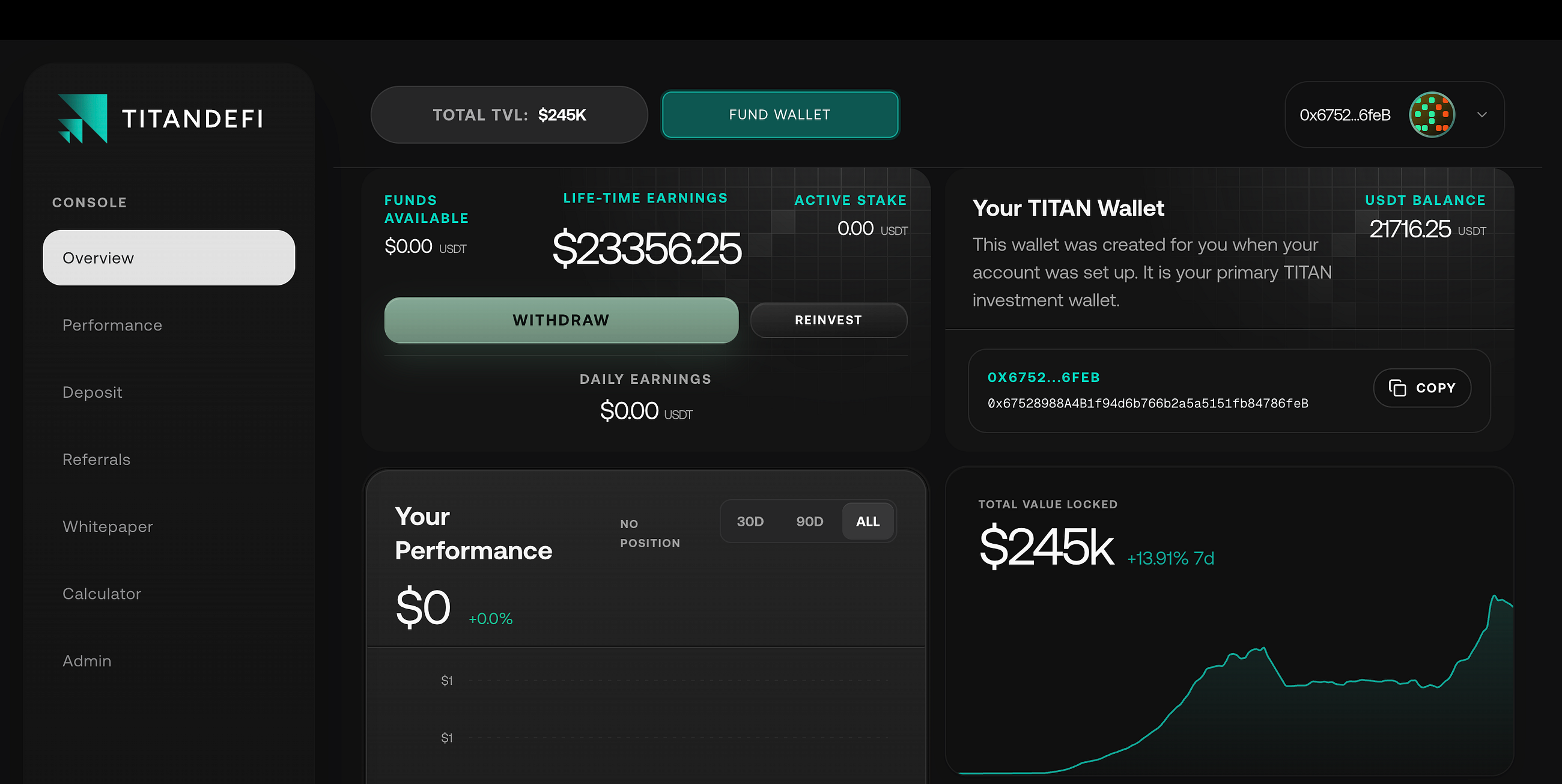
TitanDeFi Review: A New DeFi Passive Income Opportunity With Over $226K Paid Out
--
TitanDeFi is one of the DeFi passive income platforms gaining attention in 2026 for its USDT-based staking model, daily yield structure, and reported investor payouts of over $226K. While researching new DeFi yield opportunities, I came across TitanDeFi and decided to test the platform for myself.
TitanDeFi is a USDT-based yield protocol built on BNB Chain that gives users access to a structured daily yield model connected to TitanDeFi’s trading operations. According to the TitanDeFi whitepaper, when users deposit USDT into the protocol, their capital becomes part of TitanDeFi’s active trading base. That capital is then deployed across algorithmic strategies designed to generate realized trading profits, with daily yield distributions paid to participants according to the platform’s defined staking and yield structure.
I decided to test the platform with an initial deposit of $1,500. That placed me above the 1,250 USDT threshold, which qualified me for TitanDeFi’s Tier 3 yield level. From there, I reinvested my earnings to grow my active principal and move toward a higher yield tier. After roughly two and a half months, I withdrew $21,716.25.
What Is TitanDeFi?
TitanDeFi is a USDT-based yield protocol built on BNB Chain. The platform connects user deposits to TitanDeFi’s trading operations, where capital is used to support active trading, market-making, and liquidity-provision strategies.
So I decided to closer look at how the platform works, how its yield tiers are structured, and how TitanDeFi explains its trading-based income model.
According to TitanDeFi’s website and whitepaper, the platform is designed around USDT deposits, daily yield, and a tiered staking system. Instead of requiring users to manage complicated DeFi positions manually, TitanDeFi presents a more streamlined model where users deposit USDT, earn daily yields in a yield tier based on their active balance, and track daily earnings through the investor dashboard.
In simple terms, TitanDeFi’s model works like this: users deposit USDT, that USDT becomes part of the protocol’s active trading base, TitanDeFi deploys the capital across algorithmic strategies, and daily yield is paid back to participants based on their staking tier.
That structure is what makes TitanDeFi different from a basic deposit-and-wait platform. The whitepaper explains that deposits are not just sitting idle. They are used to help fund trading liquidity and operational capital, while yield is connected to realized profits generated by TitanDeFi’s trading activity.
My Experience With TitanDeFi
I started with $1,500 in USDT.
Based on TitanDeFi’s published yield tiers, that deposit placed me in Tier 3, which begins at 1,250 USDT and offers 1.50% daily yield. Instead of withdrawing earnings immediately, I chose to reinvest my daily yield back into the platform.
The reason I reinvested was simple: TitanDeFi’s model is based on active principal. When earnings are reinvested, they are added back into the user’s active balance. As that balance grows, the user can move toward higher yield tiers. The whitepaper explains that reinvestment allows users to compound their position and potentially qualify for a higher yield tier once their balance reaches the required threshold.
Over about two and a half months, I reinvested earnings to increase my active balance. After that period, I withdrew $21,716.25.
That was the point where I wanted to understand the platform beyond just the dashboard numbers. I wanted to look closer at the structure TitanDeFi describes in its whitepaper: how deposited capital enters the active trading base, how yield is generated, how staking tiers are assigned, and how reinvestment affects the user’s position.
The Problem TitanDeFi Is Addressing
TitanDeFi’s whitepaper frames one of the main problems as an Investor Access Gap. In traditional finance, proprietary trading firms, market makers, hedge funds, and quantitative desks can generate substantial returns through active capital deployment. But access to those opportunities is usually limited to institutions, accredited investors, private funds, or high-net-worth participants.
TitanDeFi’s stated solution is to narrow that gap by allowing everyday users to deposit USDT into the protocol and receive daily yield generated from TitanDeFi’s operations.
This is the core idea behind TitanDeFi: instead of users needing direct access to a professional trading desk or market-making operation, they participate through a USDT-based protocol. Their deposits help support TitanDeFi’s trading and liquidity base, and yield is distributed according to the protocol’s staking structure.
TitanDeFi’s Solution
TitanDeFi’s solution is built around a simple but specific mechanism: user deposits become part of the protocol’s active trading base.
When users deposit USDT, that capital is aggregated into TitanDeFi’s active trading capital and deployed across the protocol’s trading operations. According to the whitepaper, TitanDeFi uses this capital across proprietary quantitative trading operations, including market-making, liquidity provision, spread capture, and arbitrage strategies.
Daily yield is then distributed to investors through the protocol’s smart-contract-powered payout flow. Each user’s daily earnings are based on their principal deposit and assigned yield tier. Those earnings are reflected in the user’s wallet and dashboard according to TitanDeFi’s daily yield structure.
That is the part that should be emphasized most when explaining TitanDeFi. The platform is not just saying users deposit USDT and receive yield. It is saying that deposited USDT supports active trading liquidity and operational capital, while yield distributions are connected to realized trading profits from the protocol’s operating side.
Protocol Design
TitanDeFi is designed around USDT deposits on BNB Chain. According to the whitepaper, user deposits are handled on-chain through an audited and transparent smart contract. This contract provides the core deposit, staking, accounting, and user-balance layer.
The investor dashboard gives users a clear interface for monitoring their position and interacting with the protocol. Through the dashboard, investors can view daily earnings based on the protocol-defined rate for their principal deposit and assigned yield tier, track their active balance, and choose whether to withdraw or reinvest.
TitanDeFi also separates the user-facing smart contract layer from the protocol’s trading and liquidity operations. The smart contract records USDT deposits, user balances, staking status, reinvestment activity, and eligible withdrawal actions on BNB Chain. Meanwhile, TitanDeFi’s operating side manages capital deployment across algorithmic trading, market-making, liquidity provision, spread capture, and arbitrage strategies.
This separation is important because it explains how the platform is structured. The smart contract handles the accounting and participation layer, while TitanDeFi’s operating side handles the trading and liquidity side.
Yield Generation
TitanDeFi’s daily yield model is described as being funded from realized trading profits generated by the protocol’s operating side. The whitepaper says capital is deployed through TitanDeFi’s proprietary quantitative trading operations, including market-making, liquidity provision, spread capture, and arbitrage strategies.
This is the main engine behind the platform’s yield model.
User deposits help form the active trading base. TitanDeFi then deploys that capital into algorithmic trading strategies. When those strategies generate realized trading profits, daily yield is distributed to participants based on the protocol’s staking and yield structure.
The investor dashboard is designed to show earnings over time. Participants can track daily wallet deposits, monitor accumulated yield, and review performance metrics that show how their position develops across the life of their investment.
In other words, TitanDeFi’s yield model is built around three connected pieces:
- User capital enters the protocol as USDT deposits.
- TitanDeFi deploys that capital across trading and liquidity strategies.
- Daily yield is distributed based on the user’s active principal and assigned tier.
Staking Mechanism
TitanDeFi’s staking mechanism is based on active USDT principal.
After signup, TitanDeFi creates an embedded wallet for the user through Privy.io. The whitepaper says the wallet is secured and managed by Privy, and that TitanDeFi does not control user wallets or have access to private keys. Users can access the private key for their embedded wallet through Privy’s wallet controls.
Once a user deposits USDT, the capital is aggregated into TitanDeFi’s active trading capital and deployed across the protocol’s trading operations. Daily yield appears in the investor dashboard, where users can track earnings, withdraw earnings, or reinvest generated yield back into their principal.
That reinvestment feature is one of the most important parts of the system. When users reinvest, generated earnings are added back into active principal. As the active principal grows, the user can potentially move into a higher yield tier.
That is the strategy I used. I started with $1,500, which qualified me for Tier 3. Then I reinvested earnings to grow my active principal and move toward a higher tier. After about two and a half months, I withdrew $21,716.25.
TitanDeFi Yield Tiers
TitanDeFi uses five yield tiers based on active principal. Each tier has a minimum USDT amount and a daily yield percentage.
According to the whitepaper, investors can deposit more than the minimum amount for a tier and still earn more inside that same tier because daily earnings are calculated from the full active principal balance. A larger active balance produces a larger daily earning amount.
My starting deposit of $1,500 placed me above the 1,250 USDT requirement for Tier 3. From there, reinvestment allowed my active principal to grow over time. As the balance increased, the goal was to move into a higher tier and increase the daily earning percentage.
This is where TitanDeFi’s compounding structure becomes important. The more earnings a user reinvests, the more their active principal grows. As that active principal grows, the account can qualify for higher daily yield tiers.
Why TitanDeFi Stood Out to Me
TitanDeFi stood out to me because the whitepaper explains a direct relationship between user deposits, active trading capital, and daily yield distributions.
The platform’s model is not just about depositing USDT into a vault. TitanDeFi explains that deposited capital becomes part of its active trading base and is deployed across algorithmic trading strategies. Yield is then distributed from realized trading profits according to the user’s staking tier.
The key features that stood out were:
- USDT deposits on BNB Chain
- Active trading-base model
- Algorithmic trading strategies
- Market-making and liquidity-provision focus
- Daily yield distributions
- Smart-contract-powered payout flow
- Reinvestment into active principal
- Tier-based daily yield structure
- Investor dashboard for tracking earnings and active balance
For me, the most important part was the reinvestment structure. Starting with $1,500, I was able to qualify for Tier 3, reinvest earnings, grow the active balance, and later withdraw $21,716.25 after roughly two and a half months.
TitanDeFi as a Passive Income Opportunity
TitanDeFi positions itself as a passive income opportunity through a structured USDT yield model.
Users deposit USDT into the protocol. That capital becomes part of TitanDeFi’s active trading base. TitanDeFi then deploys the capital across algorithmic strategies designed to generate realized trading profits. Daily yield distributions are paid to participants according to the protocol’s staking and yield structure.
That is the clearest way to understand TitanDeFi.
The platform’s passive income appeal comes from the fact that users do not need to operate the trading strategies themselves. They participate by depositing USDT, tracking daily yield through the dashboard, and choosing whether to withdraw or reinvest.
For users focused on compounding, the reinvestment mechanism is a major part of the experience. Reinvested earnings increase active principal, and active principal determines both the earning amount and the user’s potential tier progression.
My Withdrawal After Two and a Half Months
After depositing $1,500, I chose to reinvest rather than withdraw daily earnings immediately.
The purpose was to grow my active principal. Since TitanDeFi’s daily earnings are based on active principal and assigned yield tier, reinvesting helped increase the balance used to calculate future yield. As that active balance grew, it helped move the account toward a higher tier.
After roughly two and a half months, I withdrew $21,716.25.
That result is what made TitanDeFi stand out to me as more than just another DeFi platform. The combination of active trading-base participation, daily yield distributions, reinvestment, and tier progression created a clear structure for growing an account over time.
Final Thoughts
TitanDeFi is a USDT-based yield protocol on BNB Chain built around active trading capital, algorithmic strategies, and tier-based daily yield distributions. The whitepaper explains that when users deposit USDT, their capital becomes part of the protocol’s active trading base and is deployed across strategies designed to generate realized trading profits.
I tested TitanDeFi with an initial deposit of $1,500. That placed me in Tier 3 based on the platform’s published yield tiers. I then reinvested earnings to grow my active principal and move toward a higher tier. After about two and a half months, I withdrew $21,716.25.
The main things to understand about TitanDeFi are its active trading-base model, USDT staking structure, smart-contract-powered payout flow, reinvestment mechanism, and five-tier yield system. For users researching DeFi passive income opportunities in 2026, TitanDeFi presents a structured model where deposited USDT supports trading liquidity and operational capital, while daily yield is distributed according to the protocol’s defined staking tiers.