There are two types of DeFi users.
--
The first one says:
“bro I’m optimizing capital efficiency.”
The second one sees him awake at 4AM rebalancing liquidity on three chains while eating cold instant noodles.
Same person by the way.
That’s the current DeFi experience.
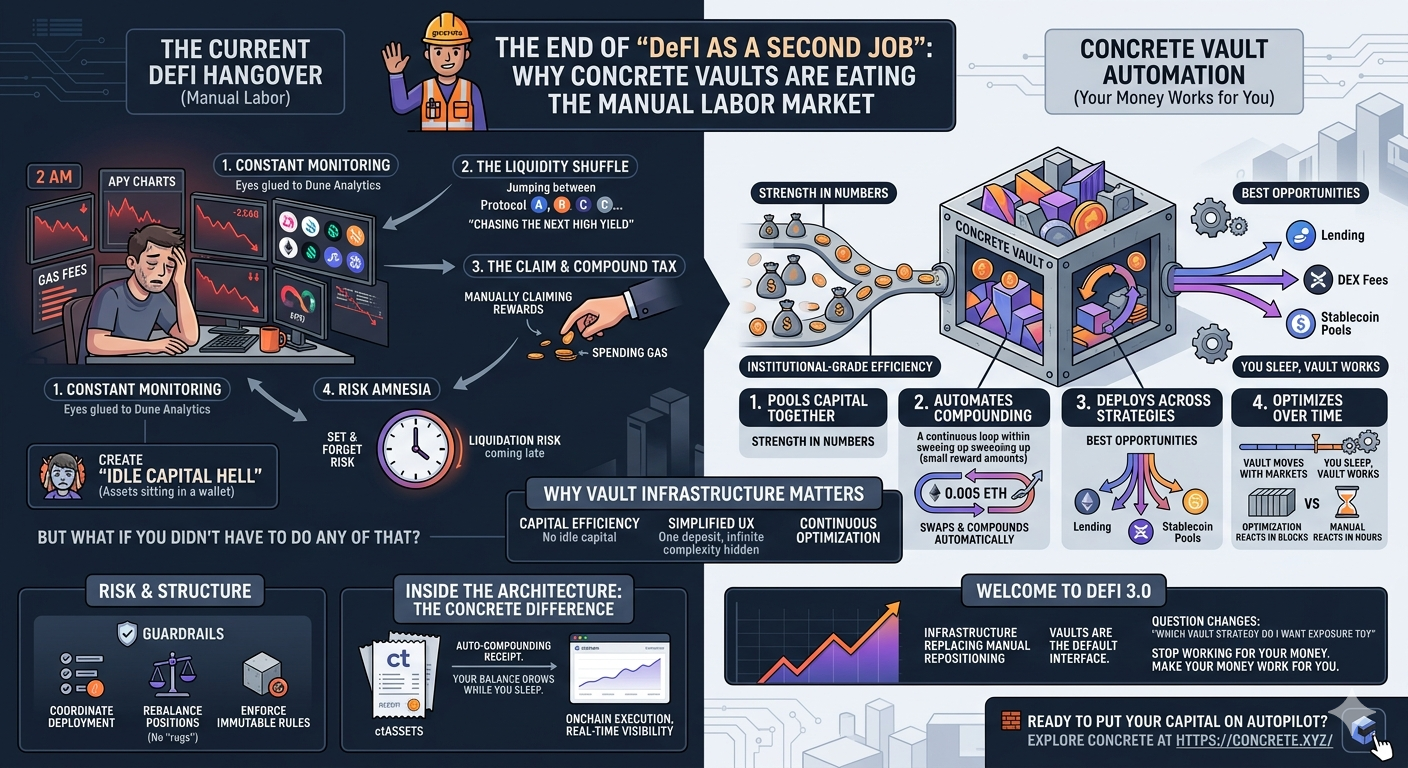
People enter DeFi thinking it’s passive income.
Then suddenly they’re:
— monitoring APYs every hour
— moving liquidity between protocols
— claiming rewards manually
— compounding emissions
— adjusting LP ranges
— tracking risk themselves
At some point you’re not investing anymore.
You’re doing remote maintenance work for your own wallet.
And this is exactly why DeFi vaults became important.
🧱 What problem do vaults actually solve?
DeFi became too efficient for humans.
Sounds weird, but it’s true.
Protocols move fast.
Yields change fast.
Liquidity rotates fast.
Meanwhile humans:
sleep.
touch grass.
forget to compound rewards for 9 days straight.
That creates massive inefficiency.
One of the best real examples was the rise of Uniswap V3.
When concentrated liquidity launched, capital efficiency improved dramatically…
…but users suddenly had a new full-time job:
managing liquidity ranges manually.
If price moved outside your range?
Your LP stopped working efficiently.
So users had two choices:
1️⃣ Constantly monitor and rebalance positions
2️⃣ Accept lower efficiency
That was a major turning point in DeFi.
People realized:
higher-performance systems also require better infrastructure.
Not more stress.
🧱 This is where Concrete Vaults come in
Concrete Vaults are designed to simplify onchain capital deployment through structured vault systems.
Instead of manually repositioning funds across opportunities every few hours, users deposit into a coordinated strategy framework.
The vault system helps:
— pool capital together
— automate compounding
— deploy across strategies
— optimize positions over time
— reduce operational complexity
In simple terms:
The system handles the busy work.
That matters more than people realize.
Because most DeFi portfolios are surprisingly inefficient.
Not because users are dumb.
Because manual management simply does not scale.
Rewards sit unclaimed.
Liquidity sits idle.
Positions drift.
Capital becomes fragmented across chains and protocols.
This is one of the biggest hidden problems in DeFi:
idle capital.
Everyone talks about APY.
Very few talk about coordination efficiency.
🧱 Why vault infrastructure matters
Good vault infrastructure is not just:
“deposit token and pray.”
A serious vault architecture continuously manages capital behind the scenes.
Concrete Vaults are built around systems designed to:
— coordinate capital deployment
— rebalance positions
— enforce strategy constraints
— optimize exposure
— respond to market conditions
This creates several advantages.
⚙️ Automation
Users don’t need to manually perform repetitive actions every day.
The vault structure handles ongoing execution automatically.
📈 Capital efficiency
Instead of rewards sitting inactive, vault systems can continuously compound and redeploy capital.
This keeps assets productive over time.
🧩 Simplified user experience
Most users do not want to manage 14 dashboards simultaneously just to maintain yield exposure.
Vaults simplify participation.
🔄 Continuous optimization
Markets move constantly.
Structured vault systems can adapt positions more consistently than manual workflows.
And honestly…
humans are emotional.
A vault does not panic sell because Twitter posted “we’re so back” followed by “it’s over” three hours later.
🧱 Why structure matters in institutional DeFi
The deeper DeFi grows, the more infrastructure matters.
Institutional DeFi participants already understand this.
Traditional finance has relied on automated portfolio systems for decades because manually coordinating large amounts of capital becomes inefficient at scale.
DeFi is heading the same direction.
And we’ve already seen what happens when systems lack structure.
During the 2021 yield farming boom, many protocols offered absurdly high emissions to attract liquidity.
Capital flooded in quickly.
Then rewards collapsed.
Liquidity disappeared.
Users rotated to the next farm overnight.
The issue wasn’t just yield sustainability.
It was the absence of structured coordination.
Concrete Vaults aim to approach DeFi differently.
Through systems like ctAssets, automated compounding, and onchain execution, vault architecture can coordinate capital more systematically across opportunities.
Instead of users manually chasing every new strategy…
The vault structure itself becomes the coordination layer.
🧱 The bigger shift happening now
DeFi is becoming too complex for manual optimization to remain the dominant model.
That’s the truth.
The future probably does not belong to users opening 19 tabs every morning trying to rebalance positions faster than everyone else.
It belongs to infrastructure.
To structured DeFi.
To automated systems.
To efficient onchain capital deployment.
Because eventually, the winning strategy is no longer:
“who clicks the fastest.”
It becomes:
“who has the best system coordinating capital.”
That’s the direction vaults are pushing DeFi toward.
And Concrete Vaults are building directly into that shift.
Explore Concrete at https://concrete.xyz/