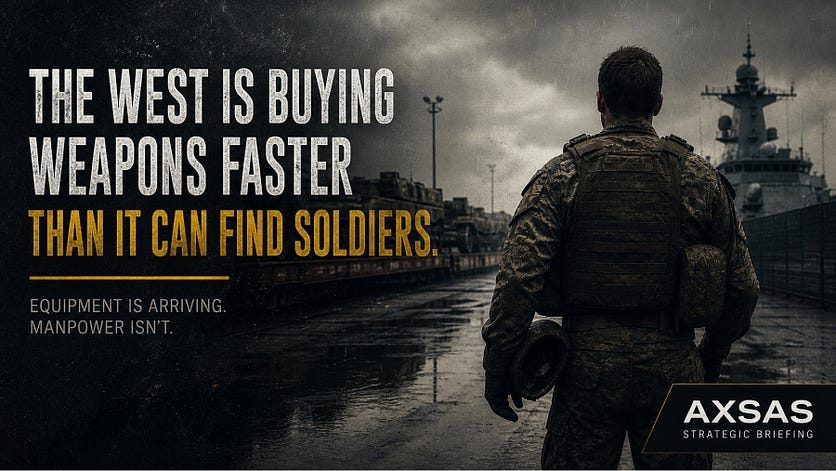
Rearmament is easy to announce. The constraint is whether countries can crew, train, maintain, rotate and replace the forces they are promising.
Executive Assessment
The West is rearming on paper faster than it is regenerating the people needed to use the equipment.
That is the quiet problem underneath the defence spending headlines. Governments can announce ships, submarines, missiles, air defence systems, drones, cyber units and industrial expansion plans. They can increase budgets, sign contracts and talk about deterrence. None of that automatically creates trained crews, maintainers, instructors, logisticians, reserve mobilisation systems or replacement depth.
A country does not have the force it announces. It has the force it can staff, train, maintain, rotate and replace under pressure.
That distinction is becoming more important as NATO, Europe, Australia and other partners try to rebuild military capacity after decades of lean force structures, small professional armies and efficiency driven planning. Equipment can be ordered faster than people can be produced. A missile launcher can arrive before the operators are trained. A ship can be built before the navy has enough sailors. A drone program can expand before the force has enough pilots, repair teams, signal specialists and instructors to use it properly.
This is not a future problem. It is already visible in Germany, the Netherlands, the United Kingdom, Australia and Ukraine. The numbers vary, but the pattern is the same. Defence ambition is rising faster than trained manpower depth.
Rearmament Is Not Force Generation
Defence announcements usually focus on hardware because hardware is visible. Ships can be named. Missiles can be counted. Armoured vehicles can be photographed. Drones can be demonstrated. Submarines can be rendered in clean graphics long before they exist.
People are less convenient.
People take time. They need recruiting systems, medical clearance, training establishments, instructors, accommodation, family support, retention incentives, career progression, discipline, trust and purpose. They also need enough equipment to train on before crisis arrives.
That is where the gap begins.
A missile battery is not just a launcher. It is operators, reload crews, radar technicians, maintainers, logisticians, air defence planners and commanders who know how to connect it into a wider fight. A warship is not combat power without sailors, engineers, weapons technicians, command teams and port support. An aircraft is not combat power without pilots, ground crews, armourers, spares teams and maintenance depth. A cyber unit is not capability without people who can operate under legal, technical and command pressure at speed.
The public version of rearmament makes the equipment look like the capability. The military version is more unforgiving. Capability only exists when the system behind the equipment can keep it useful.
That system is where many Western countries are exposed.
The Standing Force Problem
Standing forces provide immediate readiness, but they are expensive and small. That is the bargain many Western countries accepted after the Cold War. Smaller professional forces were more efficient, easier to deploy and politically easier to manage than large mobilisation structures.
That model worked for limited expeditionary operations. It is much less convincing in a prolonged high intensity war.
Germany shows the scale of the issue. Berlin is trying to expand the Bundeswehr from about 185,000 active troops to 260,000, while also doubling reservists to 200,000 by the mid 2030s. Germany’s armed forces commissioner has identified recruitment as the central problem, despite the country’s ambition to build the strongest conventional army in Europe.[1]
That is not a small administrative gap. It is a force generation gap.
The Netherlands is moving in the same direction. Dutch leaders want to raise military personnel from about 80,000 to 120,000 by 2035, while increasing reservists from around 9,000 to 20,000 by 2030. The political intent is clear. The friction is also visible. Training capacity, housing and equipment availability are already constraints.[2]
Those numbers expose the delta between aspiration and usable manpower. Europe is not only trying to buy more weapons. It is trying to rebuild the human structure that makes those weapons credible.
That cannot be done by announcement.
The Reserve Illusion
Reserves are often treated as hidden strength. In some countries, they are. In others, they are closer to paper comfort.
The difference is not whether a name appears in a database. The difference is whether the reservist is trained, current, equipped, legally usable, medically deployable, integrated with standing units and supported by an employer system that can release them when crisis arrives.
That is the reserve delta.
A reserve force can provide strategic depth, homeland defence, specialist skills, logistics support, cyber expertise, infrastructure protection and replacement manpower. But it only works if it has been built before crisis. If mobilisation systems, training cycles, equipment access and employer support are weak, reserves cannot suddenly become mass when the shooting starts.
France understands this pressure. Its new voluntary military service is due to begin in 2026 with about 3,000 participants, grow to 10,000 annually by 2030 and potentially reach 50,000 by 2035. The program is designed to strengthen national resilience, support functions and future reserve pathways rather than simply recreate old conscription.[3]
That tells us something important. Even mature militaries are now looking for hybrid manpower models. The problem is not only active force size. It is how to build a deeper pool of trained people who can move between civilian life and military requirement without collapsing either system.
That is far easier to say than to execute.
The United Kingdom Warning
The United Kingdom gives the manpower argument its sharpest warning.
Official UK statistics show that British Army Regular Force applications fell 36.6 percent in the 12 months to 30 September 2025, from 170,380 to 108,020. Over the same period, Army Volunteer Reserve applications rose only 5.3 percent, from 29,800 to 31,380.[4]
That is the uncomfortable signal. The reserve increase does not offset the regular application fall. It suggests that the Army’s immediate recruiting pressure cannot simply be solved by pointing to reserves.
The UK can still buy equipment. It can still announce programmes. It can still discuss readiness, NATO commitments and European security. But if the recruitment funnel weakens, the force structure behind those commitments becomes thinner.
This is where the gap between defence ambition and social willingness becomes visible. A country may want strategic weight, but it still has to persuade people to serve. It has to persuade them to stay. It has to persuade families to accept the burden. It has to persuade employers to absorb absence. It has to compete with civilian careers, housing pressure, private sector wages and a population that may support defence in theory while avoiding service in practice.
That is not a communications problem. It is a readiness problem.
Australia Is Improving, But From a Small Base
Australia’s position is different, but the exposure is still there.
The ADF had its strongest full time recruitment intake in 15 years during 2024 to 2025, enlisting 7,059 permanent full time personnel. By 1 July 2025, the permanent full time ADF workforce reached 61,189 people.[5]
That is a positive result. It also shows the scale of the problem.
Australia is asking a relatively small force to carry a larger strategic burden across long range strike, cyber, space, northern defence, maritime surveillance, logistics, missiles, undersea capability and the future nuclear powered submarine enterprise. Even when recruitment improves, the base remains small for the geography, the alliance expectations and the technology load being added.
This is where Australian defence debate often becomes too platform focused. The country talks about submarines, missiles, ships, aircraft and bases. The quieter constraint is the workforce behind them. Nuclear powered submarines do not only require sailors. They require engineers, safety culture, regulators, trainers, maintainers, shore infrastructure, security teams and a pipeline that can last decades. Long range strike does not only require missiles. It requires targeting, storage, transport, maintenance, command systems and crews who can operate under pressure.
Australia can improve recruitment and still face a force generation problem. Both can be true at the same time.
The Drone Trap
Drones are often presented as the escape route from the manpower problem. They are cheaper, faster to produce and less exposed than crewed platforms. That is partly true. It is also incomplete.
The drone age does not remove the need for people. It moves the people burden into a more technical layer of the force.
The magic drone still needs operators, mission planners, payload fitters, battery handlers, signal technicians, electronic warfare specialists, repair teams, data analysts, instructors and commanders who know how to integrate drones into fires, manoeuvre and targeting. Once electronic warfare enters the fight, the drone problem becomes even more demanding because every system has to adapt against jamming, spoofing, detection and rapid enemy learning.
Ukraine has shown this clearly. The Australian Army Research Centre’s analysis of Ukraine argues that drones must be built into official force structures with dedicated UAV units, manpower, logistics, budgets and procedures. If drones sit outside the system in ad hoc groups, armies misunderstand both their value and their cost.[6]
War on the Rocks has made the same point from the operator side. A base Ukrainian drone pilot course can take about five weeks, but becoming highly proficient can take months, and graduates still need experience before they are genuinely useful under combat pressure.[7]
That kills the lazy argument that drones are a shortcut around force generation. They are not. They are another demand on it.
Cheap platforms still need expensive human learning.
Maintenance Is Manpower Too
The manpower debate is often reduced to recruits, soldiers and reserves. That misses the maintenance burden.
Modern forces are maintenance heavy. Precision weapons, drones, electronic warfare systems, vehicles, aircraft, radars, sensors, cyber tools and communications networks all need specialists. The more advanced the force becomes, the more it depends on technical trades that are also in demand across the civilian economy.
That is where technology can make the manpower problem worse. A simpler army may need more bodies. A more advanced army may need fewer bodies, but those bodies are much more difficult to find, train and retain.
This is why equipment absorption is a serious readiness measure. The point is not whether a country can place an order. The point is whether the force can absorb the equipment without hollowing out other units, burning out instructors, stripping maintainers from existing platforms or creating impressive capability that cannot be used at scale.
A defence force can look modern and still be brittle. It can have exquisite platforms and shallow depth. It can have new equipment and too few people to train properly on it. It can have reserves that exist on paper but cannot be mobilised fast enough to change the first phase of a crisis.
That is not readiness. It is presentation.
The First Month Problem
The first month of war is where the manpower question becomes brutal.
Can the force replace losses. Can it rotate crews. Can it keep aircraft serviceable. Can it repair drones at scale. Can it keep ships crewed. Can it sustain missile batteries. Can it regenerate cyber teams after exhaustion. Can it mobilise reserves before infrastructure, transport and communications are already under pressure.
Most public defence debate avoids this because the answer is uncomfortable. Western forces have become skilled at high end operations with limited numbers. They are less convincing when asked to imagine sustained attrition, exhausted people, contested logistics and repeated replacement cycles.
Ukraine remains the warning. The war has shown the value of technology, but it has also shown the persistence of mass, training, reserves, mobilisation, rotation and replacement. Drones did not remove trench warfare. Precision did not remove artillery consumption. Intelligence did not remove casualty replacement. Technology changed the fight, but it did not remove the human burden.
That lesson should be sitting at the centre of Western rearmament.
Instead, too much of the debate still treats equipment as if it automatically produces force.
The AXSAS Exposure Lens
The exposure is not only how many people a country has. It is whether those people can be turned into usable capability quickly enough.
Time is visible in recruiting pipelines, training length, instructor shortages and mobilisation delay. Access is visible in whether reservists can actually be released, whether training areas are available and whether equipment is accessible for live preparation. Industrial elasticity is visible in whether maintenance, spares, repair and replacement systems can keep pace with use. Supplier visibility is visible in whether advanced systems depend on skills, tools and inputs that sit outside national control. Governance visibility is visible in whether ministers and boards can see the manpower delta before it becomes a crisis.
That is the core issue.
A country can increase defence spending and still fail the readiness problem if the human system does not grow with it. It can buy drones and still lack drone units. It can create reserve targets and still lack trained reserves. It can announce long range strike and still lack the specialists who keep the system operational.
The modern defence force is not only a collection of platforms. It is a trained human ecosystem wrapped around equipment, logistics, command, maintenance and repair.
If that ecosystem is thin, the force is thin.
Conclusion
The West is not only short of equipment. It is short of the trained people needed to convert equipment into sustained combat power.
That is the manpower problem inside the rearmament era.
Germany wants far more active troops and reservists. The Netherlands is trying to grow both standing and reserve depth. France is rebuilding voluntary service pathways. The United Kingdom is seeing serious pressure in Army Regular applications. Australia has improved recruitment, but remains a small force facing a growing strategic load. Ukraine has shown that even the drone revolution creates more skilled manpower demand, not less.
The pattern is clear.
Rearmament is not just procurement. It is absorption. It is training. It is retention. It is reserve integration. It is maintenance. It is instructors. It is rotation. It is replacement after losses. It is the ability to keep producing useful people after the first shock.
The next defence crisis may not be whether the West can buy enough equipment.
It may be whether it can still produce enough trained humans to use it.
About AXSAS
AXSAS examines defence exposure, industrial readiness, AI and cyber governance, and the strategic systems that decide whether countries can sustain action under pressure. The focus is not platform optimism. It is feasibility, visibility and execution under real world constraint.
Footnotes
[1] Reuters, “Recruitment poses main problem for German armed forces, says commissioner”, 3 March 2026. Reuters reported Germany’s plan to expand from about 185,000 active troops to 260,000 and double reservists to 200,000 by the mid 2030s, while identifying recruitment as the central challenge.
[2] Associated Press, “Royals boost Dutch military volunteers as Europe looks to ramp up troop numbers”, April 2026. AP reported Dutch plans to raise personnel from 80,000 to 120,000 by 2035 and reservists from about 9,000 to 20,000 by 2030, while noting training capacity and housing constraints.
[3] Reuters, “France launches recruitment campaign for new voluntary military service”, 12 January 2026. Reuters reporting described France’s voluntary service plan beginning with 3,000 participants, rising to 10,000 annually by 2030 and potentially reaching 50,000 by 2035.
[4] UK Ministry of Defence, “Quarterly service personnel statistics: 1 January 2026”. The MOD reported British Army Regular Force applications fell 36.6 percent in the 12 months to 30 September 2025, while Army Volunteer Reserve applications rose 5.3 percent.
[5] Australian Government Department of Defence, “ADF recruitment surge the biggest in 15 years”, 4 August 2025. The release reported 7,059 permanent full time ADF enlistments in 2024 to 2025 and a permanent full time workforce of 61,189 as at 1 July 2025.
[6] Australian Army Research Centre, “Drone Warfare in Ukraine: From Myths to Operational Reality”. The analysis argues drones must be built into official force structure with dedicated UAV units, manpower, logistics, budgets and procedures.
[7] War on the Rocks, “I Fought in Ukraine and Here’s Why FPV Drones Kind of Suck”, 26 June 2025. The article states that a base Ukrainian drone pilot course takes about five weeks, while high proficiency can take months and still requires further experience.
The West Is Buying Weapons Faster Than It Can Find Soldiers was originally published in DataDrivenInvestor on Medium, where people are continuing the conversation by highlighting and responding to this story.