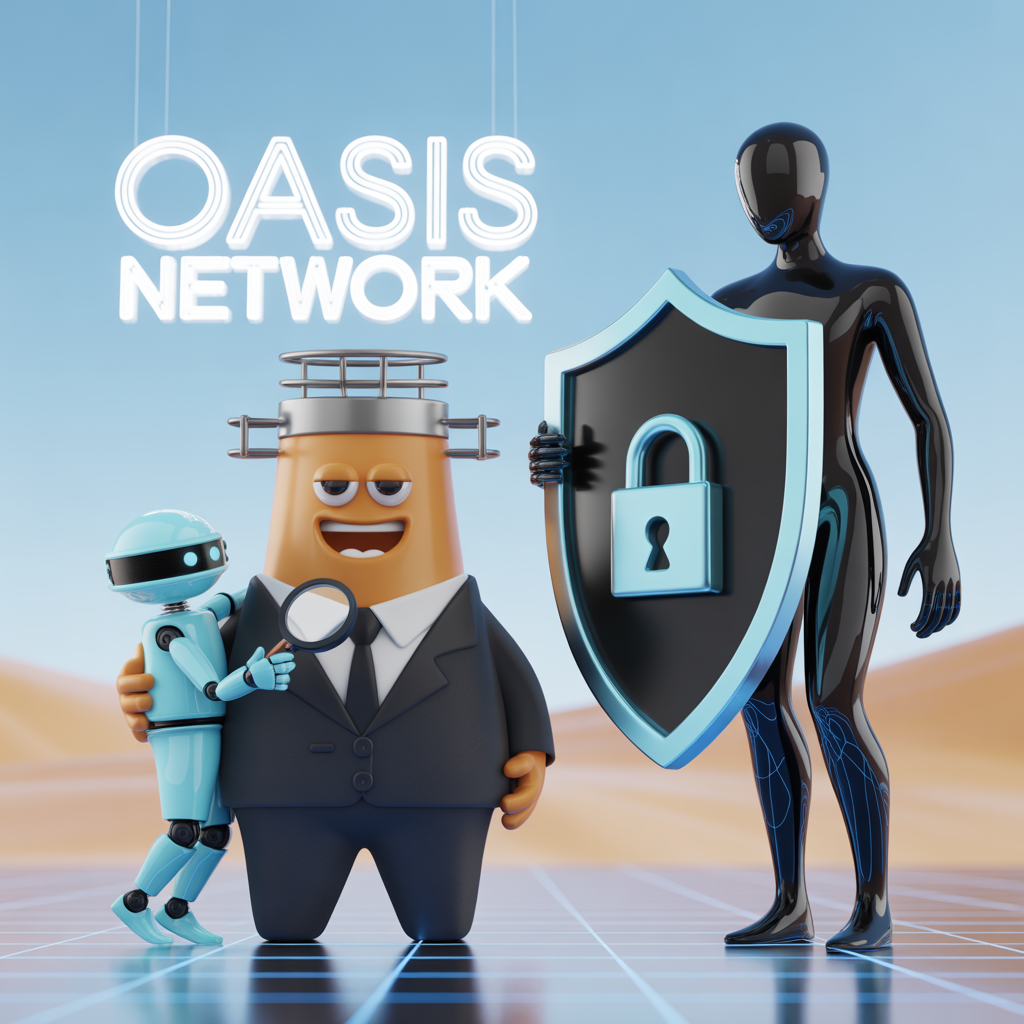
The Weirdest Love Triangle: Oil, AI and… Privacy?
--
Bear with me and let’s imagine this scenario: you’re an oil and gas company. You’ve been extracting fossils, filling certifications for decades, and everything has been working great. Your spreadsheets are trusted because YOU filled them out, your measurements are valid because YOU took them, your sustainability claims are solid because…well, YOU said so.
And then, the world has the audacity to ask for proof. And we are not talking about the “trust me bro” kind of proof.
They are asking for cryptographic proof, meaning that every methane molecule needs to be tracked. They want to know exactly where your data came from, how it was processed, and whether it’s been touched by human hands (which, let’s be honest, means it’s been lied about).
They want you to prove you’re being honest about your environmental impact using the same technology that blockchain bros use to pretend their JPEGs are worth millions.
Welcome to 2026. Where even oil companies need a privacy lawyer.
Why This Awkward Collaboration Exists
Something we need to be aware of, is the fact that the oil and gas industry has a credibility problem.
And we are not accusing anyone of lying. I mean…not this time. And this happens mostly because we’ve given them zero incentive to tell the truth, and every incentive to scramble the numbers.
A company reports methane emissions? Great. But how do we know?
- Did they measure it themselves? (Conflict of interest.)
- Did they hire someone to measure it? (Still their employee.)
- Is there an actual, verifiable chain of custody? (Lol, no.)
The certification systems exist, and it’s full of acronyms to make your head spin. But here’s the kicker: a company could get certified under one standard and… operate differently under another. Nobody’s watching. Nobody’s really verifying anything.
So when sustainability advocates and buyers started demanding actual proof, the oil and gas industry faced an existential question:
Do we build a system of transparency and accountability… or do we find the most complicated, expensive technology possible to make it LOOK like we have?
Obviously, they chose option two. And somehow this actually created something useful.
Sugar, Spice and Everything Nice
Three companies walk into a blockchain and the solution is weird enough that it might actually work.
CleanConnect.ai came to the table with some really good questions: how do you verify methane emissions in real-time? How do you make sure the data coming from oil and gas operations is actually real and not just numbers someone typed into a spreadsheet at 4pm on a Friday?
They built ProveZero, which is a multi-certification platform that can generate tokenized environmental data, verified across every major standard simultaneously. Imagine having one single chain of custody for all your certifications instead of seven different documents nobody trusts.
Diode on the other hand came with the networking layer. They specialize in zero trust technology, which is basically that “paranoid” system that assumes nothing is trustworthy, unless it can be cryptographically proven. It’s the messenger service that never, ever assumes the message is what it says it is.
And the missing piece that tied everything together was a superpower: privacy-preserving blockchain.
Quiet Luxury
Let’s talk about the privacy part, because it’s the least sexy and most important thing happening here.
Oil and gas companies have production methods. Vendor relationships. Operational details. For their competitors it would be ideal obviously, but they can’t simply drop everything they have on a public blockchain.
But they also can’t keep it private, because then nobody believes the data.
This is the fundamental tension: How do you prove something is real without revealing how you actually did it?
Most blockchains would tell you it’s impossible, as they think that transparency is the whole point.
Oasis is different, and let’s break it down and see how they managed to do it. Oasis runs code inside TEEs, which are isolated spaces where data can be processed without anyone seeing what’s actually happening. The output is verifiable and the process is private.
So when Diode routes CleanConnect.ai’s production data through its zero-trust network to Oasis, the data gets verified, computation gets audited, and the results are public and cryptographically proven.
Here’s how you make everyone happy and get the well deserved “happy ever after”: oil companies get their privacy, sustainability advocates get their transparency and the system works because it treats both as non-negotiable.
Without Oasis, this collaboration would be impossible. You’d either have:
- Public everything (oil companies laugh and leave the table)
- Private everything (nobody believes anything)
- A compromised middle ground that satisfies nobody (which is what we had before)
But when Oasis joined the table, they unlocked verifiable privacy and the ability of proving honesty without exposing any sensitive data.
It’s the infrastructure nobody thinks about until you realize the entire collaboration collapses without it.
The Non-Marketing Version Of What This Means
So these three companies built a system. What does it actually do?
CleanConnect.ai generates the data. Using AI, they monitor methane emissions, certification compliance, production metrics in real-time.
Diode secures the transmission. This data doesn’t just float around the internet like gossip spreading rumors. It travels through a zero-trust network where it has to prove it is what it says it is. The network treats everything with suspicion until proven otherwise.
Oasis anchors the proof. The data lands on Oasis’s privacy-preserving blockchain. It’s immutable, auditable, cryptographically verified, and nobody had to see the methods that generated it.
And the result? RWAs that are actually real.
For sustainability advocates, this is revolutionary. You can finally trust the data without having to audit every operation yourself.
For oil companies, this is … well, it’s honesty with a privacy policy. Which is somehow better than what we had before.
The Irony
We’ve now created a system so technologically advanced, so cryptographically secure, so blockchain-verified, that we can finally trust oil companies to tell us the truth about their environmental impact.
All it took was:
- AI to measure reality
- Blockchain to verify the measurement
- Privacy technology to protect the secret “ingredients”
- Zero-trust networking to secure the transmission
- Three companies collaborating on infrastructure
The irony is so thick you could mine it.
It’s the most expensive, most complicated, most technologically sophisticated way to say: “What if we just… didn’t lie about the environmental impact?”
But, it is what it is. Because apparently, transparency requires cryptographic proof in 2026.
Ready for the twist? Cause this is where it gets almost beautiful, in a dark way: this system works because it’s unforgeable.
You can’t fake the data, can’t edit the blockchain, can’t claim different numbers next month. The cryptographic proof is permanent.
For an industry built on trusting people to do the right thing without verification, suddenly being unable to lie is revolutionary.
What Now?
The collaboration between Diode, CleanConnect.ai, and Oasis isn’t just a proof-of-concept anymore. It’s live and operational. Companies are actually using this system to generate verifiable environmental certificates.
Also, Oasis proved something fundamental: privacy and transparency aren’t enemies. You can and should have both.
This is the infrastructure for a future where every claim, every metric, every “we’re sustainable” statement is actually verifiable.
Welcome to the future, where even oil companies need cryptographic proof to get anyone to believe them.
We now have a system where trust is mechanical, not aspirational. Sustainability is verified, not marketed.
And weirdly enough, this is progress, my fren.