The U.S Just Made Bitcoin a Reserve Asset. Here’s What it Means for Every Country that Hasn’t.
The geopolitical arms race for digital gold has already begun. Most governments just don’t know they’re losing.
 Abid S6 min read·Just now
--
A few years ago, we were told that Bitcoin wasn’t real money. Now, a sitting U.S. president put it in the national treasury.
That sentence alone is fascinating. It changes the entire geopolitical idea of what money is, who controls it, and which countries will be left behind.
So let’s unpack everything.
As someone who’s been watching Bitcoin and crypto since 2019, I remember when viral videos were going around like “Crypto: The World’s Greatest Scam”.
Those videos got millions of views, but alot of the people who made them are very quiet now.
Here’s why they missed the point.
Bitcoin has a hard cap of 21 million coins, with no CEO that can dilute your shares, and no government that can print more of it. Not even Bitcoin’s inventor, assuming he’s still alive, can force a change in the code unless the majority of Bitcoin’s network agrees to it.
That is the whole point of Bitcoin, not just a special feature.
People who understood that were not surprised when Bitcoin became a reserve asset. They were just waiting for everyone else to catch up.
Countries may be later than tech nerds in adopting Bitcoin, but they almost certainly will be ahead of the masses of boomers and NPCs.
So what does a Bitcoin reserve actually do for a country?
Well the U.S. national debt currently sits at over $38 trillion, and in 2024, it was climbing by about $1 trillion every 100 days. Anything that can help the country pay off the debt would strengthen its financial position.
To fight off larger amounts of debt, a strategy is to hold on to assets that gain in value faster than new money is being printed.
So again, it is not surprising that the government chose an asset that has outperformed every major currency, commodity, and stock index over the last decade.
The fixed supply of Bitcoin also makes it scarcer than gold. There are only 21 million coins, compared to gold reserves that grow by roughly 3 300 tonnes per year as new deposits are mined.
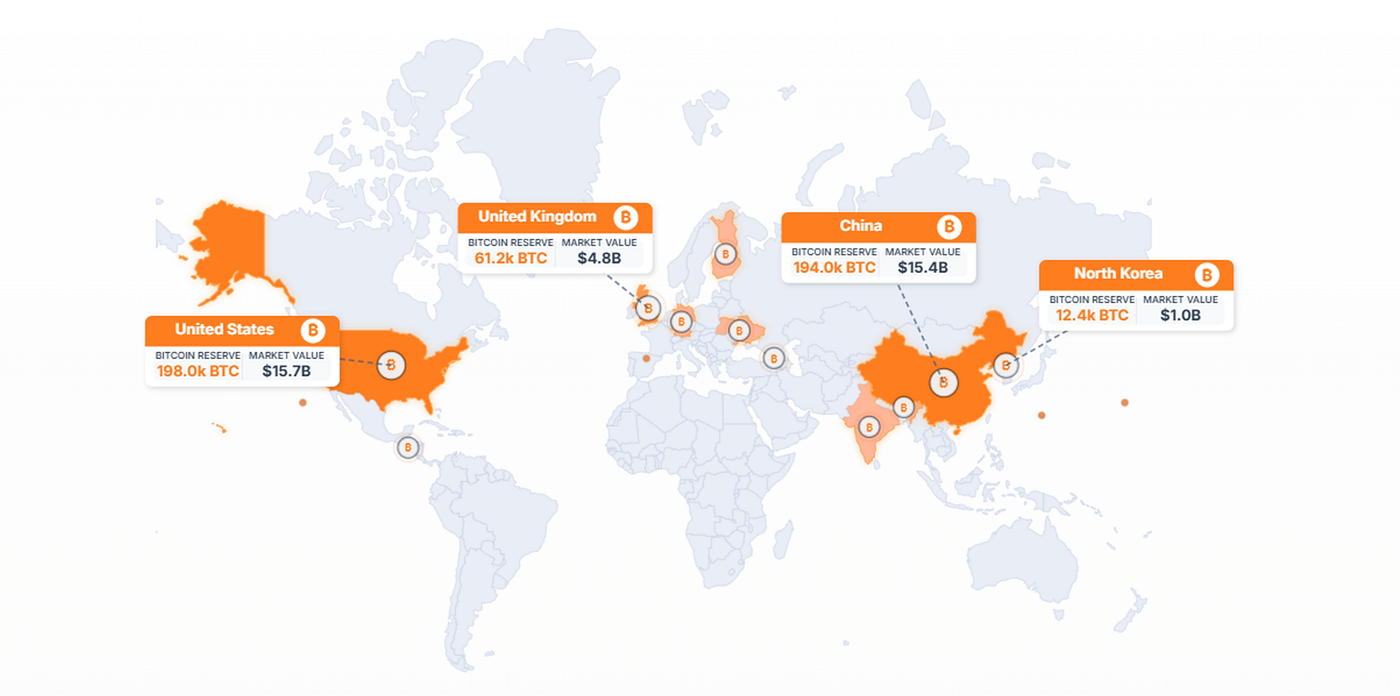
The U.S. Bitcoin Reserve which was established in early 2025, currently holds about 207 000 BTC, worth around $16 billion.
The government has committed to a no-sell policy. These coins are being treated as a long-term store of value, not a trading position.
That policy decision is actually more important than the purchase itself. It signals to every other country on earth that the world’s reserve currency issuer is treating Bitcoin like a sovereign asset, not a speculative bet.
So now we know that the race has already started, the question in geopolitics is “Which countries are moving, and how fast?”
Well the most aggressive mover is actually El Salvador, which holds more than 7 500 Bitcoin worth around $600 million, and has made over a 100% profit on its initial purchases.
They also have a legendary policy of buying 1 Bitcoin every day. This is called dollar cost averaging, where you buy a specific amount every day, week, or month, no matter the price.
Even though El Salvador is a small country, they are showing great discipline and a head start to this race.
However, if more countries start buying and holding Bitcoin, the price can go up more, which gives them less opportunities to profit.
So being one of the first to adopt Bitcoin as a reserve asset is a great strategic move, while not adopting it can leave you far behind.
China, another big player, owns around 194 000 BTC, a little less than the United states. This includes assets seized from the PlusToken Ponzi scheme, one of the biggest crypto frauds at $2 billion.
China also used to be the capital for Bitcoin mining, producing about 65% of the world’s mining capacity back in 2021. In September of that year, they declared crypto and mining illegal however.
Now in 2026 they have returned as a powerful figure in the mining space, with about 14% to 20% of global hashrate.
Now China is enforcing the ban less strictly. It is mining Bitcoin, seizing it and holding.
The United Kingdom holds about 61 000 BTC, mainly from criminal asset seizures, not reserve policy. They have a head start that they didn’t really intend.
There are other countries completely operating in the shadows.
Bhutan has been quietly mining Bitcoin using hydroelectric power since at least 2019 and now holds over 13,000 BTC. Remarkable for a country with a GDP of around only $3 billion.
Russia holds an estimated 16% of global mining dominance and has lawmakers actively pushing for a formal Bitcoin reserve as a tool to bypass Western sanctions.
Ethiopia, Paraguay, and the UAE are all expanding mining infrastructure without making formal reserve announcements.
While this is happening, Brazil has introduced a bill this year to establish its own reserve, and the Czech Republic is considering a 5% allocation for its central bank. This is completely new in the EU.
There seems to be an “arms race” going on where nations are accumulating their wealth in digital assets like crypto before more price discovery.
So who’s going to win this?
Right now it seems that the U.S. is in the lead with the holdings that they declared.
However, China has just come back into the game with significantly less national debt, an economy directed by the state, and mining tech that allows them to recieve Bitcoin before it even hits the market.
Russia’s game is a bit different but very strategic. Sanctions have cut it off from the dollar based systems. It does not see a Bitcoin reserve as a political tool, but a financial system that cannot be touched by any restriction.
Russian lawmakers are suggesting a formal Bitcoin reserve to counter sanctions and inflation, even though they already hold about 16% of mining capacity.
The more interesting story may be the smaller countries.
If Bitcoin reaches $500,000 by 2030, El Salvador’s reserve would be worth about $3 billion on an economy of $34 billion.
That would be a legendary transformation to say the least.
Now what will happen to the countries that join later? They will probably pay a much higher price. The may also lose money instead of profiting at all.
The pattern in geopolitics is always the same. The early movers write the rules, and the late movers pay them.
We saw it with oil. We saw it with nuclear capability. We saw it with semiconductors.
Bitcoin is the newest version of that story. The arms race is already three years old.
How do you think the movie plays out by 2030? Let me know in the comments.