
I’ve been observing the fintech market over the past few years and keep seeing the same pattern: companies invest heavily in acquisition but consistently underdeliver on retention. Push campaigns, promo banners, complex bonus mechanics — these are mostly forms of external pressure on the user. At the same time, they have little impact on what actually matters: the intrinsic motivation to stay in the product. Sustainable retention emerges when every user action delivers immediate, tangible value.
Crypto cashback operates precisely on that level: no deferred promises or complicated conditions, just a direct link between a transaction and a reward. Spending becomes a way to accumulate assets, creating a natural loop of repeated behavior without additional marketing stimulus. This is supported by data from Memento Research: in 2025, MAU for crypto cards reached ~40K, signaling a shift from one-off experimentation to regular usage. When economic incentives are embedded into the product, the very logic of user transaction behavior begins to change.
Why I Think Crypto Cashback Rewires User Retention
Daily category selection for cashback at first glance looks like a simple UX feature — something like “set it once and forget it.” But if you look deeper, it’s no longer about configuration, but about a daily micro-ritual. The product pushes the user to regularly answer a simple question: where is my advantage today. And this is exactly where cashback stops being a passive bonus and starts functioning as a behavioral trigger.
This is a classic behavioral loop in action, just in a very applied form. What Richard Thaler and Cass Sunstein wrote about in the context of nudge theory shows up here in a very literal way: small, repeated decisions gradually shape a stable behavior pattern. The user is not making one big financial decision — they are slightly reconfiguring their consumption model every day. And each of these choices quietly reinforces the habit of returning to the product.
As a result, the very logic of interacting with cashback changes. It’s no longer “I get something back,” but rather “I’m continuously optimizing my benefit in real time.” A sense of control emerges, along with a light strategic layer — as if the user is playing a short but ongoing game with their spending. And once the product fits into this behavioral frame, external reminders become less important: returning to the app starts happening as part of an internal financial routine.
From My Perspective, This Isn’t a Cashback Percentage Competition at All
Before breaking down the cards, it’s important to establish a basic point: on a formal level, they all solve the same core need — enabling users to spend crypto in the real world. But at the level of product design, these are fundamentally different approaches to how users are kept inside the ecosystem. And in reality, what matters here is not the cashback percentage itself, but how organically the product fits into a user’s daily behavior.
Moreover, if you look at the key market players, it becomes clear that the same objective — retention — is achieved through completely different mechanics. And it’s the depth of integration into the user’s routine, rather than a “number on a banner,” that determines long-term value.
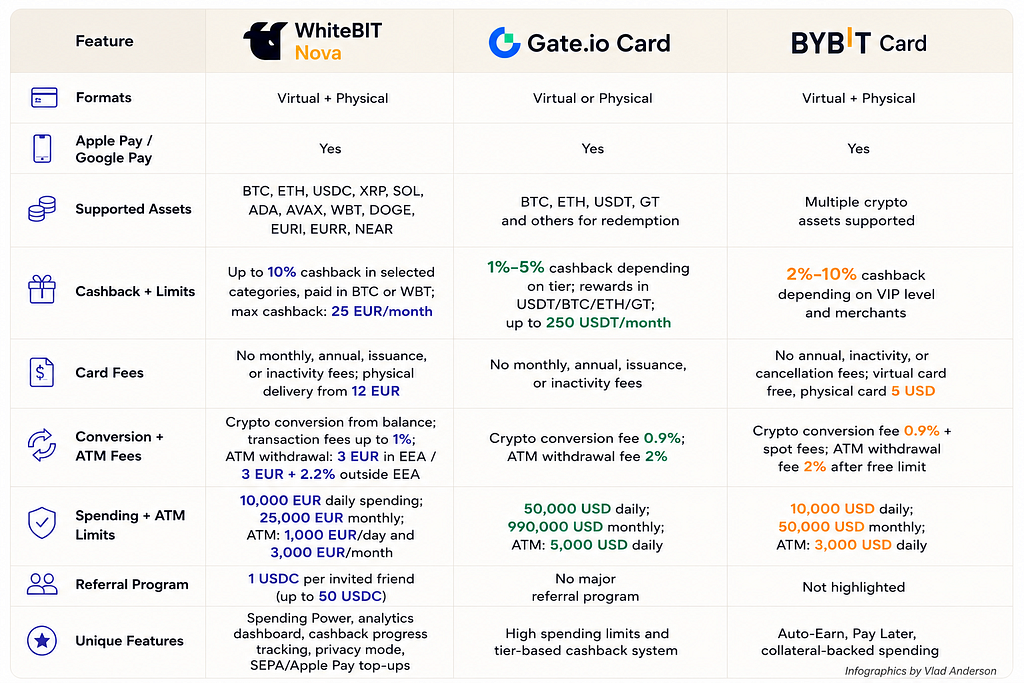
- Gate Card operates on a classic tier-based model. The logic is simple: the more you spend or the higher your VIP level, the more you receive. Cashback in the 1–5% range feels clear and predictable. But the key isn’t the numbers — it’s the architecture of constraints: monthly limits, caps, point systems, and VIP status dependencies. The user essentially moves along a predefined trajectory. This provides stability, but at the same time makes the interaction fairly “formal” — you’re not so much engaging with the product as you are following its rules.
- Bybit Card builds a different model — more dynamic and less predictable. Cashback here floats between 2–10% depending on VIP level, and on top of that there are merchant campaigns where rewards can spike significantly, sometimes even up to full reimbursement on specific transactions. This is no longer about stability, but about constant incentives and “value peaks.” The user is effectively in a continuous comparison mode: where to make a transaction right now to get the maximum benefit. And it’s this variability that keeps engagement high.
- WhiteBIT Nova works differently. There’s no rigid dependence on VIP hierarchies or one-off promotions as the main driver. The core mechanism is a daily choice of spending categories. The user decides where their cashback applies today: transport, subscriptions, entertainment, etc. This shifts the focus from “receiving rewards” to a daily calibration of personal financial behavior. In essence, cashback stops being a bonus or a status perk and becomes a tool for everyday spending optimization.
If you put it all together, the difference is not in cashback size, but in how each product drives user return. Gate retains users through structure and hierarchy. Bybit through variability and bonus-driven scenarios. WhiteBIT Nova through daily interaction that gradually turns into a habit.
Final Thought
What I keep coming back to is how quietly the meaning of “reward” is changing here. When cashback lands in BTC, it doesn’t really feel like you’ve been given something back — it feels more like you’ve accidentally started saving, one transaction at a time. Nobody thinks of a coffee or a ride as an investment decision, but over weeks and months that’s exactly what it turns into: a slow build-up of an asset you never actively scheduled into your life.
And maybe that’s why this model sticks. Not because it’s more generous or more complex, but because it slips into behavior without asking for extra attention. You stop evaluating cards by what they return and start noticing what your spending turns into. From where I sit, that’s the real line of separation now — between products that reward spending, and products that quietly reshape what spending even means in the first place.
Disclaimer: This is not financial or investment advice. Do your own research before making any decisions. Use at your own risk.
The Real Reason Crypto Cards Keep You Coming Back Daily was originally published in Coinmonks on Medium, where people are continuing the conversation by highlighting and responding to this story.