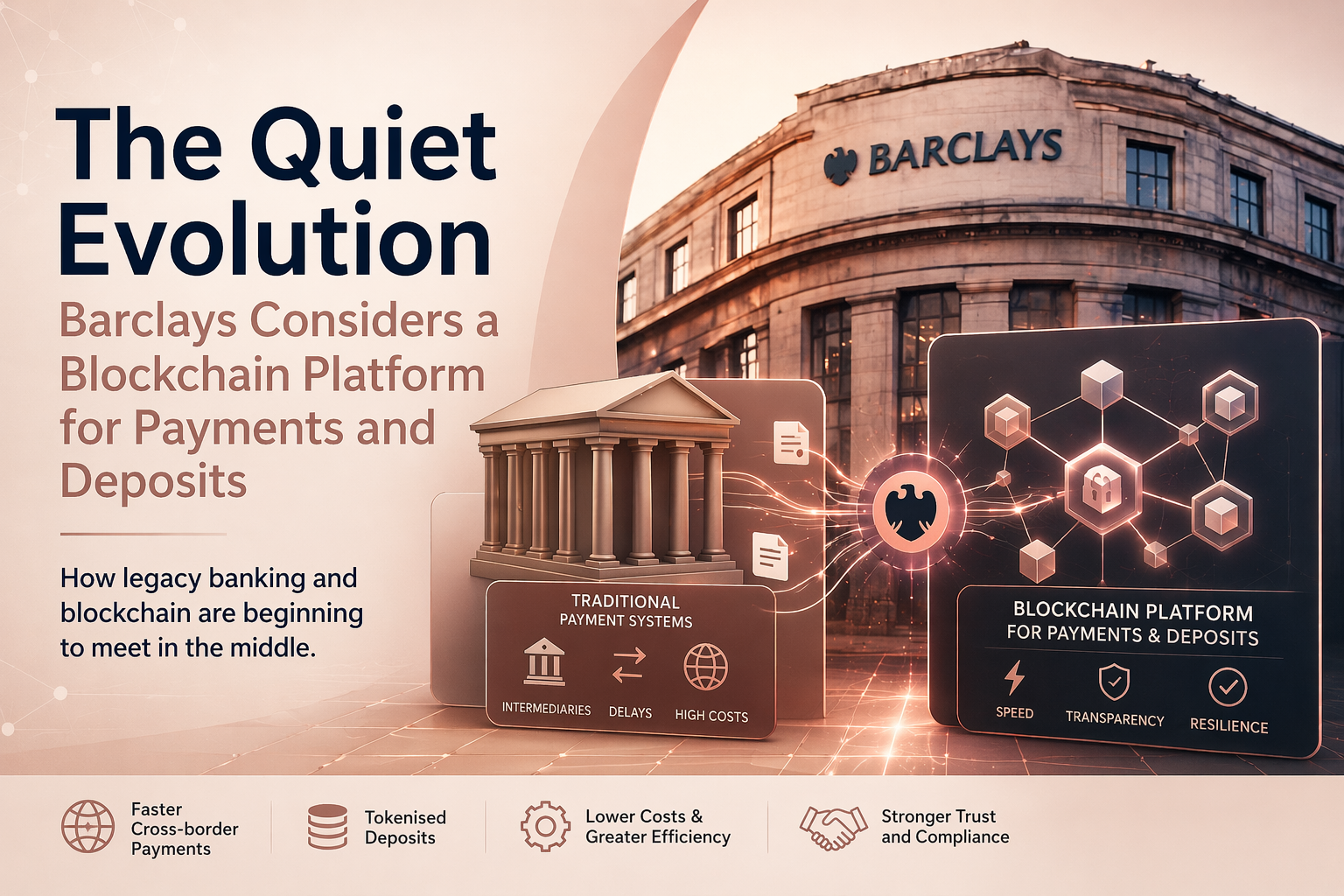
The Quiet Evolution: Barclays Considers a Blockchain Platform for Payments and Deposits
How legacy banking and blockchain are beginning to meet in the middle.
 Idea Drift5 min read·Just now
--
I still remember the frustration. It was a month in 2023. A small business owner, I waited three days for a cross-border payment to clear. The supplier in Europe needed funds urgently to ship materials. Traditional banking rails. With their many intermediaries, delays and high fees. Turned a simple transfer into a source of anxiety and lost opportunity.
That delay was not unusual. It was the norm in a system built for an era.
Fast forward to 2026. News emerged that Barclays, one of the UK’s banks, is exploring its own blockchain-based platform for payments and deposits. The bank sent requests for information to technology providers. They might select a vendor as early as April. Reports suggest the platform could support payments and tokenised deposits.
This is not a story of disruption or revolutionary overnight change. It is about why a major bank like Barclays is quietly assessing blockchain for core banking functions. The persistent problems in today’s payment systems, the cautious promise of money, and what this might mean for speed, transparency and resilience in everyday finance.
Why This Development Caught My Attention
Living in India, I have seen how UPI has transformed payments into near-instant experiences. Cross-border and institutional flows are often still slow and expensive. When I read about Barclays issuing RFIs to tech providers for a blockchain platform, it felt like another sign of finance cautiously bridging toward digital asset infrastructure.
The Real Problem Traditional Payments and Deposits Still Face
Despite decades of progress, many core banking processes remain surprisingly inefficient. Cross-border payments can take days, involve correspondent banks, and incur significant fees and FX costs. Reconciliation between systems is often manual or semi-automated. This creates delays and error risks. Deposits sit in accounts earning yields while liquidity remains fragmented.
For businesses, these frictions tie up working capital. Limit agility. Tokenised deposits and stablecoins promise money. Funds that can carry conditions settle near-instantly on-chain and interact seamlessly with smart contracts. But integrating them into infrastructure is complex.
The Big Picture: What a Blockchain Platform for Payments and Deposits Could Mean
A blockchain-based platform would use distributed ledger technology to record and settle transactions in a transparent, potentially faster manner. By relying on centralised databases and batch processing, it could enable near-real-time settlement with immutable records.
Possible features include support for payments and tokenised deposits. This could reduce intermediaries, lower costs for flows and enable new use cases like conditional payments or automated treasury management.
My Reflections Following the News: Optimism and Lingering Questions
When the reports surfaced in late February 2026, I felt a mix of hope and realism. Hope that faster efficient settlement could benefit businesses everywhere. Realism because banks move deliberately for a reason. Regulatory compliance, customer protection and systemic stability cannot be compromised.
Key Insights and Practical Lessons
Several observations emerge from watching institutions explore these technologies.
- Efficiency gains come from reducing intermediaries and batch processing.
- Tokenisation adds programmability.
- Interoperability will determine success.
Practical takeaways for businesses and observers:
- Monitor how tokenised assets perform in pilots before committing capital.
- Focus on use cases with pain points, such as cross-border payments or collateral management.
- Prioritise solutions that maintain compliance and audit trails.
Benefits and Outcomes
If implemented thoughtfully, such a platform could deliver settlement, reduced operational costs and improved liquidity management. Businesses might see access to funds, lower FX friction in certain corridors and new tools for automated finance.
Challenges and Realities
The path is far from straightforward. Regulatory uncertainty around stablecoins and tokenised deposits varies by jurisdiction. Technical integration with decades-old core systems carries execution risk. Security remains paramount. Any vulnerability in a payment platform could have consequences.
Decision-Making Under Uncertainty
Barclays cautious approach. Issuing RFIs while keeping details reflects strategic thinking in uncertain times. Leaders must balance pressure to innovate with the need for robust risk management and regulatory alignment.
Real Use Cases
In trade finance, tokenised deposits could enable collateral movement or conditional payments upon shipment milestones. Corporate treasurers might use stablecoins for cross-border liquidity management with reduced settlement risk.
Advice for Readers
If you work in finance, payments, or international trade, follow developments like Barclays exploration with curiosity rather than hype. Assess your pain points. Where do delays or costs hurt most?. And evaluate whether emerging technologies address them meaningfully.
Whats Next
The project remains at this stage. Barclays could select technology partners soon. Full deployment would take time and careful testing. Broader industry trends point toward continued experimentation with assets, stablecoins and hybrid on-chain/off-chain models.
The Measured Path Toward Smarter Money Movement
As I think about Barclays’ reported exploration, I feel a little hopeful. Traditional banks are not going to get rid of proven systems. They are figuring out how distributed ledger technology can make functions like payments and deposits stronger without risking safety or compliance.
- In a world where money needs to move to keep up with global trade innovations, like tokenised deposits and stablecoin integration, these are small but important steps.
- They use the strengths of existing infrastructure. Fix long-standing problems.
For businesses in places like Uttar Pradesh or big companies anywhere, the real value will be in actual results: faster settlements, lower costs where it matters and greater reliability.
The journey from RFI to live platform is long. Each careful step helps create a financial system that slowly becomes more responsive to users’ needs.
The internet showed us that connectivity changes everything.
In finance, the next chapter might be about making money itself more connected, programmable and efficient. While keeping the trust that has always been its foundation.
Barclays’ quiet assessment is part of that change, reminding us that meaningful change in banking often starts with careful questions rather than bold statements.
If this reflection on Barclays exploration of blockchain for payments and deposits made you think, I’d love to hear your experiences in the comments.
Have you had problems with -border payments or treasury operations?
What potential do you see in deposits or stablecoins for real-world use?
- Please applaud if the piece gave you perspective or clarity. It helps more readers find grounded discussions on the evolution of financial infrastructure.
- Follow for thoughtful explorations at the intersection of banking, technology and practical finance.
I’m always open to conversations and potential collaborations with writers or professionals who have insights into payments, blockchain or digital assets.
Feel free to reach out.
Thank you for reading.
In a financial world, taking time to understand small changes, like this, helps us all navigate change more wisely.