Energy, geopolitics, and the quiet battle between the United States and China for the resources of the Western Hemisphere
For most of the last two decades, the world’s geopolitical attention focused on the Middle East, Eastern Europe, and the South China Sea.
But something is changing.
A quiet shift is taking place across the Western Hemisphere, and the implications could shape global energy markets, geopolitical alliances, and economic growth for decades.
Latin America is moving back into the spotlight. Not because of ideology. Not because of politics. But because of energy, geography, and resources.
Oil discoveries, mineral reserves, and global supply chain pressures are turning Latin America into one of the most strategically important regions in the world.
Major global powers have noticed.
The United States is re-engaging across the hemisphere.
China continues expanding trade and infrastructure investment.
Europe is looking for alternative energy partners.
Meanwhile, new oil discoveries are transforming countries that only recently played a minor role in global energy markets.
The region is entering a moment that many analysts believe could redefine its place in the global economy.
And at the center of it all is one commodity that has shaped world politics for more than a century.
Oil.
Latin America Between Giants
Living or doing business in Latin America often creates a unique perspective on global power dynamics.
You can feel the presence of the giants.
To the north sits the United States, the dominant economic and military power in the hemisphere.
Across the Pacific, China has emerged as an enormous economic partner for many Latin American countries.
Trade between China and Latin America has exploded over the past twenty years, fueled largely by commodities, infrastructure development, and energy cooperation.
- Brazil exports agricultural products and iron ore to China.
- Chile exports copper.
- Peru exports minerals.
- Venezuela exports oil.
China now ranks as the largest trading partner for several South American economies.
At the same time, the United States continues to dominate in financial markets, investment flows, technology partnerships, and security cooperation across the region.
For Latin American governments, businesses, and investors, this creates a delicate balancing act.
The region sits between two global giants whose strategic interests are increasingly overlapping.
But there is one factor that makes this competition far more intense than before.
Energy…….
Oil Is Back at the Center of Global Strategy
For years, many analysts believed that renewable energy would gradually reduce the strategic importance of oil.
But recent global events have reminded policymakers of something fundamental.
Oil still matters.
A lot.
Global demand remains high.
Emerging markets continue expanding energy consumption.
And geopolitical disruptions can send oil prices soaring almost overnight.
When instability threatens major supply routes or producing regions, global markets immediately look for alternative sources.
This is exactly what is happening today.
Energy security has returned to the center of global strategy.
And Latin America is becoming one of the most important places on the map.
Venezuela: The World’s Largest Oil Reserves
At the heart of the region’s energy story sits Venezuela.
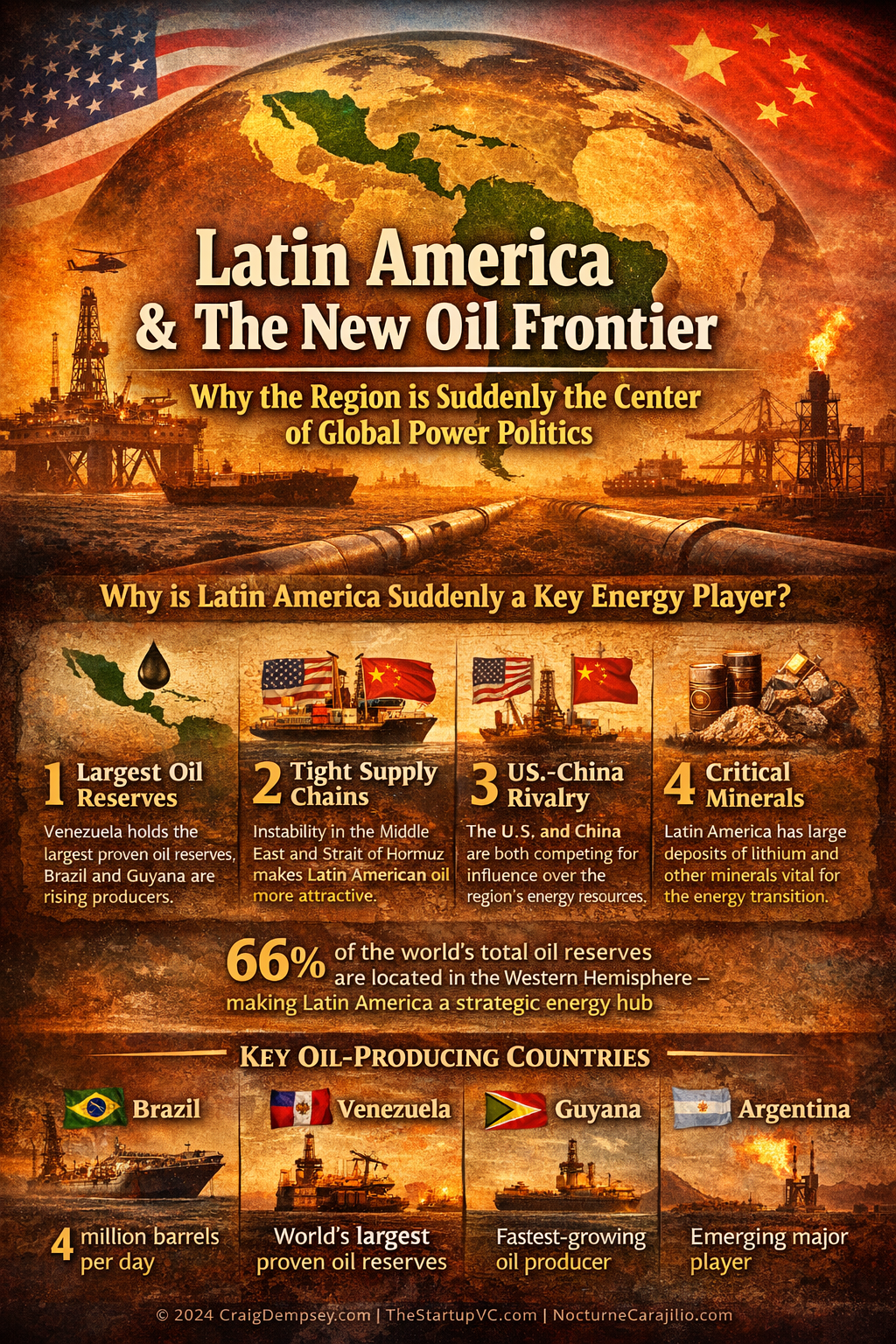
The country holds the largest proven oil reserves on Earth.
For decades, Venezuela’s oil industry struggled under political turmoil, sanctions, and lack of investment.
Production collapsed dramatically from its peak levels.
But the country’s geological potential never disappeared.
Today, international energy companies are once again looking at Venezuela with renewed interest.
Large reserves remain untapped.
Infrastructure can be rebuilt.
And global demand for oil continues to grow.
For global powers, Venezuela represents one of the largest potential energy prizes in the world.
For Latin America, it represents both opportunity and geopolitical complexity.
Brazil: A Stable Energy Giant
While Venezuela has the largest reserves, Brazil may be the region’s most powerful energy player.
Over the past decade, Brazil has transformed itself into one of the world’s major oil producers.
Massive offshore discoveries in Brazil’s pre-salt fields have unlocked enormous new reserves beneath the Atlantic Ocean.
These fields require sophisticated technology to develop, but the rewards are immense.
Brazil now produces millions of barrels of oil per day and continues expanding production.
Unlike many oil-producing nations, Brazil also offers political stability, advanced engineering capabilities, and access to international financial markets.
This combination makes Brazil one of the most attractive energy investment destinations in the world.
Guyana: The Oil Discovery That Changed Everything
Perhaps the most remarkable energy story in Latin America is unfolding in Guyana.
Just a decade ago, Guyana was one of South America’s smallest and poorest economies.
Then oil was discovered offshore.
Not just a little oil.
Massive reserves.
Production began in 2019 and has expanded at an extraordinary pace.
New projects are expected to increase output dramatically over the coming years.
Guyana’s economy is transforming almost overnight.
GDP growth has surged.
Infrastructure projects are accelerating.
And global energy companies are investing billions of dollars in offshore development.
For a country that once sat quietly on the geopolitical sidelines, Guyana has suddenly become a strategic energy hub.
China’s Expanding Influence
China’s growing presence in Latin America is one of the defining economic trends of the past twenty years.
Chinese companies have invested heavily across the region in sectors such as:
- Energy
- Mining
- Infrastructure
- Transportation
- Agriculture
Chinese banks have financed large infrastructure projects including ports, railways, power plants, and industrial facilities.
From Beijing’s perspective, Latin America offers several strategic advantages.
First, the region provides reliable access to commodities and energy resources.
Second, it allows China to diversify supply chains away from politically sensitive regions.
Third, it strengthens China’s diplomatic relationships across the developing world.
China’s approach has often been quiet and pragmatic.
Rather than military expansion, Beijing focuses primarily on trade, finance, and infrastructure partnerships.
But the scale of these investments has significantly increased China’s influence across the region.
The United States Reengages
For much of the early twenty-first century, the United States focused its geopolitical attention elsewhere.
Conflicts in the Middle East, rising tensions with Russia, and strategic competition in Asia drew attention away from the Western Hemisphere.
That is changing.
Washington has begun re-engaging across Latin America with renewed urgency.
Energy security is one reason.
Supply chains are another.
Limiting geopolitical rivals’ influence is a third.
The United States continues to maintain strong financial and institutional relationships across the region.
And as global competition intensifies, the Western Hemisphere is once again becoming a strategic priority.
Energy Transition and Oil Reality
It is true that the global energy system is gradually transitioning toward renewable sources.
Latin America actually leads the world in renewable energy generation in many ways.
Hydropower, solar energy, and wind power are expanding rapidly across the region.
Countries such as Chile, Brazil, and Uruguay have made enormous progress in renewable electricity.
But the transition away from oil will take decades.
Oil remains central to transportation, manufacturing, and global trade.
As a result, Latin America finds itself in a unique position.
It sits at the intersection of both the traditional energy economy and the emerging renewable energy economy.
Few regions in the world have this dual advantage.
Strategic Geography Still Matters
Energy geopolitics is not only about resources.
It is also about transportation routes.
Latin America occupies one of the most strategically important geographic positions in the world.
The Panama Canal connects the Atlantic and Pacific Oceans.
Major shipping routes cross the Caribbean and South Atlantic.
Energy exports from South America can reach North America, Europe, and Asia.
In a world increasingly shaped by supply chain security, geography matters more than ever.
Beyond Oil: The Lithium Triangle
While oil dominates many geopolitical discussions, Latin America holds another strategic resource that is reshaping global industry.
Lithium.
Lithium is essential for batteries used in electric vehicles, renewable energy storage, and modern electronics.
Three countries hold a large portion of the world’s lithium reserves:
Argentina
Chile
Bolivia
Together, these nations form what many analysts call the Lithium Triangle.
As electric vehicles and energy storage technologies expand, lithium demand is expected to surge dramatically.
This means Latin America is not only important for traditional energy resources like oil.
It is also critical for the future of clean energy technologies.
The Opportunity for Latin America
Periods of global competition can create enormous opportunities for regions rich in resources.
Latin America may be entering one of those periods.
Competition between major powers could drive investment in infrastructure, energy development, and industrial capacity.
Foreign capital could accelerate technological development.
New trade relationships could expand export markets.
But success is not automatic.
History has shown that resource wealth does not always translate into long-term prosperity.
Governments will need strong institutions, transparent policies, and long-term economic strategies to convert this opportunity into sustainable growth.
A Personal Perspective from the Region
Living and investing in Latin America provides a unique vantage point on these global trends.
The region’s potential is enormous.
Energy development, infrastructure investment, and economic modernization are creating opportunities across many sectors.
Entrepreneurs and investors are increasingly building companies that connect the region’s resources with global markets.
Projects ranging from energy services to hospitality and consumer brands are emerging across Latin America’s rapidly evolving economies.
If you are interested in exploring some of these ventures, you can learn more at:
- https://www.craigdempsey.com/
- https://www.thestartupvc.com/
- https://www.nocturnecarajillo.com/
- https://www.medicaltourismpackages.com/
Each reflects a different dimension of how entrepreneurship, investment, and regional growth intersect in today’s Latin American economy.
What the Next Decade Could Look Like
If current trends continue, Latin America’s global importance will increase dramatically over the next twenty years.
Several developments appear likely.
Oil production in Brazil and Guyana will continue expanding.
Venezuela could gradually rebuild its energy industry if political and investment conditions improve.
Renewable energy projects will accelerate across the region.
Demand for critical minerals such as lithium and copper will surge as electric vehicles and battery technologies expand.
At the same time, competition between global powers will likely intensify.
Latin America may increasingly find itself at the center of global economic strategy.
Why Latin America May Become the World’s Most Important Resource Region
The coming decades could mark a turning point.
Few regions combine so many strategic advantages:
- Energy reserves
- Agricultural production
- Critical minerals
- Young populations
- Strategic geography
- Growing economies
These advantages make Latin America one of the most important regions for the future of global energy and economic development.
The world is beginning to notice.
For those already living and investing here, the transformation is becoming impossible to ignore.
Latin America is no longer just a supplier of commodities.
It is becoming a central player in the future of global energy.
And the race to shape that future has already begun.
The Energy Map Is Being Redrawn: Where that leaves Latin America?
The world’s energy map is changing.
Old supply routes are under pressure.
New producers are emerging.
And global powers are quietly repositioning themselves for the next phase of the energy economy.
Latin America sits right in the middle of this transformation.
For investors, entrepreneurs, policymakers, and observers of global markets, the region is becoming impossible to ignore.
The giants are watching.
And increasingly, they are moving.
Frequently Asked Questions (FAQs)
Why is Latin America becoming more important in global energy markets?
Latin America holds large reserves of oil, natural gas, lithium, and other strategic minerals. New discoveries in countries like Guyana and Brazil are increasing the region’s importance to global energy supply.
Which Latin American countries produce the most oil?
Major oil producers in the region include Brazil, Venezuela, Mexico, and Colombia. Guyana is emerging as one of the fastest-growing oil producers in the world.
Why are the United States and China interested in Latin America?
Both countries want access to energy resources, minerals, and agricultural commodities. They are also interested in infrastructure development and trade partnerships across the region.
Will renewable energy reduce Latin America’s role in oil markets?
Not in the near future. Oil demand is expected to remain strong for decades while renewable energy gradually expands.
What is the Lithium Triangle?
The Lithium Triangle refers to Argentina, Chile, and Bolivia, which together hold some of the world’s largest lithium reserves used in electric vehicle batteries and energy storage systems.
#LatinAmerica #OilMarkets #EnergyGeopolitics #GlobalEnerg #OilIndustry #EnergyTransition #USChina #CommodityMarkets #OilInvesting #LatinAmericaEconomy #Geopolitics #EnergySecurity #Investing #GlobalTrade #CraigDempsey #TheStartupVC
The New Oil Frontier: Why Latin America Is Suddenly the Center of Global Power Politics was originally published in DataDrivenInvestor on Medium, where people are continuing the conversation by highlighting and responding to this story.