The New and Rise of DEX Interface and Liquidity: Cellframe DEX
--
Do you remember the first time you used a DEX?
Yes, it felt exciting at first — but also frustrating.
The interface was confusing.
Liquidity was thin, and every trade felt like a compromise.
Sometimes, on certain Web3 projects, I got poor pricing.
Other times, I just went back to centralized exchanges.
And then I started to wonder:
Are DEX platforms really meant for everyday traders?
Or are they still just tools for early adopters in the crypto and Web3 ecosystem?
For a long time, the answer felt obvious.
But recently, that assumption started to change.
When I explored Cellframe DEX more deeply, something felt different.
The interface looked familiar.
The order books were active.
The pricing moved in real time.
And for the first time, I had to pause and ask a new question:
What if a DEX could finally feel like a CEX… without giving up control?
CEX-Level Liquidity Inside a Decentralized Framework
With the latest upgrade, Cellframe DEX introduces a key development:
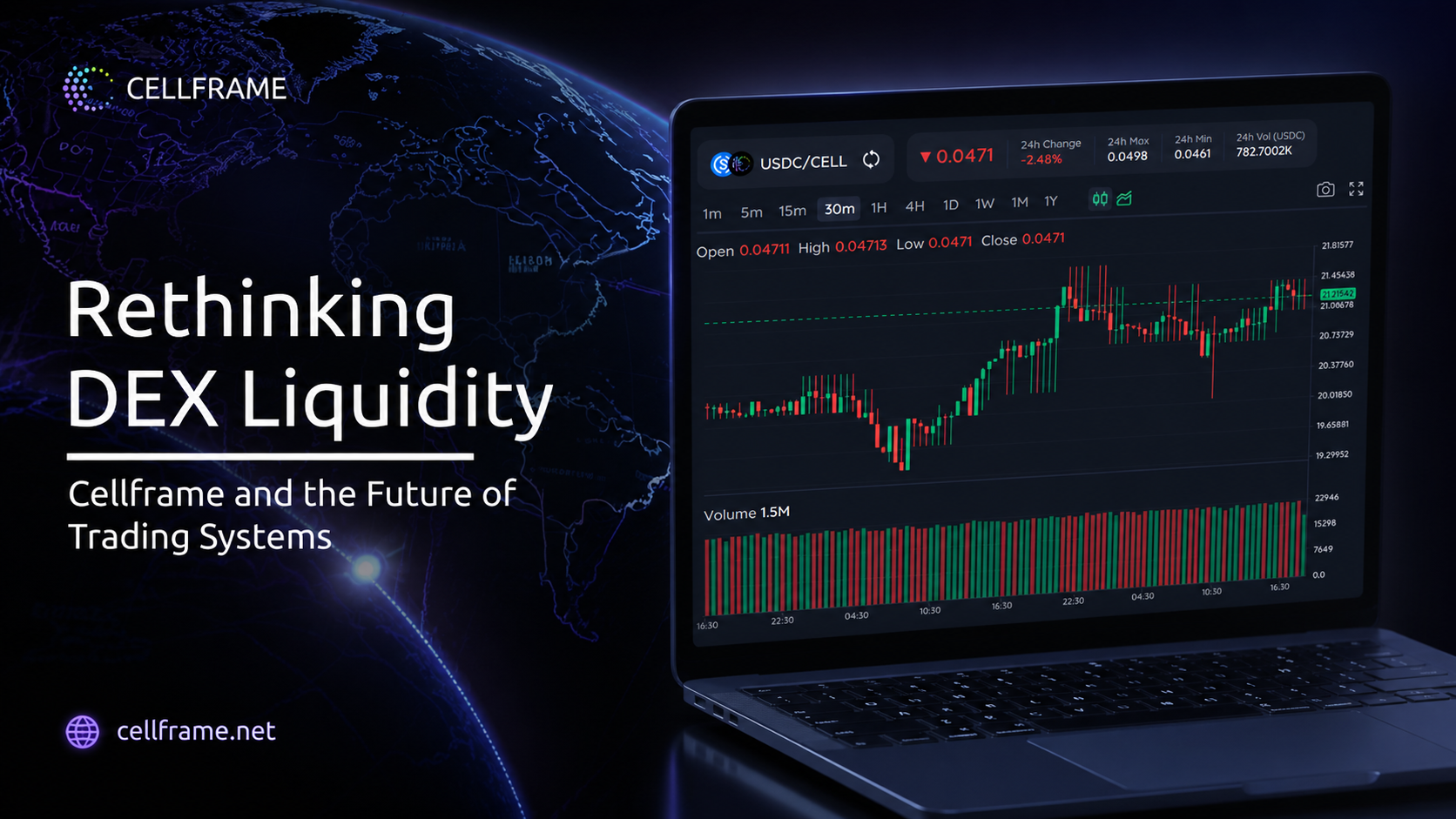
Order books are now synchronized with external trading venues.
This is not a minor technical adjustment — it fundamentally changes how liquidity is accessed within a decentralized environment.
Trading pairs such as:
- CELL/USDC
- KEL/USDC
are now operating with:
- Real-time market pricing
- Improved order book depth
- Reduced slippage under execution
For me, this is where it starts to feel different.
Not just another DEX with isolated liquidity — but something that actually connects to the real market.
Revisiting the Tradeoff: Control vs Efficiency
For a long time, I felt like I had to choose:
- Use a CEX → gain efficiency, lose custody
- Use a DEX → retain custody, sacrifice performance
What I started to notice is this: Cellframe DEX is trying to remove that tradeoff.
The platform now delivers:
- A familiar order book interface, comparable to centralized exchanges
- Minimal slippage, due to deeper liquidity integration
- Full transparency, inherent to decentralized systems
- And critically, self-custody of assets at all times
Which leads to a more important question:
What if efficiency no longer requires surrendering control?
Positioning the DEX Within the Cellframe Architecture
Before discussing security and long-term implications, it is important to understand that Cellframe is not designed merely as a trading platform.
Cellframe is positioned as a Layer-0 infrastructure, with a focus on:
- Cross-chain communication
- Post-quantum cryptography
- Scalable decentralized services
In its whitepaper direction, Cellframe does not aim to build a single application, but rather a multi-layered ecosystem where different services — data transfer, decentralized applications, and financial tools — can operate within the same secure framework.
Within this architecture, the DEX is not an isolated feature.
It functions as:
A liquidity and execution layer inside a broader decentralized infrastructure
This distinction matters.
Because the development of Cellframe DEX is not only about improving trading experience,
but about aligning trading mechanisms with a system that is designed for:
- interoperability
- resilience
- and long-term scalability
From this perspective, the DEX becomes part of a larger objective:
building a decentralized system that is not only usable, but structurally sustainable.
The Added Layer: Quantum-Safe Assurance
Beyond liquidity and interface, Cellframe introduces another dimension — quantum-safe architecture.
While most exchanges still rely on classical cryptographic assumptions, Cellframe integrates a forward-looking security model designed to anticipate future computational threats.
In this sense, the platform is not only addressing current limitations (liquidity and usability),
but also considering long-term resilience.
From Alternative to Viable Infrastructure
This is where I started to rethink something simple:
maybe this is not just another DEX upgrade.
It is a shift in positioning:
From:
Decentralized exchanges as alternatives
Toward:
Decentralized exchanges as competitive infrastructure
With CEX-level liquidity, real-time pricing, and self-custody preserved,
Cellframe DEX begins to challenge the assumption that traders must choose between performance and ownership.
Conclusion
Perhaps the real question is no longer whether DEX can compete with CEX.
But whether the foundational tradeoff that once separated them is starting to disappear.
If so, then this is not just an upgrade.
It might be an early signal that the structure itself is starting to change.
not only in how trading systems are designed,
but in how decentralization itself is implemented in practice.
Stay updated:
Official website: https://cellframe.net
Join the official Telegram: https://t.me/cellframe
$CELL
#Cellframe #DEX #QuantumSafe #Web3 #Layer0