The Month Crypto Converged: RWA, AI, and the Rewiring of Global Finance
 @Xmultiverse_org7 min read·Just now
--
April 2026 was not simply another cycle of conferences, summits, and ecosystem gatherings. It was a month in which the global crypto industry stopped behaving like a fragmented sector and began operating like a synchronized financial narrative system.
Across the United States, Europe, and Asia, more than 20–30 major events unfolded simultaneously — ranging from Bitcoin macro discussions in Las Vegas, to institutional finance restructuring in Paris, to tokenization and AI-driven financial system design in Hong Kong. On the surface, these were independent conferences. Structurally, they were not.
What defined April 2026 was convergence: not of companies or protocols, but of ideas, capital direction, and system design logic.
Five events anchored this global signal: Bitcoin 2026 in Las Vegas, Hong Kong Web3 Festival, Paris Blockchain Week, TEAMZ Summit Tokyo, and UN:BLOCK Riga. Each represented a different layer of the emerging financial stack — macro monetary assets, tokenized capital markets, institutional compliance systems, regulated enterprise adoption, and early-stage infrastructure experimentation.
But the defining characteristic of the month was not any individual event. It was the fact that all of them, regardless of geography or audience, began describing the same underlying transformation: the restructuring of global finance through blockchain, AI, and tokenized real-world assets.
Key Words from April 2026 Events — The Convergence Layer of Global Finance
Real-World Asset Tokenization (RWA): The Recomposition of Capital Markets
If there was a single dominant signal across April 2026, it was RWA — not as a narrative, but as an emerging financial architecture.
Across Hong Kong, Paris, and institutional panels embedded within Bitcoin 2026 discourse, tokenization was no longer discussed as a crypto-native experiment. It was framed as a mechanism for rebuilding capital markets from first principles.
The focus had shifted decisively toward structural migration: sovereign debt instruments, private credit markets, real estate exposure, and institutional fund structures were increasingly discussed as assets that would not simply be “represented on-chain,” but reissued in blockchain-native form.
In Hong Kong, this was expressed through discussions between global asset managers and Asian financial institutions around liquidity efficiency and cross-border capital access. In Paris, the same concept took a more institutional form — tokenization as a compliance-compatible extension of banking balance sheets under MiCA. In Bitcoin 2026, even indirect references through ETF flows and treasury allocation strategies reflected the same direction: capital is moving toward programmable infrastructure.
What emerges is not incremental innovation, but a deeper inversion: financial markets are no longer interfacing with blockchain systems — they are gradually being reconstructed by them.
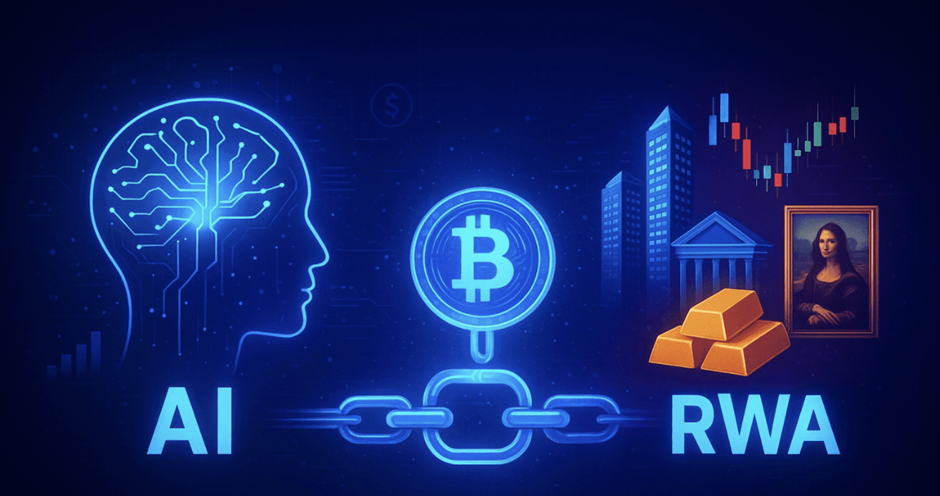
AI × Web3: The Emergence of Autonomous Financial Execution Systems
Artificial intelligence, across all major April events, underwent a critical narrative transformation. It was no longer positioned as an analytical layer supporting decision-making, but as an operational layer embedded within financial systems.
In Hong Kong, discussions centered on AI agents dynamically managing liquidity across decentralized protocols, effectively acting as autonomous capital allocators. In developer-focused environments like UN:BLOCK Riga, AI was explored as a tool for automated smart contract generation, auditing, and cross-protocol orchestration. In institutional settings such as Paris, AI appeared in risk modeling, compliance automation, and financial monitoring systems.
Across these contexts, a consistent structural idea emerged: AI is becoming an execution layer for capital markets, not merely an optimization layer.
This shifts the operating logic of financial systems. Human decision-making is no longer the sole driver of market activity; instead, it is increasingly mediated through autonomous systems capable of executing, adjusting, and optimizing financial strategies in real time.
The implication is not simply efficiency gain, but the emergence of hybrid economic systems where capital allocation is partially machine-operated.
Institutional Integration: The Dissolution of TradFi and Crypto Boundaries
One of the most visible structural shifts across April 2026 was the disappearance of the conceptual boundary between traditional finance and crypto infrastructure.
In Paris Blockchain Week, banking institutions such as BNP Paribas and Société Générale framed blockchain not as disruptive technology, but as a modernization layer for financial infrastructure. In Hong Kong, global asset managers and ecosystem builders treated tokenization and stablecoin systems as extensions of existing asset management pipelines. In Bitcoin 2026, institutional capital flows via ETFs reinforced Bitcoin’s position as a macro reserve asset rather than a speculative instrument.
The pattern is consistent: institutions are no longer “entering crypto.” Instead, they are rebuilding parts of their internal architecture using blockchain systems.
This represents a structural convergence where crypto is absorbed into traditional finance rather than existing alongside it. The result is a unified financial architecture in which blockchain becomes an internal subsystem of global capital markets rather than an external alternative.
Regulatory Embedding: From External Constraint to System Architecture
Regulation in April 2026 no longer functioned as a perimeter layer around crypto systems. It had become a structural component of system design itself.
The EU MiCA framework served as the dominant reference point in Paris, where compliance was framed as an enabler of institutional participation rather than a constraint on innovation. In the United States, Bitcoin 2026 featured political and regulatory engagement that signaled increasing integration of crypto into macroeconomic policy discussions. In Hong Kong, regulatory frameworks were explicitly designed as controlled experimentation environments for tokenization and stablecoin systems.
Across these geographies, a unified pattern emerged: regulation is becoming architectural rather than reactive.
Instead of being applied after systems are built, compliance logic is increasingly embedded directly into custody systems, token issuance models, and financial protocol design. This transforms regulation from an external force into a foundational design constraint shaping the structure of financial systems themselves.
Stablecoins: From Trading Instruments to Global Settlement Infrastructure
Stablecoins appeared across nearly every major April 2026 event, but their conceptual role had shifted significantly.
Rather than being discussed as exchange liquidity tools or trading pairs, stablecoins were increasingly positioned as foundational settlement infrastructure for global financial systems.
In Hong Kong, they were framed as cross-border liquidity bridges between traditional banking systems and tokenized assets. In Paris, they were discussed as regulated settlement instruments compatible with banking infrastructure under MiCA. In Bitcoin 2026, they appeared indirectly as liquidity anchors within ETF-driven capital flows.
The convergence point is clear: stablecoins are evolving into programmable global settlement layers, capable of operating across both crypto-native and traditional financial systems.
This positions them as a structural alternative to legacy correspondent banking systems, particularly in cross-border payments and institutional settlement flows.
Blockchain as a Unified Financial and Computational Layer
Beyond all individual narratives, April 2026 revealed a deeper structural redefinition of blockchain itself.
Across events, whether discussing Bitcoin macro adoption, RWA tokenization, AI integration, or institutional banking systems, the implicit assumption was consistent: blockchain is no longer a sector. It is becoming a base layer for financial and computational systems globally.
This includes the tokenization of real-world assets, the embedding of AI-driven execution systems, the institutional integration of financial infrastructure, the architectural embedding of regulation, and the emergence of stablecoins as settlement rails.
The convergence of these elements signals a transition from fragmented innovation to systemic reconstruction. Blockchain is no longer being evaluated as an industry trend — it is being absorbed as a core infrastructure layer of global finance.
What This Convergence Actually Signals
When viewed collectively, the keyword structure of April 2026 does not describe isolated technological trends. It describes a coordinated system-level transition in how global finance is being redesigned.
The first structural shift is the migration from native digital assets toward real-world financial representation systems. RWA is not a product category — it is the redefinition of what financial assets are.
The second is the integration of AI into financial execution, introducing partially autonomous market systems where capital flows are increasingly machine-mediated.
The third is institutional absorption, where traditional financial institutions are not adopting crypto externally but reconstructing internal systems around blockchain infrastructure.
The fourth is regulatory embedding, where compliance becomes part of system architecture rather than an external constraint.
The fifth is the emergence of stablecoins as global settlement infrastructure, enabling interoperable financial flows across fragmented systems.
Together, these shifts indicate a single directional outcome: global finance is being reassembled as a unified, programmable infrastructure stack built on blockchain and AI systems.