The Missing Link: Chains, Liquidity, and the Quest for Real Yield
--
Why liquidity fragmentation is blockchain’s biggest hurdle and how “Chain Abstraction” is the solution.
Crypto has evolved far beyond simple token transfers. Today, we live in a multi-chain world. On paper, the explosion of Layer 1s, Layer 2s, appchains, and modular infrastructure looks like progress. More chains should mean more scalability, lower fees, and better innovation.
But beneath the surface, a major problem is growing: Liquidity is becoming increasingly fragmented.
Without solving this fragmentation, the holy grail of DeFi (Real Yield) remains out of reach.
The Multi-Chain Expansion
The rise of ecosystems like Ethereum, Solana, Arbitrum, and Base has dramatically expanded what’s possible on-chain. We now have chains specializing in everything from AI and Gaming to Real World Assets (RWAs).
However, every new chain introduces another liquidity silo. Instead of one unified financial layer, capital is scattered across dozens of isolated networks.
What Is Liquidity Fragmentation?
Liquidity fragmentation occurs when assets, users, and trading activity are spread thin across multiple networks. This creates a “death by a thousand cuts” for the user experience:
Lower Capital Efficiency: Your money has to work harder for less.
Higher Slippage: Trading large amounts becomes expensive due to shallow pools.
Complexity: Users are forced to play “bridge commander,” moving assets back and forth just to access a specific protocol.
Why “Real Yield” Became the Standard
In previous cycles, protocols “bought” users with aggressive token emissions. They offered astronomical APYs that were essentially just printing money. When the printing stopped, the systems collapsed.
Real Yield changed the conversation. It refers to returns generated from actual economic activity, such as:
Trading Fees from DEX volume.
Lending Revenue from borrowers.
Protocol Cash Flow from services rendered.
The Equation of Sustainable Economics
The relationship between liquidity and yield is mathematical:
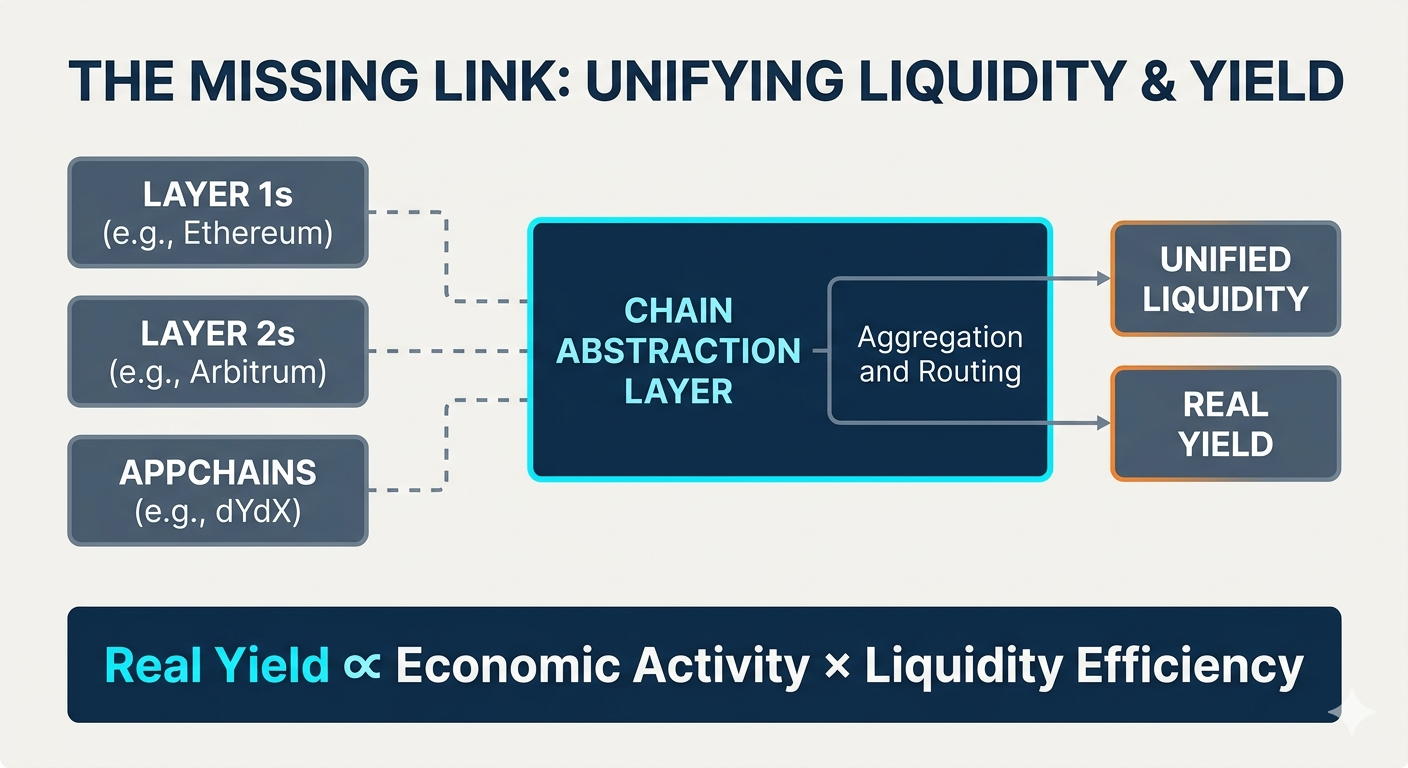
Real Yield ∝ Economic Activity × Liquidity Efficiency
A protocol cannot generate sustainable revenue without deep liquidity and active users. When capital is scattered, trading volume drops, execution quality worsens, and liquidity providers earn less. Fragmented liquidity directly weakens sustainable economics.
The Next Evolution: Chain Abstraction
The industry is moving toward a future where “which chain you are on” no longer matters. This is the core of Chain Abstraction.
The goal is to hide blockchain complexity entirely. Instead of manually bridging assets or switching networks, applications will automatically route transactions behind the scenes.
If successful, chain abstraction will be the “missing link” that connects these fragmented silos into one fluid global market.
Final Thoughts
Scalability alone is not enough. The future belongs to the ecosystems that best connect users, liquidity, and sustainable value creation. As we move away from speculation and toward revenue-backed protocols, the “winners” will be those who master liquidity coordination.
Originally authored by Ibraheem for Mitosis University. Updated and archived here to maintain a record of my technical research and DeFi contributions.
About Me
Ibraheem is a DeFi Ecosystem Researcher and Technical Analyst. Since 2020, I have focused on the intersection of blockchain infrastructure, modularity, and the fundamental mechanics of decentralized finance. My goal is to translate complex on-chain data into clear, actionable insights for developers and investors alike.
Beyond research, I am a blockchain educator and community engagement specialist, dedicated to onboarding the next billion users into a transparent and decentralized financial future.
Let’s Connect: X/Twitter | LinkedIn
#DeFi #BlockchainInfrastructure #RealYield #ChainAbstraction #CryptoAnalysis