The Invisible Rails: Who Actually Issues Your Fintech Card
Behind every Revolut swipe and Chime purchase lies a quiet banking arrangement most users never see
 Ritika Prajapati6 min read·1 hour ago
--
TLDR Key Insights
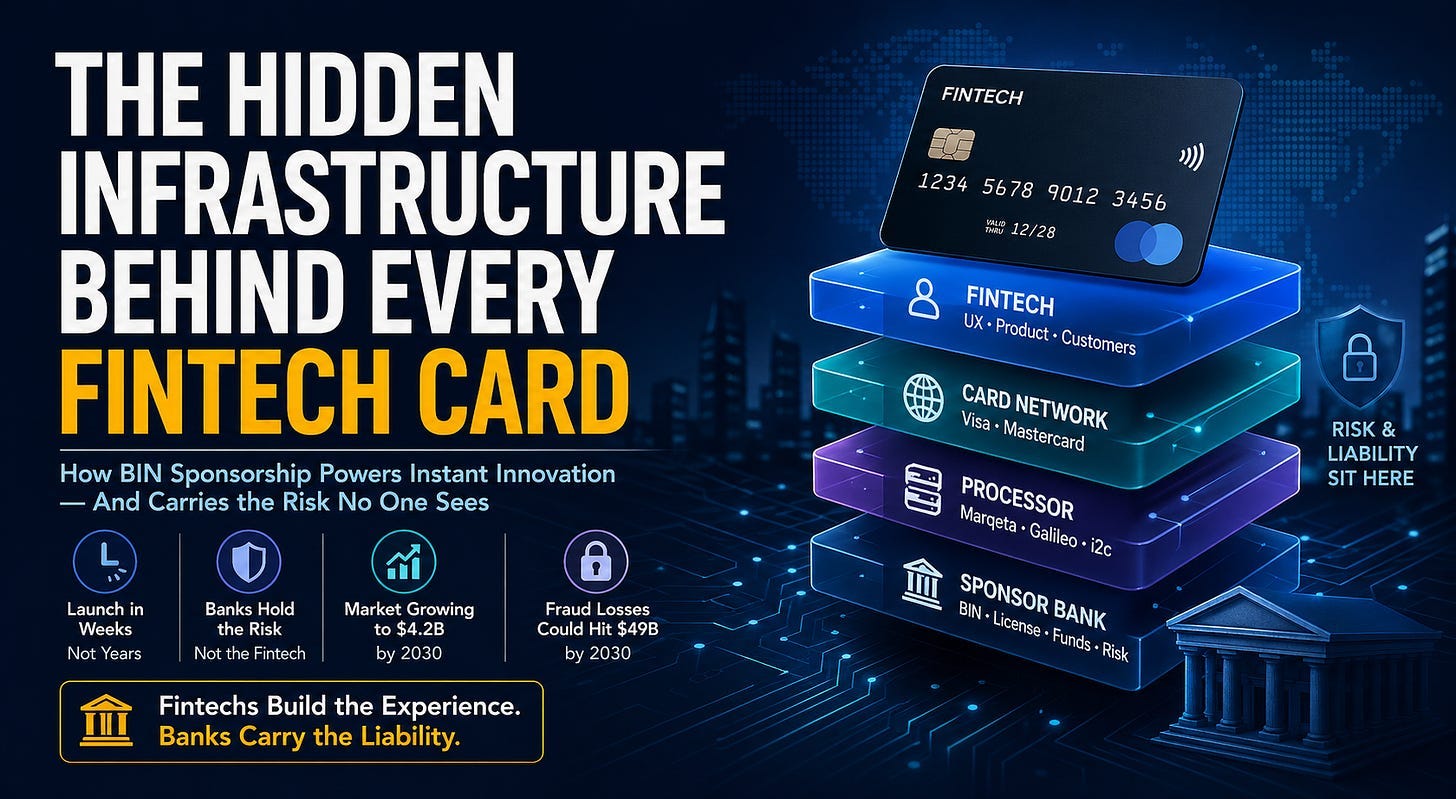
- Fintechs cannot legally issue cards on their own and rely on licensed banks called BIN sponsors who carry regulatory and financial liability
- The modern card issuing market is around 1.8B dollars in 2025 and projected to reach 4.2B dollars by 2030 driven by embedded finance
- BIN sponsorship cuts time to market from years to months but caps innovation at the sponsor bank’s risk tolerance
- Legacy banking infrastructure is around 30 percent more expensive to operate giving cloud native fintechs a structural edge
- Global card fraud could hit 49B dollars by 2030 and sponsors absorb the first layer of loss
- The uncomfortable truth is that most fintechs are API orchestration layers sitting on top of banking licenses they do not own
Opening Hook
In 2021 a founder in Lagos built a card program in a week.
Three API calls. One dashboard. No banking license. No compliance department. No years long regulatory process.
Her employees started swiping physical debit cards almost immediately.
What she did not see and did not need to see was this:
The cards were legally issued by a small bank in Utah. Every transaction flowed through a BIN tied to that institution. And every disputed charge the liability sat with the bank not her startup.
This is the quiet reality of modern fintech.
A layer of invisible banking infrastructure that made instant card issuance possible and quietly defines what fintech companies can and cannot become.
Context and Problem
Issuing a payment card is not a software problem. It is a regulated banking function.
Card networks like Visa and Mastercard only work with licensed financial institutions. Regulators require capital buffers AML controls reporting frameworks and consumer protection systems that take years to build.
Most fintechs do not have that time.
So they found a workaround.
The fintech does not issue the card. The bank does. The fintech just designs the experience around it.
This workaround is BIN sponsorship and it has become one of the most important structural layers in modern finance.
It powers neobanks expense platforms gig economy wallets and embedded finance products across industries.
And yet it remains almost invisible in public discourse.
System Breakdown
Strip away branding UX and apps and every fintech card system collapses into four layers:
Customer
↓
Card Network Visa or Mastercard
↓
Processor
↓
Sponsor Bank BIN and License
The fintech sits on top of this stack.
It owns:
- User experience
- Product logic
- Spending rules
- Customer relationship
But it does not own:
- The BIN
- The regulatory license
- The funds
- The first layer of liability
The sponsor bank is the real issuer. It provides the BIN holds deposits runs KYC and AML approves transactions and reports to regulators.
Processors like Marqeta Galileo and i2c sit in between translating fintech APIs into banking grade transaction flows in real time.
A card swipe is therefore not a fintech action.
It is a synchronized approval loop across three institutions completed in milliseconds.
Deep Dive The Economics of Dependency
Why banks participate
Sponsor banks are not passive infrastructure. They are commercial participants.
Institutions like Metropolitan Commercial Bank Cross River Bank and Evolve Bank and Trust earn a share of interchange revenue by sponsoring fintech programs.
They gain:
- Low cost exposure to fintech growth
- Diversified transaction flows
- Revenue without consumer acquisition costs
But they also inherit something less visible. Risk without full control of product behavior.
This imbalance has become more visible after regulatory scrutiny intensified in 2023 and 2024 especially following failures like Synapse where customer funds became trapped in reconciliation breakdowns.
The hidden ceiling on fintech innovation
BIN sponsorship accelerates entry but limits evolution.
Every product change from credit logic to rewards design must pass through sponsor bank approval.
That means:
- Product velocity is partially externalized
- Risk appetite is externally defined
- Innovation is gated by compliance interpretation
This is why even large fintechs cannot fully operate like software companies.
Chime cannot freely redesign overdraft logic.
Revolut cannot roll out products uniformly across regions.
The real roadmap is co authored with banks.
Real World Comparison
Stripe Issuing
Enables instant card creation via API but product rules are shaped by sponsor banks behind the scenes.
Revolut and Chime
Consumer brands but legally dependent on underlying banks for issuance and compliance.
OneCard India
Uses SBM Bank India as issuer while OneCard controls UX rewards and acquisition.
Checkout.com
Moves further down the stack reducing reconciliation overhead by owning more of the issuing pipeline.
Key Metrics
Modern Issuing Market
1.8B dollars to 4.2B dollars by 2030
Total Card Issuing Market
28.9B dollars to 56.2B dollars by 2033
Digital Issuance CAGR
Around 13.2 percent
Global Card Fraud 2030
Around 49B dollars
North America Share
35 percent
European Union Cards in Circulation
637.7M
The gap between modern issuing and total issuance shows the scale of transition still underway from legacy banking systems to API driven infrastructure.
Risks
Operational risk
Legacy banking systems were not built for real time application programming interfaces. Failures often emerge as reconciliation gaps between processor network and bank systems making debugging slow and non linear.
The real fragility is not transaction failure. It is traceability failure.
Financial risk
Interchange economics are thin and heavily split across bank processor and fintech. Durbin regulated markets compress margins further forcing scale dependency.
Fraud risk
Fraud is growing faster than detection systems.
Projected global losses 49B dollars by 2030.
The misalignment is structural:
- Fintechs design onboarding and user experience
- Banks absorb first loss liability
- Networks enforce rules
Tokenization and biometric authentication reduce risk significantly but adoption remains uneven.
Bull vs Bear Case
Bull case
- Embedded finance expands rapidly across non financial apps
- Application programming interfaces reduce integration costs further
- Fraud detection improves via artificial intelligence
- Banks and fintechs deepen collaboration
- Virtual cards become dominant in business to business payments
Bear case
- Regulatory tightening after infrastructure failures
- Sponsor consolidation increases dependency risk
- Revenue sharing compresses margins
- Large banks build competing issuing stacks
- Innovation slows due to compliance overhead
What Most People Miss
01 Issuing is a legal illusion
Fintech branding creates the perception of issuance but legally the issuing entity is always a bank. When failures occur liability flows through that institution not the app users interact with.
02 BIN sponsorship is not transitional
For most fintechs it is not a stepping stone. It is a permanent operating model. Licensing is too expensive and complex for most firms to justify.
03 Processors are becoming the real power layer
Migration between banks is easier than migrating processor infrastructure. This gives processors structural leverage over the ecosystem and explains why networks are acquiring infrastructure players.
Key Variables to Watch
- Regulatory tightening around sponsor banks
- Processor consolidation by Visa and Mastercard
- Rate of fintechs pursuing banking licenses
- Fraud growth versus detection capability
Each of these directly reshapes the balance of power in the stack.
Strategic Impact
For fintechs
Treat sponsor banks as strategic infrastructure not interchangeable vendors.
For banks
Fintech partnerships are now balance sheet and reputational risk programs not just revenue streams.
For investors
The durable advantage lies in owning multiple layers of the stack not just user facing brands.
For regulators
The challenge is balancing innovation with visibility into who actually holds risk.
Conclusion
BIN sponsorship solved a real constraint. It made card issuance accessible in a world designed for banks not startups.
It turned financial infrastructure into an application programming interface layer.
But beneath that abstraction lies a structural tradeoff:
Fintechs gained speed.
Banks absorbed risk.
And customers rarely see either side of the equation.
This system works until it does not.
Because the real question is not who issues your card.
It is who is responsible when it breaks.
And right now that answer is split across institutions that do not always see the same version of the truth.
The next phase of fintech will not be defined by better apps.
It will be defined by who gets clarity over the risks they are already carrying.