The Future of Prediction Markets: Why the Next Evolution Might Belong to Ascend on Midnight
 Nathan West5 min read·Just now
--
By design, markets are meant to answer one question: what does the crowd believe is true? But the way we trade that belief is rapidly evolving.
Prediction markets have emerged as one of the most compelling intersections of finance, information theory, and decentralized technology. By assigning real monetary value to probabilities, these platforms transform subjective beliefs into quantifiable market signals.
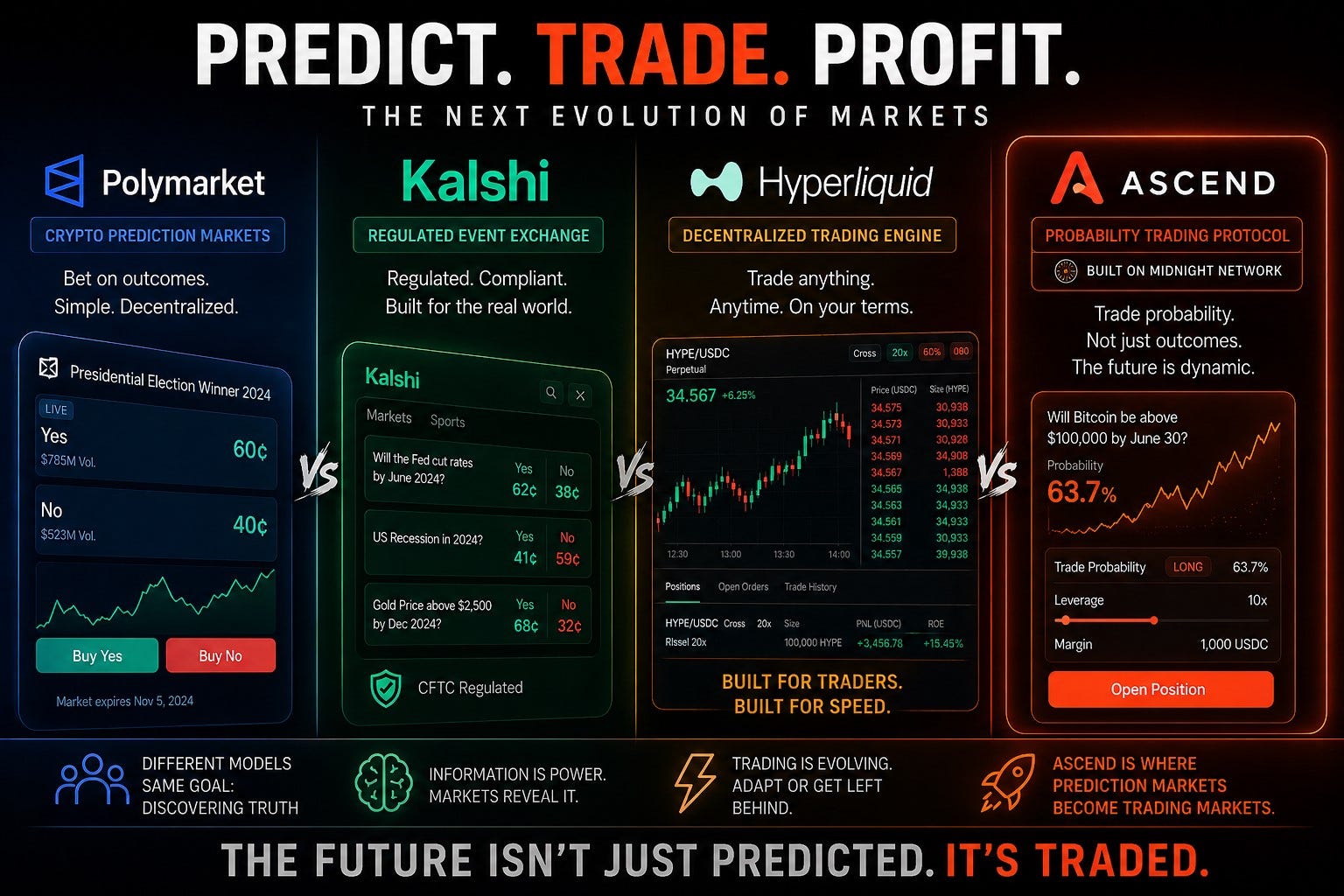
Over the past few years, the space has matured into four distinct approaches:
- Crypto-native prediction markets (Polymarket)
- Regulated event derivatives exchanges (Kalshi)
- High-performance decentralized trading engines (Hyperliquid)
- Hybrid probability trading protocols (Ascend)
Each platform represents a different philosophy on how markets should function. This article provides a structured comparison across architecture, trading mechanics, tokenomics, and long-term viability — while highlighting why the hybrid model introduced by Ascend may represent the next evolutionary step.
Market Structure & Core Functionality
Polymarket: Decentralized Probability Markets
Polymarket allows users to trade binary outcomes (“Yes” or “No”) on real-world events. Prices reflect consensus probabilities, and contracts settle at $1 or $0 depending on the outcome.
Key characteristics:
- Stablecoin-based (USDC)
- Blockchain settlement (Polygon)
- Continuous trading prior to resolution
While efficient in aggregating information, Polymarket’s structure is inherently static. Profitability is closely tied to being directionally correct rather than actively trading volatility.
Kalshi: Regulated Event Derivatives
Kalshi offers a similar product structure but operates within a regulated U.S. framework. Contracts are denominated in USD and comply with oversight from the Commodity Futures Trading Commission (CFTC).
Key characteristics:
- Fully compliant and regulated
- Accessible to U.S. participants
- Institutional-grade infrastructure
Kalshi’s strength lies in regulatory clarity and trust. However, this compliance framework introduces constraints on market diversity and innovation speed.
Hyperliquid: Decentralized Trading Infrastructure
Hyperliquid is not a prediction market but is essential for contextual comparison. It represents the current benchmark for decentralized trading systems.
Key characteristics:
- On-chain central limit order book
- High-speed execution comparable to centralized exchanges
- Perpetual futures with leverage
Hyperliquid demonstrates that modern users increasingly favor active trading environments over static positions. Its architecture prioritizes execution speed, liquidity, and capital efficiency.
Ascend: Hybrid Probability Trading Protocol
Ascend introduces a hybrid model that bridges prediction markets and derivatives trading. Built within the Midnight Network ecosystem, it enables users to trade probability as a dynamic, continuously priced asset.
Key characteristics:
- Probability-based trading rather than static positions
- Potential for leverage and active position management
- Integration with privacy-preserving infrastructure
Ascend shifts the paradigm from predicting outcomes to trading probability movement, aligning more closely with modern trading behaviors.
Trading Paradigms: Static vs Dynamic Markets
The fundamental distinction between these platforms lies in how users interact with risk.
Traditional prediction markets reward correctness at resolution. In contrast, trading platforms reward timing, strategy, and adaptability.
Ascend occupies a unique position by enabling continuous trading of probability, effectively merging both paradigms.
Architecture & Technology Stack
The integration with Midnight Network introduces a potential advantage for Ascend: selective privacy in trading activity, which may appeal to both retail and institutional participants seeking strategic confidentiality.
Tokenomics & Value Capture
Hyperliquid: Revenue-Aligned Model
Hyperliquid’s token model is widely regarded as one of the most advanced in decentralized finance. With fee-driven buybacks and a deflationary structure, it directly links platform usage to token value.
Polymarket & Kalshi: Limited Token Integration
- Polymarket currently operates without a native token
- Kalshi, as a regulated entity, does not utilize tokenization
This limits direct value accrual for users beyond trading profits.
Ascend: Emerging Incentive Layer
Ascend is expected to implement a tokenized incentive system that may include:
- Trading rewards
- Liquidity incentives
- Governance participation
- Potential fee alignment mechanisms
While still developing, this model offers the opportunity to align user activity with long-term ecosystem value, particularly when combined with Midnight’s infrastructure.
Strategic Positioning
Each platform occupies a distinct niche:
- Polymarket: Crypto-native prediction leader
- Kalshi: Regulatory and institutional gateway
- Hyperliquid: High-performance decentralized trading benchmark
- Ascend: Emerging hybrid model with cross-category potential
The key differentiator lies in market adaptability. As financial markets evolve, users increasingly demand systems that allow for dynamic positioning rather than binary outcomes.
Conclusion
Prediction markets are undergoing a structural transformation. The progression is clear:
- Static outcome markets (Polymarket, Kalshi)
- Dynamic trading systems (Hyperliquid)
- Hybrid probability trading (Ascend)
While Polymarket and Kalshi continue to serve important roles in information aggregation and regulated participation, and Hyperliquid sets the standard for decentralized trading infrastructure, Ascend introduces a compelling synthesis of both models.
By enabling users to actively trade probability — rather than simply predict outcomes — Ascend aligns more closely with the evolving expectations of modern market participants.
If successfully executed, particularly within the privacy-enabled Midnight Network, Ascend has the potential to redefine how prediction markets function — not as static instruments of belief, but as fully tradable financial assets.
In increasingly complex markets, the edge no longer belongs solely to those who are correct — it belongs to those who can adapt fastest to changing probabilities.