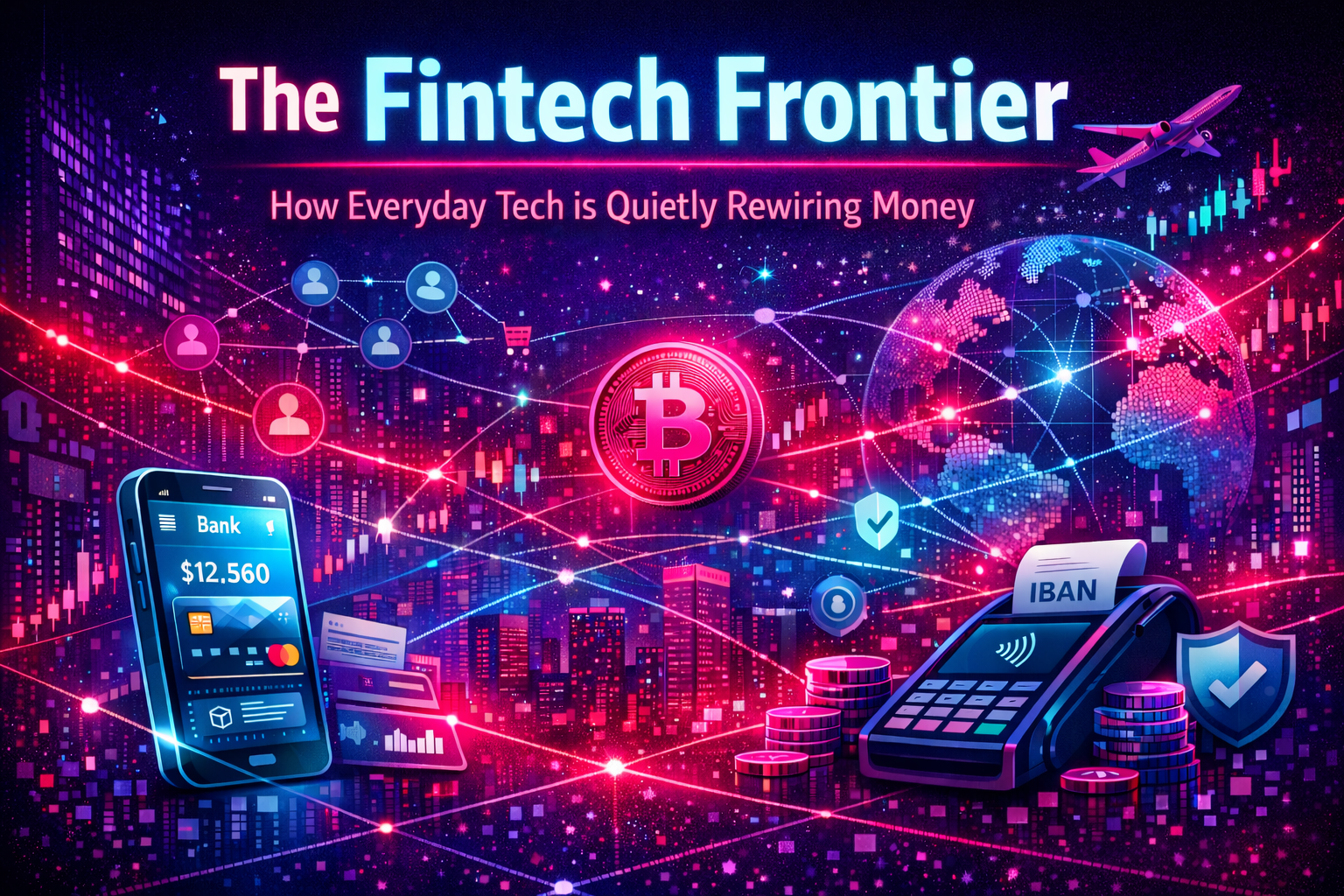
The Fintech Frontier: How Everyday Tech is Quietly Rewiring Money
In the bustling streets of Mumbai, a street vendor named Raj swaps his old cash register for a smartphone app that not only accepts payments.
 Lalit kumar5 min read·Just now
--
But predicts his busiest hours based on weather data. Halfway across the world, in a small town in Kenya, a farmer named Aisha secures a microloan in minutes through her basic feature phone, bypassing the hours-long trek to a bank. These aren’t scenes from a sci-fi novel they’re the quiet revolutions happening right now in the world of fintech.
But what exactly is fintech, and why should you care?
It’s not just about fancy apps or cryptocurrencies; it’s about how technology is democratizing finance, making it faster, fairer, and sometimes, a bit frightening.
Fintech, short for financial technology, encompasses everything from mobile banking to blockchain-ledgers and AI-driven investment advice. It’s the invisible force that’s turning your phone into a personal banker, your watch into a payment device, and your data into a credit score. As we step into 2026, with global fintech investments hovering around $200 billion annually, it’s clear this isn’t a fad it’s the new normal.
But let’s peel back the layers: how did we get here, where are we headed, and what pitfalls lurk in the shadows?
The Humble Beginnings: From ATMs to Algorithms
Picture this: It’s the 1960s, and the first ATM spits out cash in London, forever changing how we access money. That clunky machine was fintech’s awkward first step. Fast-forward to the 1990s, and online banking emerges, letting people pay bills without leaving home. But the real explosion came with smartphones in the late 2000s. Suddenly, apps like those for peer-to-peer payments turned friends owing you for dinner into a quick tap-and-send affair.
What makes fintech so intriguing isn’t the tech itself, but how it solves real human problems. Take remittances money sent home by migrant workers. Traditionally, this involved hefty fees and days of waiting. Fintech platforms now slash those costs by up to 50% using digital wallets and blockchain, putting more money back into families’ pockets. In 2025 alone, global remittances topped $800 billion, much of it flowing through fintech channels. It’s a reminder that behind the buzzwords, fintech is about empowerment.
Yet, it’s not all smooth sailing. Early fintech adopters faced hacks and glitches that exposed vulnerabilities. Remember the 2010s’ wave of data breaches? They taught us that convenience comes with risks, sparking a regulatory arms race. Governments worldwide, from the EU’s GDPR to India’s UPI framework, are now scrambling to balance innovation with security.
The AI Takeover: Smarter Money Management
Imagine waking up to a notification: “Based on your spending patterns, skipping that latte today could add $500 to your retirement fund by 2040.” That’s AI in fintech not some distant dream, but a reality in apps that analyze your habits in real-time. Artificial intelligence is fintech’s secret sauce, turning raw data into actionable insights.
One fascinating application is in credit scoring. Traditional banks rely on outdated metrics like salary and credit history, often excluding the “unbanked” about 1.4 billion people globally who lack formal financial records. Fintech uses AI to factor in alternative data: your utility payments, social media activity, or even how you type on your phone. In regions like sub-Saharan Africa, this has boosted financial inclusion by 20% in the last five years, allowing entrepreneurs to access loans they once dreamed of.
But here’s where it gets interesting and a tad eerie. AI doesn’t just predict; it personalizes. Robo-advisors, for instance, manage investments with algorithms that outperform human brokers in volatile markets. During the 2022 crypto crash, AI-driven portfolios recovered 15% faster than traditional ones, according to industry reports.
Yet, this raises questions: What if the AI is biased? Studies show algorithms can perpetuate inequalities, like denying loans to certain demographics based on flawed data patterns. It’s a double-edged sword empowering yet potentially discriminatory.
To add a human touch, consider the story of Maria, a freelance graphic designer in Brazil. Struggling with irregular income, she turned to an AI-powered budgeting tool that forecasted her cash flow and suggested gig opportunities. Within months, her savings grew by 30%.
Stories like hers illustrate fintech’s potential to level the playing field, but they also highlight the need for ethical AI development.
Blockchain and Beyond: The Trustless Economy
No fintech discussion is complete without blockchain, the tech behind cryptocurrencies like Bitcoin. But forget the hype around volatile prices; blockchain’s real magic is in creating transparent, tamper-proof records. It’s like a digital ledger that everyone can see but no one can alter unilaterally.
In supply chain finance, for example, blockchain tracks goods from farm to table, ensuring fair payments for all parties. This has revolutionized industries like agriculture, where farmers in developing countries often get shortchanged. A 2024 pilot in Vietnam used blockchain to cut payment delays from weeks to hours, increasing farmer incomes by 25%.
Then there’s decentralized finance (DeFi), which cuts out middlemen entirely. Want a loan? Borrow directly from a global pool of lenders via smart contracts self-executing code that enforces terms automatically. DeFi’s total value locked hit $100 billion in 2025, signaling a shift toward a “trustless” economy where trust is built into the system, not reliant on banks.
Of course, this frontier isn’t without dangers. The 2023 collapse of a major DeFi platform due to a coding exploit wiped out billions, reminding us that code is only as strong as its weakest link. Regulatory bodies are stepping in, with the U.S. SEC cracking down on unregistered securities and the EU pushing for MiCA regulations. The question isn’t if blockchain will dominate, but how we tame its wild side.
The Human Element: Challenges and the Road Ahead
For all its innovations, fintech isn’t a panacea. Cybersecurity threats loom large; in 2025, fintech-related hacks cost $6 billion worldwide. Privacy concerns are rampant do you really want an app knowing your every purchase? And let’s not ignore the digital divide: While urban millennials thrive on fintech, rural elderly populations often get left behind, exacerbating inequalities.
Looking ahead to 2030, experts predict fintech will integrate with emerging tech like quantum computing for unbreakable encryption and augmented reality for virtual banking experiences. Imagine trying on a “financial future” in AR, visualizing how investments grow over time.
But the most exciting prospect? Fintech’s role in sustainability. Green fintech apps now track carbon footprints tied to spending, encouraging eco-friendly choices. In Europe, “impact investing” platforms direct funds to renewable energy, blending profit with purpose.
As we navigate this fintech frontier, one thing is clear: Money isn’t just numbers anymore; it’s a dynamic, tech-infused ecosystem. Whether you’re a vendor like Raj or a farmer like Aisha, fintech is reshaping how we earn, save, and spend. The key is staying informed, vigilant, and open to change. After all, in a world where your phone holds the keys to your finances, the future isn’t coming it’s already in your pocket.
Edited for Write A Catalyst by Wandering Mind