The End of Hallucination: AI, Incorruptibility, and the Global Divide
 Rattan Whig4 min read·Just now
--
The Best-of-2 Protocol: A Manifesto for Human-Machine Cognition
Aletheia, introduced by Google DeepMind, and powered by an advanced version of Gemini Deep Think, is a specialized AI agent designed to solve complex math problems.
In the history of mathematics, breakthroughs are typically whispered in university hallways or debated over chalk dust in Princeton or Bonn. But on February 24, 2026, the silence of the mathematical community was broken by a technical report from the Google DeepMind team titled “Aletheia tackles FirstProof autonomously.”
What Aletheia managed, the Aletheia paradigm, was not just another model advancement, or a record of solved problems, rather a paradigm shifting discovery. In other words, it was a manifesto for a new era of human-machine cognition.
Unlike the International Mathematical Olympiad (IMO) problems, which often rely on tricks or known patterns, FirstProof consisted of ten questions drawn directly from the unpublished research notes of the authors. These were problems that didn’t exist in any AI training corpus as of January 2026. There were no StackOverflow threads, no LaTeX preprints, and no GitHub repositories to experiment or memorize.
FirstProof benchmark, designed to be contamination-proof, was created by a steering committee led by Mohammed Abouzaid (Stanford) and including luminaries like Fields Medalist Martin Hairer, and released February 5, 2026.
While competitors like OpenAI’s latest reasoning models and various academic bridge models struggled to produce even one verifiable solution, Aletheia systematically dismantled the set.
Aletheia, variously translated as “unconcealed-ness”, “disclosure”, “revealing”, also “reality”, is most commonly known as truth or disclosure in philosophy.
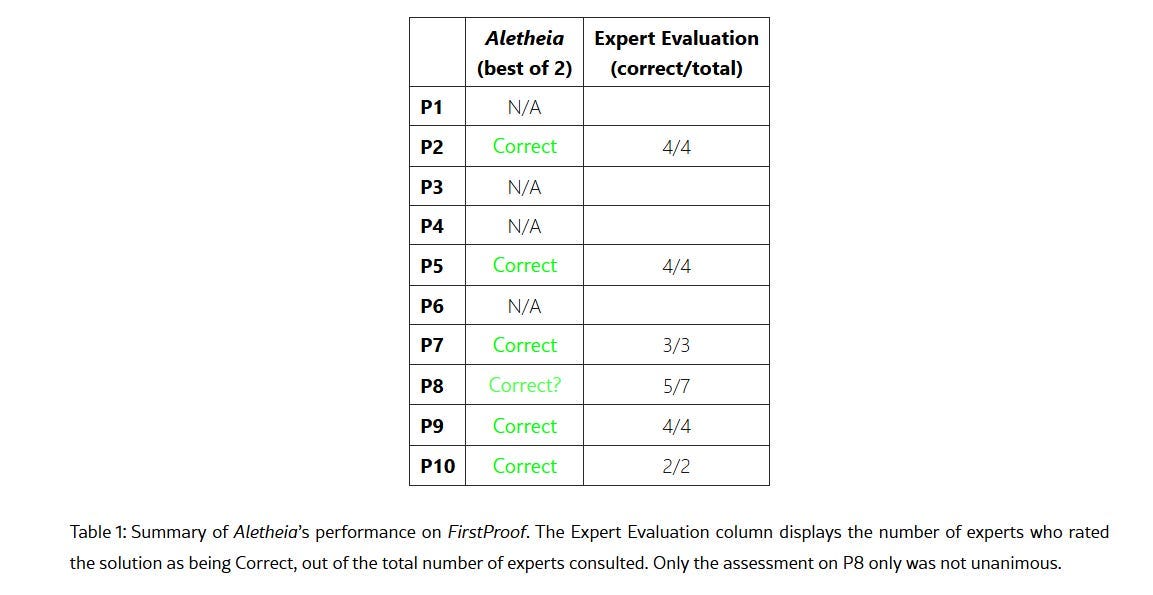
Aletheia focused on Problems 2, 5, 7, 8, 9, and 10. Out of these 6, it managed to verifiably solve 5 with contested results on 1.
Image Credit: arxiv
The secret to Aletheia’s success lies in the shift from Generative AI to Reasoning AI. Built on the Gemini 3 Deep Think architecture released in late 2025, Aletheia utilizes a Verification-Time Compute (VTC) strategy.
In the old paradigm (GPT-4 era), models predicted the most likely next token. Aletheia, however, operates through a Best-of-2 autonomous verification loop. It generates multiple potential trajectories for a proof, then uses an internal critic model to stress-test each step for logical consistency. If a path fails a sanity check, the model backtracks — a behavior once thought unique to human problem-solvers.
Aletheia didn’t just guess the answer to Problem 10, rather spent hours of thought time (inference-time compute) exploring the topology of the problem, discarding four failed attempts before settling on the successful proof. This is autonomy in the strictest sense, no human nudged it, no one tweaked the model, and no manual interventions were done.
The significance of Aletheia’s performance on FirstProof extends far beyond the specialized circles of academic mathematics. While solving a proof sounds abstract, it represents the first time a non-human entity has demonstrated formalized integrity — the ability to be right not because it is popular, but because it is logically unimpeachable.
Until 2025, the greatest weakness of AI was its tendency to hallucinate, to go sideways, to conjure up reality, to confidently state a falsehood. Mathematics, however, is a binary environment: a proof is either 100\% correct or 100\% useless.
We are shifting from AI as a creative assistant, or side experiments, to AI as a reliable source of truth. This of course has huge implications as the same reasoning logic is being ported into medical diagnostic tools and legal contract auditing. If an AI can be trusted to navigate a 50-page mathematical proof without a single logical slip, it can be trusted to ensure a surgery plan or a mortgage agreement is flaw-free.
Building trust is the first step towards democratization of high-level research expertise. Research-level mathematics was, and in many parts of the world, still is, a walled garden accessible only to few. This has the potential to create a massive surge in innovation in the Global South, where talent and opportunity often exist on different plains.
Aletheia acts as the ultimate tutor and collaborator, leveling the playing field between a student in Lagos and a professor in London.
This realization — that AI can now act as an arbiter of absolute, verifiable truth — is sparking a very different kind of technological deployment outside of Western tech hubs. To ensure this new reasoning power isn’t controlled by a single centralized entity, developing economies are merging it with blockchain ledgers.
Decentralized AI protocols are being rapidly developed in countries like Kenya and Vietnam to provide autonomous, incorruptible audits of public records. There is substantial academic and policy discussion in the region around utilizing decentralized data governance to secure public health records, tokenize and digitize assets, ensure data sovereignty, and prevent commercial exploitation.
The ability of an AI system to meticulously stress-test its own pathways without hallucinating is the exact mechanism required to build trustless civic networks. If an AI can be trusted to police its own logic without human bias, it can be trusted to police state infrastructure.
![ZENDEX (ZV1): The Strategic Hub for ZEN on Base [TLDR]](https://cdn-images-1.medium.com/max/1344/1*HxVHBM0XV-uR7El8v241jw.png)