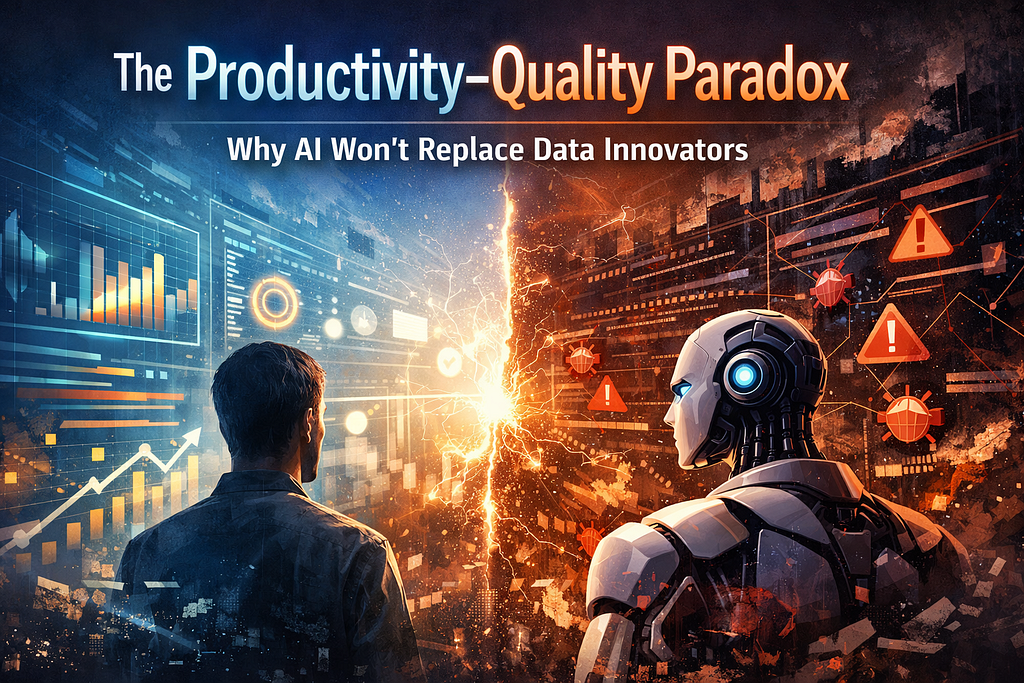
The Productivity–Quality Paradox: Why AI Won’t Replace Data Innovators
The real shift isn’t automation — it’s responsibility.
Spend five minutes in any tech discussion today, and you’ll hear a confident prediction:
“AI is replacing developers and data scientists.”
With tools from Anthropic and models like Claude advancing rapidly, it’s easy to see why. Leaders like Dario Amodei have hinted that AI systems may soon handle most software tasks end-to-end.
But this narrative misses something critical.
The people actually building systems in 2026 — engineers, analysts, and data scientists — aren’t worried about being replaced.
They’re worried about what AI is producing.
The Illusion of Full Automation
AI has undeniably changed the game.
- Code generation is faster than ever
- Data preprocessing that took hours now takes minutes
- Prototyping has become almost instantaneous
Models like GPT-5.3 and Claude can generate entire pipelines, dashboards, and models in a single prompt.
But here’s the catch:
AI solves 80% of the problem instantly — and makes the remaining 20% harder than ever.
That final 20% includes:
- Edge cases
- System design decisions
- Real-world constraints
- Business alignment
And that’s where everything breaks.
The Productivity–Quality Paradox
We are entering a phase best described as the Productivity–Quality Paradox.
AI increases output dramatically — but at the cost of:
- Larger, harder-to-review codebases
- Increased hidden bugs and regressions
- Poorly understood system behavior
Teams are shipping faster — but spending more time debugging, validating, and fixing.
The bottleneck hasn’t disappeared.
It has shifted.
From:
“Can we build this?”
To:
“Can we trust what we built?”
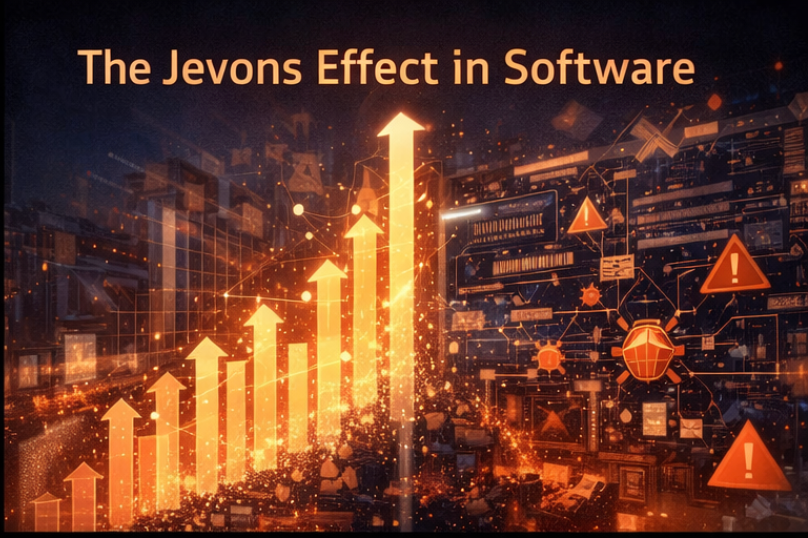
The Jevons Effect in Software
There’s a deeper economic force at play here: the Jevons Paradox.
When something becomes more efficient, we don’t use less of it — we use more.
- Cheaper code → more products
- Faster pipelines → more experiments
- Easier prototyping → more ideas executed
AI doesn’t reduce the need for data professionals.
It explodes it.
Because now:
- Every team wants analytics
- Every product needs intelligence
- Every decision demands data
The Rise of the “Code Curator”
The biggest shift isn’t technical — it’s philosophical.
We are moving from:
Code Writers → Code Curators
Your value is no longer in typing syntax.
Your value is in:
1. System Thinking Over Execution
Understanding how systems interact:
- Data pipelines
- Model dependencies
- Infrastructure constraints
AI can generate components.
Only humans can design systems.
2. Business-Aware Data Science
AI can optimize metrics.
But it cannot answer:
- Should we optimize this?
- Does this drive real value?
Future data scientists will dominate not through modeling — but through decision-making frameworks.
3. Debugging as a Superpower
AI-generated systems are:
- Non-deterministic
- Complex
- Often poorly documented
The ability to:
- Trace errors
- Interpret outputs
- Identify failure modes
…will become the most valuable skill in tech.
What This Means for Data Innovators
If you’re in data, AI is not your replacement.
It is your amplifier.
But amplification cuts both ways:
- Good engineers become exceptional
- Weak understanding becomes catastrophic
The winners in this new era will be those who:
- Think in systems, not scripts
- Understand causality, not just correlation
- Take ownership of outcomes, not just outputs
Final Thought
The idea that AI replaces data professionals comes from a misunderstanding.
We were never hired to write code.
We were hired to:
translate messy human problems into reliable, scalable solutions.
AI can now generate the code.
But it cannot:
- Define the problem
- Judge correctness
- Take responsibility
That still belongs to us.
And it always will.
The “End of Coding” is a Myth. The Reality is Much Harder was originally published in DataDrivenInvestor on Medium, where people are continuing the conversation by highlighting and responding to this story.