We’re entering a period of unprecedented economic centralization driven by AI, and we have perhaps 2 to 10 years — maybe less — to shape whether this transition destroys or transforms society. This isn’t science fiction. This is happening now, in my closet, in offices across Silicon Valley, in factories in Germany and China. And most people have no idea.
AI and robotics will replace you, this isn’t an if, but a when, and with this replacement we will see an absolute centralization of economic value like we have never seen before.
Last weekend, I built an agent-to-agent identity, reputation, and payment system. It works. It’s buggy, but it works. A year ago, this would have been a 6 to 12-month project requiring a team of engineers.
I’m telling you this not to brag, but because you need to understand what’s coming.
A bomb dropped and we’re just starting to see the fallout
[Primer]
An AI agent is a software program that operates autonomously to achieve specific goals, utilizing reasoning, planning, and memory to execute multi-step tasks without constant human intervention.’
An AI agent swarm is a collaborative, multi-agent system where multiple specialized AI agents work together to achieve complex, shared goals.
AI Agent Swarms — Available to anyone for a few hundred a month.
I work closely with AI, I run an agentic swarm on a Linux box in my closet. Not at some frontier lab. Not with venture capital. In my closet. This swarm handles everything from day-to-day administration, to RevOps (revenue operations), Lead Gen, Marketing, and Product functions at my company. I also use parallel agents to code.
Here’s how it works:
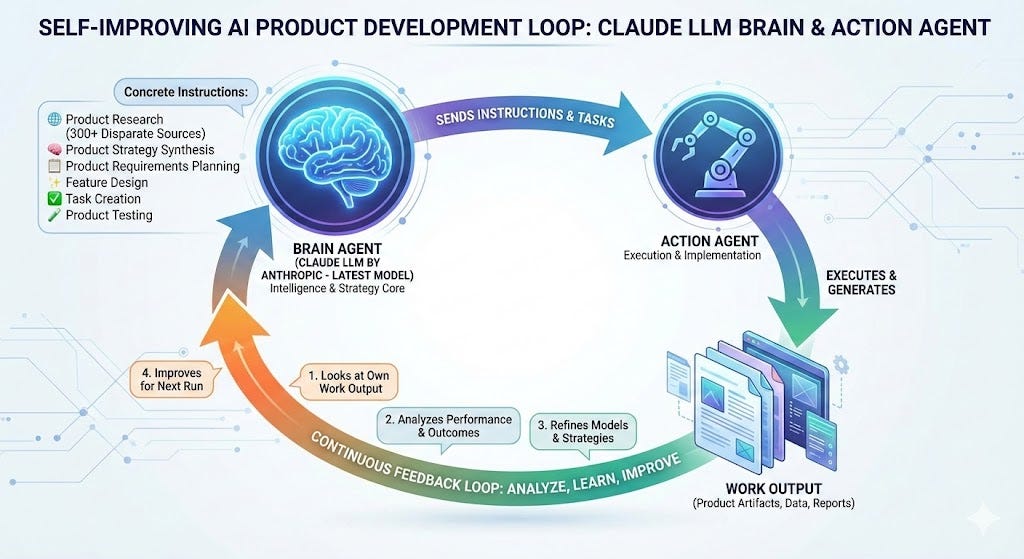
> Each agent has a brain — Claude, the latest model from Anthropic (Claude Opus 4.6). Not the free version everyone’s using. The free versions are a few generations behind. Think high school interns versus specialists with 15 years of experience, except these specialists are faster and can do a week’s work in hours.
> I give each agent concrete instructions: product research from across 300 disparate sources, product strategy synthesis, requirements planning, feature design, task creation, testing. The agent executes. Then it looks at its own output, analyzes it, and improves itself for the next run. On a loop. Continuously.
I have agents doing product, marketing, revops, and engineering. That’s 4 to 6 full time people, I no longer need to hire for my company. They don’t complain. They don’t require insurance. They don’t take sick days. They cost 2 to 10% of a human equivalent.
And I’m early. But not that early.
The speed of change is moving fast. Very fast. I need daily updates sent to me by my marketing agent just to keep pulse on what’s shifting in the market.
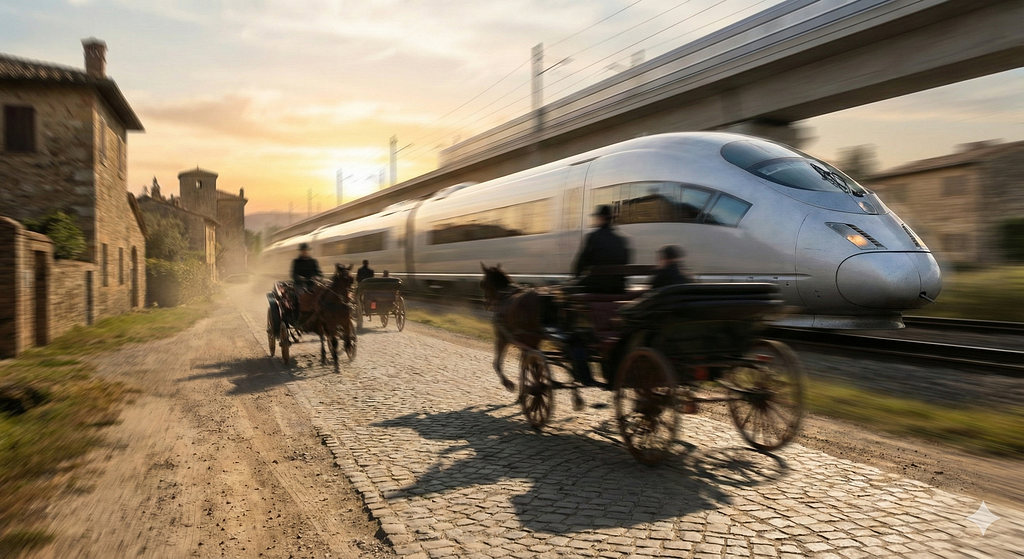
It would be impossible otherwise. I see other people working the same way I am. We’re moving at the speed of a bullet train while everyone else is on a horse-drawn carriage. Maybe those with tools like Claude CoWork’s new features are in a car at least, but the gap is widening every day.
But, here’s what keeps me up at night: ALL the work I’ve done in my career — aside from maybe novel concepting and idea generation — can now be handled by AI agents. The only human skills that still matter are providing these machines with clear instruction sets and coming up with genuinely new ideas — for now.
Everything that you know about the way our economy works is about to change.
I know what you’re thinking. We’ve heard this before. The Luddites smashed textile machines. People said cars would eliminate all jobs. Computers were supposed to make everyone unemployed.
But here’s why this time is actually different.
Speed and Breadth. Previous automation waves took decades to roll out and hit one sector at a time. This is happening simultaneously across white-collar and blue-collar work. Frontier AI labs like Anthropic, Google DeepMind, and OpenAI are now in a place where AI agents write code to build the next best version of themselves. Think about that for a minute. A technology that continuously improves itself at the thing it’s doing.
And it’s not just software. There are now robots — built by companies like Figure, Cobalt, Robco — that do everything from assembly line manufacturing to cleaning public toilets. All costing less than the average annual salary for the role they’re performing. Each robot is tied to an AI brain. Multiple robots working as a swarm.
The Math Doesn’t Work. When automation replaced farmers, they became factory workers. When it replaced factory workers, they became service workers. What happens when it replaces both the factory workers AND the service workers AND the knowledge workers at the same time? I don’t know what we adapt to. I don’t know if we’ll even be needed to run agent swarms.
Value Concentration. Here’s the economic reality: if you replace 60% of the workforce, that economic value gets shifted to two places.
- Shareholders of companies implementing cost-cutting tools.
- AI labs and robotics manufacturers.
The primary winners are AI labs and robotics manufacturers. The primary losers are everyone else, because when people lose their jobs, they lose their ability to be consumers. The whole economic engine starts to break down.
Buckle up for economic upheaval and massive societal shift.
We’re going to see massive change in the next 2 to 10 years as AI and robotics take over most white and blue-collar functions. The fundamental question of who we are as humans and what our function is in this new reality is going to be a central pillar of the next decade if not generation.
We’re also going to see huge disruption and fragmentation. Agent orchestration will allow any company to own its own Salesforce, its own Marketo. Large SaaS value propositions are going to become completely redundant, as will consulting and services businesses. But because of this redundancy and the unique needs of each business, fragmentation will increase exponentially. Think of it this way: one brain, maybe two, powering millions of agents specifically designed for a single unique workflow.
This is both a threat and an opportunity. The opportunity exists in solving problems and micro-problems agentically. But it’s a winner-take-most scenario. You will have an oligarchy controlling most of the economic activity. New value creation will exist only for those who can orchestrate and solve problems in this new paradigm. Meanwhile, massive unemployment and continuous economic hardship for most of the population due to skill gap and obsolescence.
We are looking at a winners take most scenario.
We will have an oligarchy controlling most of the economic activity, new value creation will exists only to those who can orchestrate and solve problems / micro problems agentically while massive unemployment and continuous economic hardship for most of the population due to skill gap and obsolescence. Historically this has meant civil unrest. Geopolitically, this will also mean a widening gap between technologically advanced and wealthy societies, and those with less soft power exertion and capital — so a the gap between haves and have nots turns into a chasm.
The two probable futures, but hopeful for a third despite the odds.
Given this new reality, society will have to transform. I see three possible outcomes.
A few big winners, with little need for human skills, and the majority of the population holding the short end of the stick, with limited or nonexistent earning potential, mean almost certain societal shift. To where that is an altogether different question.
Silicon Valley culture, Washington culture, Beijing culture, New York culture, has never been one of altruism, each focuses on power centralization and maximum value extraction. Regardless of the winners, we will likely see a world that is either a dystopian inequality, or a UBI (universal basic income) socialist state — neither is good.
Scenario 1: Dystopian Inequality
Assuming that our social contract no longer possesses a mandate to one another, winners have little pressure to safeguard the security of the populace. Meaning the loss of economic viability in most of the population will directly impact basic physiological and safety needs.
In this scenario, we’re looking at something like modern feudalism. A very small class that lives in comfort while the vast majority struggles for basic security. Our social contract assumes people can earn their way to safety and stability. When that assumption breaks, what keeps society together?
Scenario 2: UBI Socialist State
[primer]
Universal Basic Income (UBI) is a government-guaranteed, regular, and unconditional cash payment delivered to every individual, regardless of their employment status or income level.
Behavioral Sink a collapse in social behavior resulting from abundance, of whose outcome is the end of reproduction and eventual extinction.
Policymakers see what’s coming and implement UBI that gets funded by taxing the economic output of agentic activities and AI-driven production.
On paper, this is better. Less suffering. Basic needs met. But here’s what worries me: a UBI model removes the necessity of the human condition for purpose. What do people do when they’re not needed? When there’s no work, no contribution, no place in the economic engine? We haven’t figured this out as a species. Maybe we will become a society of artists and philosophers, but more likely decreased levels of expected hardships in a socialist UBI model remove the necessity of the human condition for purpose and accelerates humanity’s entry into its behavioral sink era.
Scenario 3: Responsible Capitalism
This is the improbable future, but the one I’m holding out hope for. In this scenario, today’s leaders — in government, in tech companies, in civil society — recognize what’s coming and embrace a model of responsible capitalism to build a more sustainable society as we enter humanity’s new age.
What would this look like? I don’t have all the answers, but some pieces:
- A new post-AI social contract
- Ownership structures that distribute AI productivity gains more broadly than just to shareholders, this isn’t socialism but:
- International cooperation to prevent a race to the bottom on AI safety and worker protections
This requires leaders to act against their own short-term interests. It requires companies to voluntarily share gains. It requires unprecedented cooperation across nations and ideologies. Like I said: improbable, likely impossible.
Why this matters to you, now.
I understand that this may read as outrageous. But I assure you it is not. It is a collection of thoughts I’ve been having on this emergent technology and its implications on society for the past two years.
Thoughts based not on speculation, but on what I see working in my closet, on my desktop, in my business, right now.
The shift that is coming is seismic, and if you read this, please consider preparation and how you can retool into this new economy, if we have a workforce that is capable and ready to use these emergent tools — we as society might just be able to navigate through these uncharted waters before us. So here’s my primer for getting though this.
Immediate to Med-term now > 5 years.
- Think how you can implement your core skillset into orchestration. Conduct the orchestra, don’t play the oboe.
- Reduce fixed costs ruthlessly. Every fixed cost is a liability, you will need capital.
- Accumulate capital now — as much as you can. It’s not a race, but do what you can for you, your family and loved ones.
Focus on skills that wont commoditise:
- Novel problem identification (agents solve known problems)
- Taste and judgment (what’s good vs acceptable)
- Trust and relationship building (humans still trust humans)
- Extremely high-touch service (until robots are perfect)
- Regulatory navigation (this will be a HUGE field)
Position yourself regardless of the outcome.
For the first time in my tech career, I don’t know what to prepare for, all I know is these agents just keep getting better. We need to decide, right now, what kind of world we’re building because the agents don’t sleep and they don’t slow down.
Appendix
Probability Assumptions: I make bold claims here, some are more probable than others. While urgency is key, I want to communicate that I loosely modeled these.
Overall the direction is correct. AI agents ARE replacing knowledge work now. The economic logic of 2–10% cost is irresistible. Value concentration IS happening. Very High Probability (70–90%)
- Significant white-collar job displacement in 2–10 years
- AI agents handling substantial portions of knowledge work
- Cost of AI-powered labor continuing to drop dramatically
- Some level of increased economic concentration
- Self-improving AI reaching the runaway point
Medium Probability (30–60%)
- 60% workforce replacement in 10 years
- Simultaneous white AND blue collar displacement at scale
- An extreme “oligarchy” scenario as you describe
- Major SaaS disruption — this will likely be slower
Low Probability (10–30%)
- Complete economic breakdown / “modern feudalism”
- Physical robotics matching software AI pace (robotics is MUCH harder)
- The timeline being as compressed as 2–5 years for major upheaval
Speed: I’m in a tech bubble and I know this, I’m technical, decently well-capitalized, working in software. Most of the economy moves MUCH slower.
Adaptability: We as Humans, we are weird, New jobs emerge. New needs arise. The “lump of labor fallacy” has been wrong every previous time, but this time MIGHT be different. Emphasis on might.
Innovation: We don’t know what emergent solutions arise, what new economic models develop, how society adapts
Your Business — On AutoPilot with DDImedia AI Assistant
(Join Our Waitlist)
Visit us at DataDrivenInvestor.com
Join our creator ecosystem here.
DDI Official Telegram Channel: https://t.me/+tafUp6ecEys4YjQ1
Follow us on LinkedIn, Twitter, YouTube, and Facebook.
The Economic Reckoning: Why AI Will Reshape Society Faster Than You Think was originally published in DataDrivenInvestor on Medium, where people are continuing the conversation by highlighting and responding to this story.