The Death of the Card? Why “Pay-by-Bank” is the New Gold Standard for High-Volume Merchants
 Chloe Johnson5 min read·Just now
--
For decades, the credit card has been the undisputed king of the checkout page. Since the mid-20th century, the plastic card — and its digital iteration in mobile wallets — has served as the primary bridge between consumer desire and merchant fulfillment. However, beneath the surface of every “swipe,” “dip,” or “click” lies a complex, expensive, and increasingly aging infrastructure. As we move further into the decade, a seismic shift is occurring in the global payments landscape. The Account-to-Account (A2A) revolution, often referred to as “Pay-by-Bank,” is moving from a niche alternative to the new gold standard for high-volume merchants.
The Cost of the Legacy Middleman
To understand why A2A is winning, one must first look at the inefficiencies of the traditional card model. When a customer uses a credit or debit card, the transaction travels through a labyrinth of intermediaries: the merchant acquirer, the payment processor, the card network (Visa, Mastercard), and the issuing bank. Each of these entities takes a slice of the pie.
For high-volume merchants — those processing thousands of transactions daily with thin margins — these interchange and processing fees represent a massive leakage of revenue. In a world where 2% to 3% of every sale vanishes into the “interchange ether,” the appeal of a system that bypasses these middlemen is undeniable. Pay-by-Bank moves funds directly from the customer’s bank account to the merchant’s account, effectively cutting out the card networks and their associated costs.
The Mechanics of Open Banking
The engine driving the A2A revolution is Open Banking. Facilitated by regulatory frameworks like PSD2 in Europe and market-driven shifts in the US and Asia, Open Banking allows third-party providers to initiate payments directly from a user’s bank account with their explicit consent.
Unlike traditional bank transfers of the past, which were clunky and slow, modern A2A payments are seamless. They leverage Real-Time Payment (RTP) rails — such as SEPA Instant in the UK/EU, Pix in Brazil, and FedNow in the United States. This means that for the merchant, the payment is not just authorized; it is settled almost instantly. The “pending” period that plagues card transactions is eliminated, drastically improving cash flow management for large-scale operations.
Solving the Chargeback Headache
One of the most significant pain points for high-volume merchants, particularly in industries like iGaming, e-commerce, and luxury retail, is the “friendly fraud” associated with chargebacks. The card network rules were originally designed to protect consumers, but they have often been weaponized against merchants, leading to costly disputes and lost inventory.
A2A payments fundamentally change the security dynamic. Because the payment requires Strong Customer Authentication (SCA) — typically a biometric thumbprint or face scan via the user’s banking app — the “I didn’t authorize this” claim becomes nearly impossible to make. A2A transactions are generally considered “push” payments, meaning the customer explicitly pushes the money to the merchant. This reduces the risk of chargebacks to near zero, saving merchants millions in administrative costs and lost revenue.
Enhancing the Consumer Experience
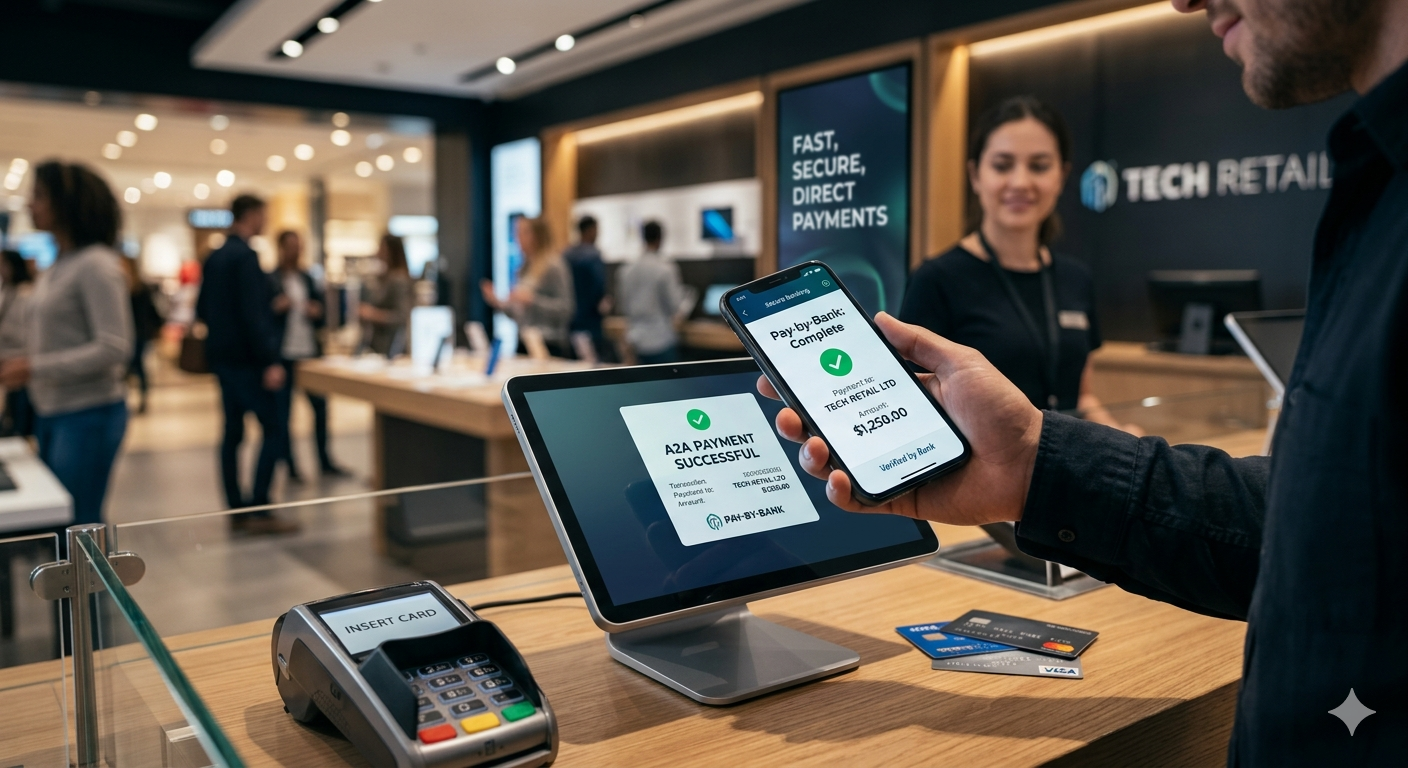
Critics of Pay-by-Bank often point to the friction of moving away from the “auto-fill” convenience of credit cards. However, the modern A2A user journey is arguably faster and safer. There is no need to type in 16-digit card numbers, expiration dates, or CVV codes. Instead, the customer selects “Pay-by-Bank” at checkout, is redirected to their trusted banking app, authenticates with biometrics, and the transaction is complete.
In an era of rising data breaches, consumers are also becoming more protective of their card details. A2A payments offer a “credential-less” experience. The merchant never sees or stores the customer’s sensitive financial data, which reduces the merchant’s PCI compliance burden and increases the customer’s peace of mind.
Why High-Volume Merchants are Leading the Charge
High-volume merchants are the early adopters of A2A because they have the most to gain from marginal gains. For a global airline or a massive subscription-based streaming service, a 1% reduction in transaction fees translates to tens of millions of dollars in annual savings.
Furthermore, A2A payments allow for higher transaction limits compared to standard debit cards. For high-ticket items — such as motor vehicles, high-end electronics, or luxury travel — the card networks often impose limits that lead to declined transactions and abandoned carts. Pay-by-Bank allows customers to spend up to the limit of their actual bank balance, facilitating larger sales with higher conversion rates.
The Global Landscape: A Fragmented but Fast Success
The A2A revolution is not a monolithic event; it is happening at different speeds across the globe. In Brazil, the “Pix” system has become a cultural phenomenon, used by over 70% of the population. In India, UPI (Unified Payments Interface) has revolutionized micro-payments and large-scale retail alike. Europe is leading with Open Banking maturity, while the US is rapidly catching up as the infrastructure for real-time payments matures.
For merchants operating internationally, the challenge is no longer about accepting the “big two” cards, but about integrating with the local A2A rails that consumers now prefer. This shift is forcing payment service providers (PSPs) to pivot, offering “orchestration layers” that allow merchants to toggle on various A2A methods with a single integration.
The Verdict: Is the Card Dead?
It is premature to declare the total death of the card. Credit cards still offer “buy now, pay later” mechanics and rewards programs that are deeply ingrained in consumer behavior, particularly in the US. However, for the merchant, the card is no longer the only — or even the best — option.
The “New Gold Standard” is a hybrid ecosystem where A2A takes the lion’s share of high-volume, high-frequency, and high-value transactions, while cards move to the periphery for specialized credit needs. For the merchant, the revolution offers a simple, powerful choice: why pay for the middleman when you can go straight to the source?
The A2A revolution is here, and for those processing at scale, the message is clear: adapt to Pay-by-Bank, or continue to pay the price of the past.
#Fintech #OpenBanking #A2APayments #PayByBank #DigitalTransformation #PaymentsRevolution #HighVolumeMerchant #FutureOfFinance #FintechInnovation #MerchantServices #RealTimePayments #BankingTech