The crypto honeymoon is over for now as analysts warn of a major first-quarter profit squeeze
Several major investment firms have preemptively downgraded Coinbase and other platforms as a sharp drop in trading activity and falling token prices threaten to derail upcoming first-quarter earnings results.
By Helene Braun, AI Boost|Edited by Nikhilesh De Apr 11, 2026, 5:00 p.m. Make preferred on
What to know:
- Wall Street analysts are cutting forecasts for Coinbase and other crypto firms as trading volumes and token prices slump to their weakest levels since late 2023.
- Barclays downgraded Coinbase and now expects significantly lower profitability, while Oppenheimer trimmed its volume and revenue estimates but remains relatively more optimistic.
- Pockets of strength in stablecoins and newer businesses like derivatives and tokenized assets have yet to offset the slowdown in core trading, prompting analysts to reset expectations ahead of upcoming earnings reports.
Crypto trading has cooled in early 2026, and Wall Street analysts are racing to adjust their forecasts before companies report first-quarter earnings.
New research from Barclays and Oppenheimer shows multiple analysts are reaching similar conclusions, a few weeks into the second quarter. Expectations are coming down across the sector as trading volumes weaken and earlier projections look too optimistic.
Barclays took the most direct step, downgrading Coinbase (COIN) and warning that “global crypto trading activity has declined to a level not seen since the end of 2023.” The bank added that “absent a resurgence in near-term crypto trading activity, we see profitability under pressure at Coinbase.”
The slowdown is visible in the data. Coinbase’s March trading volume marked “the lowest volume month since September 2024,” Barclays wrote, with April showing “no signs of improvement.” For the first quarter, the bank estimates volumes fell roughly 30% from the prior quarter.
Coinbase and other exchanges charge fees on each transaction they facilitate, meaning lower volumes will lead to less revenue.
The mechanics are straightforward. When markets turn quiet, many traders step back. A retail user who once traded weekly during a rally may stop altogether when prices flatten. Multiply that behavior across millions of accounts, and exchange volumes drop quickly.
That matters because transaction fees remain the main revenue driver for most crypto platforms. Barclays underscored this risk, saying its forecast for Coinbase’s adjusted EBITDA is about 24% below the Street, driven largely by weaker spot trading and retail activity.
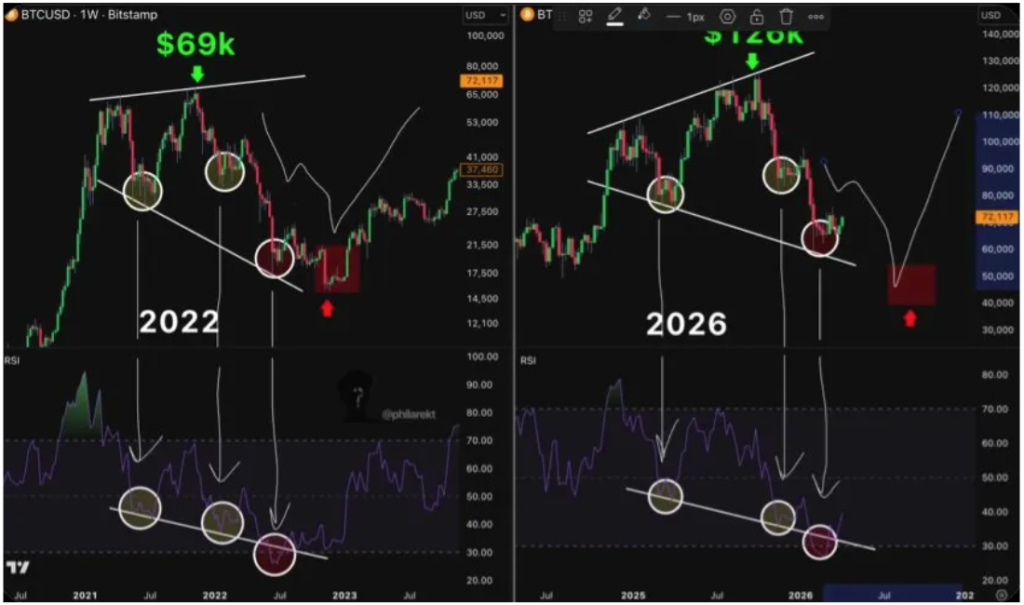
Crypto prices have pulled back in the first quarter, with the average price of major tokens falling sharply quarter-over-quarter. Bitcoin lost over 22% of its value in the first quarter of this year, while ether was down 29%.
Oppenheimer struck a similar tone but kept a more upbeat stance on Coinbase. The firm said it is cutting its forecasts due to softer crypto prices and lower trading activity in the first quarter, driven in part by broader economic uncertainty. It also noted that current Wall Street estimates still do not fully reflect the drop in trading volumes during that period.
That lag is now being corrected.
Across the industry, analysts are revising models downward to reflect a quieter market.
Oppenheimer cut its Coinbase volume estimate to $211 billion for the quarter, down from $244 billion previously, and now expects total revenue of $1.48 billion, below prior forecasts and consensus.
The reset is not limited to Coinbase. Oppenheimer said that Circle (CRCL) continues to expand the USDC stablecoin network, with stablecoin market cap and USDC transfer volume rising about 1% and 12% quarter over quarter, respectively.
Crypto platform Bullish (BLSH), the owner of CoinDesk, saw “strong on platform activity” tied to volatility in February, though spot volumes still missed expectations. As a result, Rosenblatt downgraded BLSH earlier this week while Compass Point downgraded CRCL — to "neutral" and "sell," respectively.
Even these pockets of strength highlight the broader issue: the core business of crypto trading is slowing.
Efforts to diversify revenue streams are underway but may take time to offset the downturn. Coinbase’s push into becoming what it calls an “everything exchange” includes derivatives, tokenized assets and new markets. Barclays was skeptical, writing that the strategy is “likely to take a long time to pay off” and that it sees “little ‘right to win’ in new asset classes like equities.”
Stablecoins, often seen as a steadier revenue stream, also face uncertainty. Barclays pointed to ongoing debate in Washington over regulation, noting that the status of stablecoin rewards “remains in question.” At the same time, Oppenheimer sees near-term support from new use cases, saying “increased prediction market activity could support USDC growth.”
Still, those areas remain secondary to trading.
The broader takeaway is that analysts are moving preemptively. With earnings season approaching, firms are lowering estimates now rather than risk being caught off guard by weak results later.
Coinbase reports second-quarter earnings on May 7 and Bullish reports on April 23. Circle has not yet announced a date.
CoinbaseCircleBullishAI Disclaimer: Parts of this article were generated with the assistance from AI tools and reviewed by our editorial team to ensure accuracy and adherence to our standards. For more information, see CoinDesk's full AI Policy.More For You
Encryption Supremacy: Zcash and Privacy in the Age of Scale
By CoinDesk ResearchMar 31, 2026 Commissioned byGenZcash
Most crypto privacy models weaken as blockchain data grows. Encryption-based models like Zcash strengthen. CoinDesk Research maps the five privacy approaches and examines the widening gap.
Why it matters:
As blockchain adoption scales, the metadata available to machine learning models scales with it. Obfuscation-based privacy approaches are structurally degrading as a result. This report provides a comprehensive comparison of all five major crypto privacy architectures and a framework for evaluating which models remain durable as AI capabilities improve.
View Full ReportMore For You
Bitcoin, broader market flat as U.S.-Iran negotiations begin
By Francisco Rodrigues|Edited by Nikhilesh De35 minutes ago
The market rose over the week after a two-week ceasefire was announced, triggering a derivatives short squeeze that wiped out over $430 million in bearish positions.
What to know:
- Bitcoin is trading below $73,000, down 0.6% in 24 hours, as U.S. and Iranian officials opened high-level talks in Islamabad. The broader crypto market is mostly flat.
- The market rose over the week after a two-week ceasefire was announced, triggering a derivatives short squeeze that wiped out over $430 million...

$1.6 billion Ether Machine SPAC deal collapses over unfavorable market
2 minutes ago
Bitcoin, broader market flat as U.S.-Iran negotiations begin
35 minutes ago
Iran war oil-price shock revives inflation trade and a new stablecoin play
1 hour ago
Crypto perpetuals predict the direction of Wall Street’s Monday open with 89% accuracy, data shows
2 hours ago
Crypto Clarity bill has 30% chance of passing this year, Wintermute’s Hammond says
3 hours ago
Bitwise files updated S-1 for Hyperliquid ETF as HYPE fund race heats up
3 hours agoTop Stories
Bhutan has sold 70% of its bitcoin in 18 months. It may have stopped BTC mining too.
14 hours ago
Federal judge blocks Arizona from bringing criminal charges against Kalshi
17 hours ago
Trump-backed WLFI token drops 12% to record lows after team defends multi-million lending position
Apr 10, 2026
Star Xu calls CZ a ‘liar’ as founders of world’s largest crypto exchanges argue over past allegations
Apr 10, 2026
Binance offers UAE staff temporary relocation as Middle East conflict disrupts region
Apr 10, 2026