The Cost of Acting Too Fast in Arbitrage
 HETHA.IO5 min read·Just now
--
In arbitrage, speed is usually seen as an unconditional advantage. The faster a system receives market data, recalculates chains, and delivers a signal for execution, the higher the chance of using a price difference before the market removes it.
This is true. But only up to a point.
When the question is not chain generation, but the trading decision itself, another issue appears: should the first acceptable chain always be executed immediately?
At first glance, the answer seems obvious. If a chain already passes the minimum profitability threshold, the opportunity exists. The sooner it is executed, the better. But in a real arbitrage system, this logic does not always lead to the best result.
Sometimes the problem is not that the system reacted too late. The problem is that it reacted too early.
Arbitrage Opportunities Often Appear in Waves
An arbitrage chain rarely exists as a single isolated event. More often, the market creates a short series of similar signals. Prices shift, order books update, liquidity changes, and within a few seconds the system may see several versions of the same opportunity.
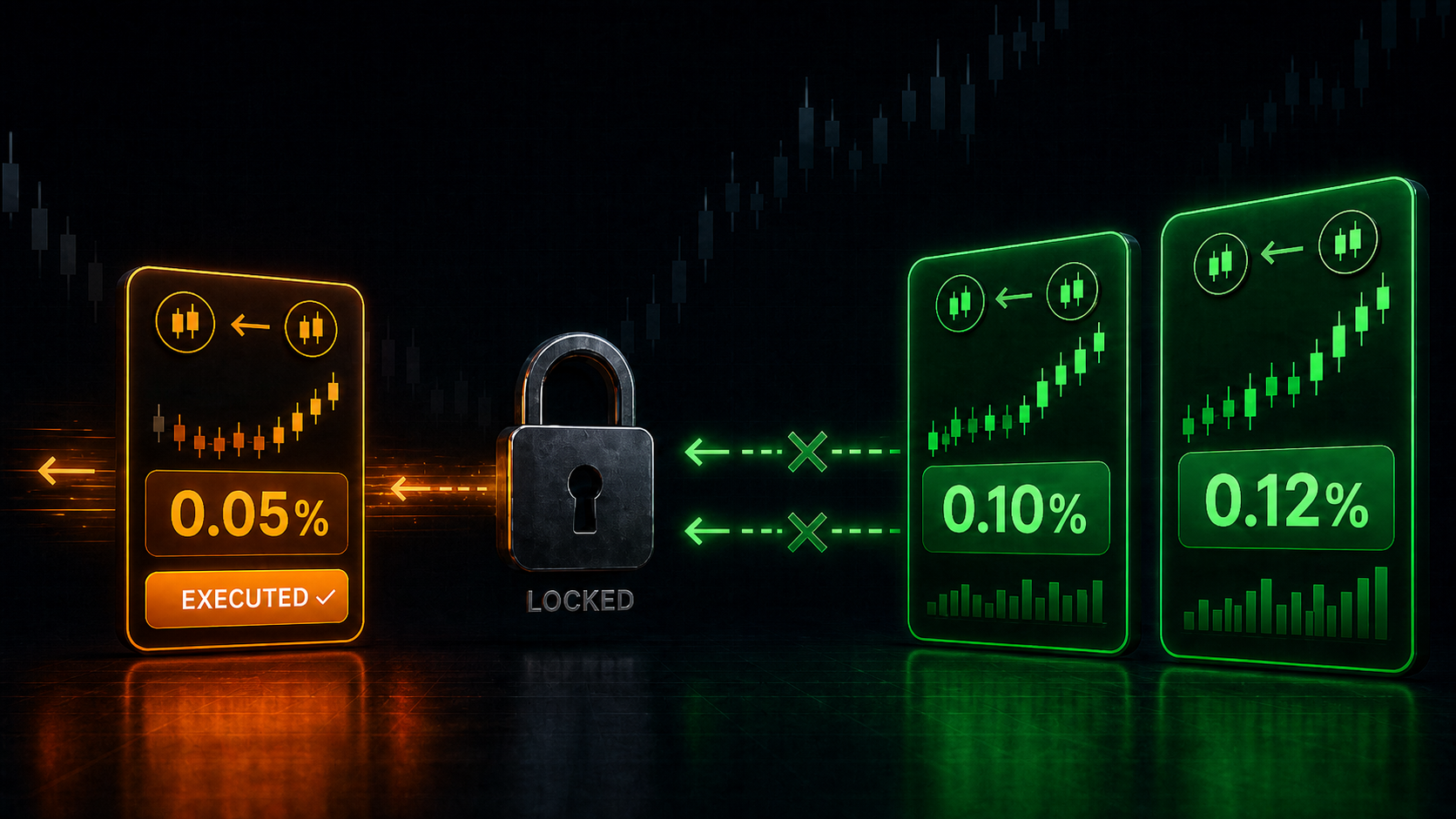
For example: BTC/USD -> BTC/USD profit 0.05%
A few seconds later: BTC/USD -> BTC/USD profit 0.10%
Then shortly after: BTC/USD -> BTC/USD profit 0.12%
Formally, the first chain is already profitable. If the minimum entry threshold is set too low, the bot may accept it for execution immediately. From the point of view of a simple scanner, this looks correct: an opportunity was found, and the trade was started.
But after a chain is launched, part of the assets becomes locked. The system has to wait for order execution, balance updates, and confirmation of the new asset state. While this is happening, the next chains using the same assets may be unavailable for execution.
As a result, the bot may take the first weaker opportunity and miss a more profitable one that appears almost immediately after it.
More Trades Do Not Always Mean More Profit
One common mistake in arbitrage is treating the number of trades as a value in itself. It may seem that if a system executes more chains, it is using the market more efficiently.
In practice, this is not always the case.
Every executed chain carries operational risk. An order may not close immediately. One leg may remain open. The price may move. Balance updates may be delayed. Even if the risk of a single trade is relatively low, it accumulates as the number of executions increases.
That is why an aggressive strategy with a low entry threshold may look active, but not necessarily more efficient. It uses capital more often, locks assets more often, and makes more decisions based on weaker signals.
In arbitrage, activity itself is not the goal. The quality of selected opportunities matters more. Sometimes a more reasonable strategy is to execute fewer chains, but choose the ones where profitability and execution conditions are stronger.
The Minimum Threshold Defines System Behavior
The minimum profitability parameter is often seen as a simple filter: everything below the threshold is rejected; everything above it is accepted.
In reality, this parameter affects the behavior of the entire system.
If the threshold is too high, the system may miss valid opportunities. If it is too low, the system may enter too early and take weaker chains at the beginning of a wave.
This becomes especially important when chains arrive in series. A low threshold can increase the number of trades, but at the same time reduce the average quality of entry. The bot starts reacting to the first acceptable signals rather than the best signals within the market movement.
After a chain is launched, part of the assets becomes locked: the system must wait for order execution, balance updates, and confirmation of the new asset state. During this period, the assets involved in the trade are effectively removed from the next decision.
This is why early entry can look profitable within a single trade, but worsen the overall result. In the report, the first chain may be closed with a profit, but the system may have missed a higher-quality opportunity simply because the required assets were already occupied.
Threshold configuration is not only a question of “how much profit is enough.” It defines the system’s behavior model: aggressive, cautious, or balanced. It determines whether the bot will take almost every acceptable signal or wait for stronger opportunities with a better balance of profit, risk, and capital availability.
Speed Matters, but the Decision Matters More
Chain generation speed remains critically important. Outdated data, order book delays, and slow signal delivery can make an arbitrage opportunity irrelevant before execution even begins.
But speed should not turn into automatic acceptance of every signal that passes the minimum criteria.
A good arbitrage system evaluates not only the fact that a chain has appeared, but also the quality of the opportunity, its position within a market series, its impact on available balances, and the risk of locking assets. The goal is not just to see the signal in time, but to understand whether it should be used at that exact moment.
At this level, arbitrage stops being a simple search for spreads and becomes a controlled process.
Why This Matters for Infrastructure
If arbitrage is viewed as a single trade, early execution seems natural. But if arbitrage is viewed as a stream of decisions, the picture changes.
Each chain affects the system’s next actions. It changes balances, asset availability, capital distribution across exchanges, and the risk of unclosed orders. That is why the execution decision cannot be evaluated in isolation.
This is the logic behind HETHA.IO as an arbitrage infrastructure layer. The system is not designed only to surface price differences. It is built to control the full process: which chains were found, which were rejected, which were executed, which assets were used, and how each decision affected further operation.
In this sense, filtering, entry thresholds, asset locking, and balance updates are not secondary technical details. They are elements of trading logic.
In arbitrage, speed is still necessary. But speed alone is not enough. The real advantage comes from combining fast detection with controlled decision-making — so the system does not simply react to every opportunity, but selects the ones that are actually worth executing.
Learn more about HETHA.IO: https://hetha.io