The Complete Guide to Theoriq: The AI-Powered Protocol Reshaping DeFi
 Acquire.Fi6 min read·Just now
--
There is a genuine hunger for tools that can handle the complexity that modern DeFi has become. Most people can’t juggle managing positions across a dozen protocols, optimizing liquidity, and keeping up with yield strategies all at once. Theoriq AI is one of the most interesting responses to that problem. It doesn’t just automate tasks. It builds an entirely new economic layer around autonomous AI agents operating directly on-chain.
Here’s what you need to know.
What Theoriq actually is
Theoriq is a decentralized protocol that coordinates swarms of autonomous AI agents to execute complex financial strategies on blockchain networks. The core product suite has four components:
- AlphaProtocol is the foundation layer. It provides on-chain primitives for agent identity, permissions, messaging, staking, and settlement. Every agent in the Theoriq ecosystem must register here. This creates an accountability layer most AI agent projects skip entirely.
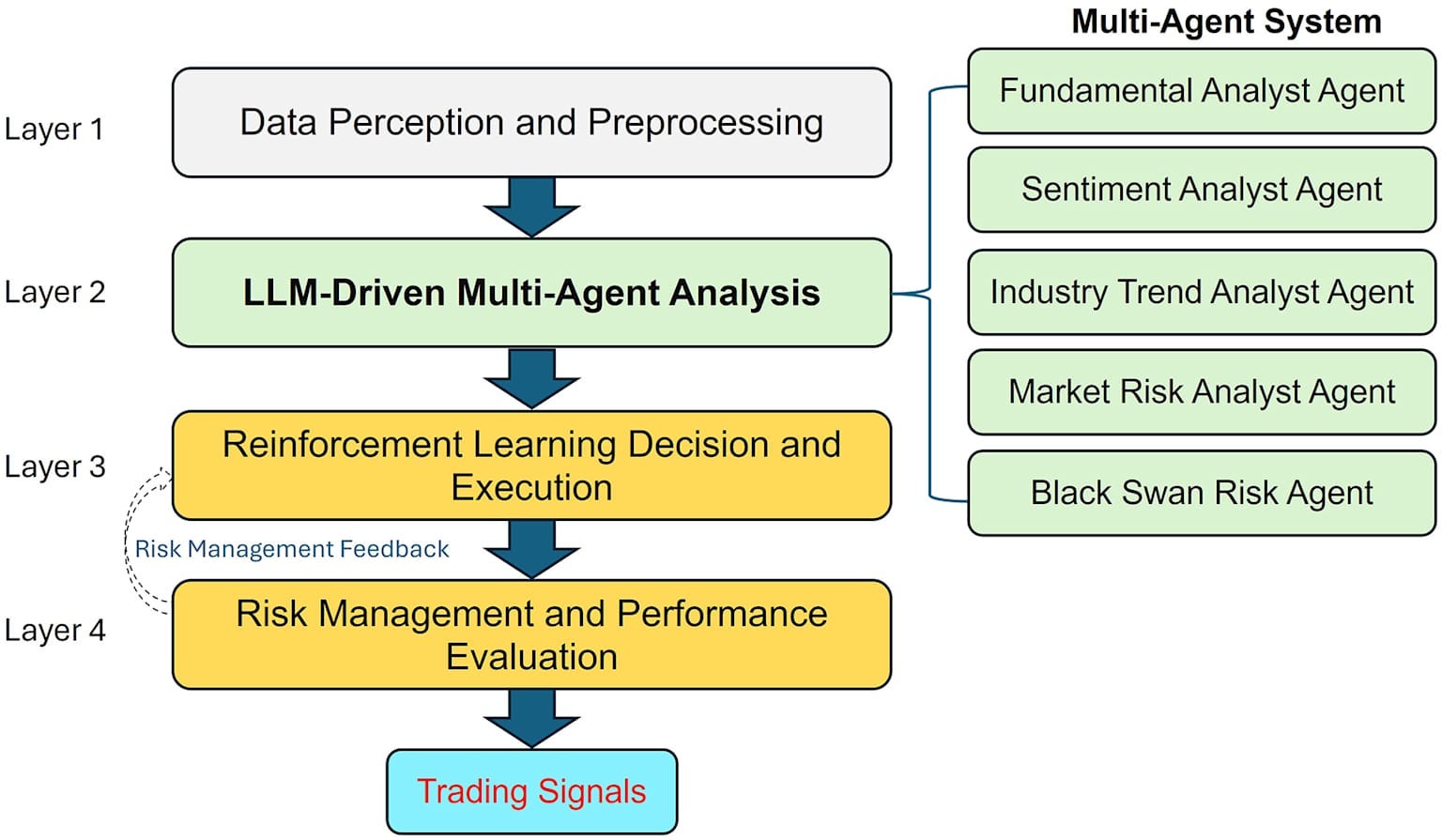
- AlphaSwarm is where the real action happens. The architecture supports real-time market optimization and on-chain risk management. Multiple agent types work together, such as the Portal Agents for user interaction, Knowledge Agents for strategy and data analysis, and LP Assistant Agents for liquidity optimization.
- AlphaVault is the flagship product. It is an agent-managed vault-of-vaults on Ethereum that accepts ETH, WETH, and wstETH and allocates across integrated sub-vault strategies under clearly defined constraints.
- AlphaStudio is the no-code layer for non-technical users. It makes it easy to discover and interact with agents and vaults without needing to write a single line of code.
What people are actually using it for
The use cases for Theoriq are broader than they might first appear. The early deployments focused on Uniswap-style concentrated liquidity on Base, where agents optimize liquidity provider (LP) ranges, fees, and capital allocation. But the design supports a much wider set of applications.
- Yield optimization across multiple protocols without manual position management
- Liquidity provisioning where AI agents maintain optimal LP positions continuously
- Real-world asset strategies using on-chain data feeds for dynamic positioning
- Prediction market applications where macro data informs agent decision-making
- Cross-protocol capital allocation where swarms dynamically shift funds based on live conditions
As DeFi gets more complex, Theoriq is positioning smart agents as the core layer that can automate decision-making while minimizing friction for both users and protocols. The no-code AlphaStudio layer means teams without deep technical knowledge can still deploy and interact with agents, which meaningfully expands the addressable market beyond just developers.
Where it came from and how it got here
Theoriq was founded in 2022 under the name ChainML before rebranding to Theoriq AI. The rebrand signaled a deliberate shift toward a consumer-facing “agentic economy” vision rather than just machine language (ML) infrastructure.
The mainnet launched on December 15, 2025. Within four days, AlphaVault hit $21 million in total value locked. And a community token sale on the Kaito Capital Launchpad raised $2 million and was approximately 40 times oversubscribed. Frankly, those are strong early numbers for any protocol launch.
Theoriq received solid support from venture capitalists from the get-go. The seed round raised $4 million in September 2022, led by IOSG Ventures. Then in May 2024, a seed extension round added $6.2 million, which was led by Hack VC, with several VCs all joining the cap table.
Beyond direct investment, Theoriq was accepted into NVIDIA’s Inception Program and Google Cloud’s Startup Program. That gave them access to GPU credits, AI infrastructure, and technical support from two of the biggest players in global AI. For a DeFi-native AI protocol that kind of institutional backing is genuinely unusual.
Beyond VC funding and Google Cloud and NVIDIA relationships, the protocol has assembled a meaningful stack of data and infrastructure integrations.
Key partnerships include:
- Truflation partnership allowed real-time on-chain inflation and macro data fed into AI agent collectives for RWA strategies.
- Chainbase partnership streamlined blockchain data infrastructure for Web3 analytics.
- Parasail partnership pooled globally distributed compute and hardware access.
- IO.net partnership distributed compute infrastructure for AI decentralization.
- Filecoin partnership enabled storage and data availability for AI model storage and agent state management.
- The Graph partnership brought indexing and querying of blockchain data used by AI agents.
The tokenomics of $THQ
$THQ is the native token of the Theoriq ecosystem. THQ coin has a clean fixed-supply design capped at 1 billion tokens total. The distribution breaks down like this:
- 30% to Investors, supporting foundational capital and long-term alignment
- 28% to the Treasury, funding ecosystem incentives, strategic partnerships, and protocol operations
- 24% to Core Contributors, with a three-year vesting schedule and a one-year cliff
- 18% to Community incentives, rewarding ambassadors, partners, agent operators, and contributors
Under the insider vesting schedule, investors, the team, and advisors unlock 33.33% of their tokens after a one-year cliff. The rest vest linearly over the next two years at one twenty-fourth per month. That first major insider unlock about a year post-TGE is worth noting.
The THQ token serves three primary functions:
- Staking and security: users stake THQ to mint sTHQ, which can be slashed if agents or the protocol misbehave.
- Access and gating: holding THQ unlocks advanced features and is required for agent registration.
- Boosted vault rewards: staking THQ significantly increases rewards from AlphaVault deposits.
Staking $THQ mints sTHQ, which locks economic value and serves as a security layer providing insurance against potential failures. sTHQ holders earn THQ token emissions and may also receive rewards from ecosystem partners. There is also a more advanced tier where locking sTHQ for one to 24 months within the AlphaLocker mints αTHQ, which is a non-transferable representation of time-weighted power. And αTHQ holders can delegate portions to specific AI agents to directly fuel the Agentic Economy’s operational integrity.
The buyback engine is an underappreciated element. THQ staking favors durable participation over short-term churn. Protocol revenue flowing into buybacks creates ongoing buy pressure that scales with actual usage.
At the time of writing, the fully diluted valuation of Theoriq sits at approximately $21 million, with roughly 158 million THQ in circulation out of a total supply of 1 billion. The THQ coin reached an all-time high of $0.1654 in December 2025 at launch and has since corrected significantly. That is standard behavior for early-stage tokens following an airdrop-driven launch. Not a red flag in isolation.
How to buy THQ tokens on centralized exchanges
For straightforward spot exposure to Theoriq crypto, centralized exchanges are the easiest path.
The most active CEX trading pairs include:
- Gate (THQ/USDT)
- Coinbase (THQ/USD)
- Bithumb (THQ/KRW)
- Bitvavo (THQ/EUR)
- BingX (THQ/USDT)
- LBank (THQ/USDT)
- Bitget (THQ/USDT), which historically had the highest volume for the THQ token
- XT.COM (THQ/USDT)
The process is the same across most platforms.
- Create and verify an account on your chosen exchange.
- Deposit fiat or another crypto (USDT is typically the most liquid pair).
- Search for THQ or Theoriq in the spot trading section.
- Place a market or limit order for your desired amount.
- Withdraw to a self-custody wallet if you plan to hold long-term or participate in staking.
Liquidity on Bitget is generally solid for standard retail-sized trades. For smaller amounts, any of the above will work fine.
For larger positions, this is where things get interesting. Over-the-counter (OTC) desks are underutilized by retail buyers who don’t realize they are accessible to them.
Buying THQ coins OTC makes sense in a few specific scenarios:
- You want to purchase a large block without moving the market price.
- You’re interested in locked or vesting tokens at a discount to spot.
- You want direct access to SAFT rights before tokens are fully circulating.
- You need to negotiate specific terms, vesting schedules, or delivery arrangements.
OTC desks typically provide a cleaner paper trail for institutional buyers and allow negotiation on lock-up terms. No CEX offers that. If you’re moving a meaningful amount, it is worth understanding OTC options before defaulting to spot markets.
The bottom line on Theoriq is this. It is one of the more technically coherent attempts to bridge AI and DeFi that I’ve come across. The product is live, TVL is real, and the partnerships suggest genuine infrastructure ambition. Whether the THQ token fully captures that value over time depends on developer adoption and whether AlphaVault can scale beyond early institutional testing into broader usage. That’s the thing worth watching.