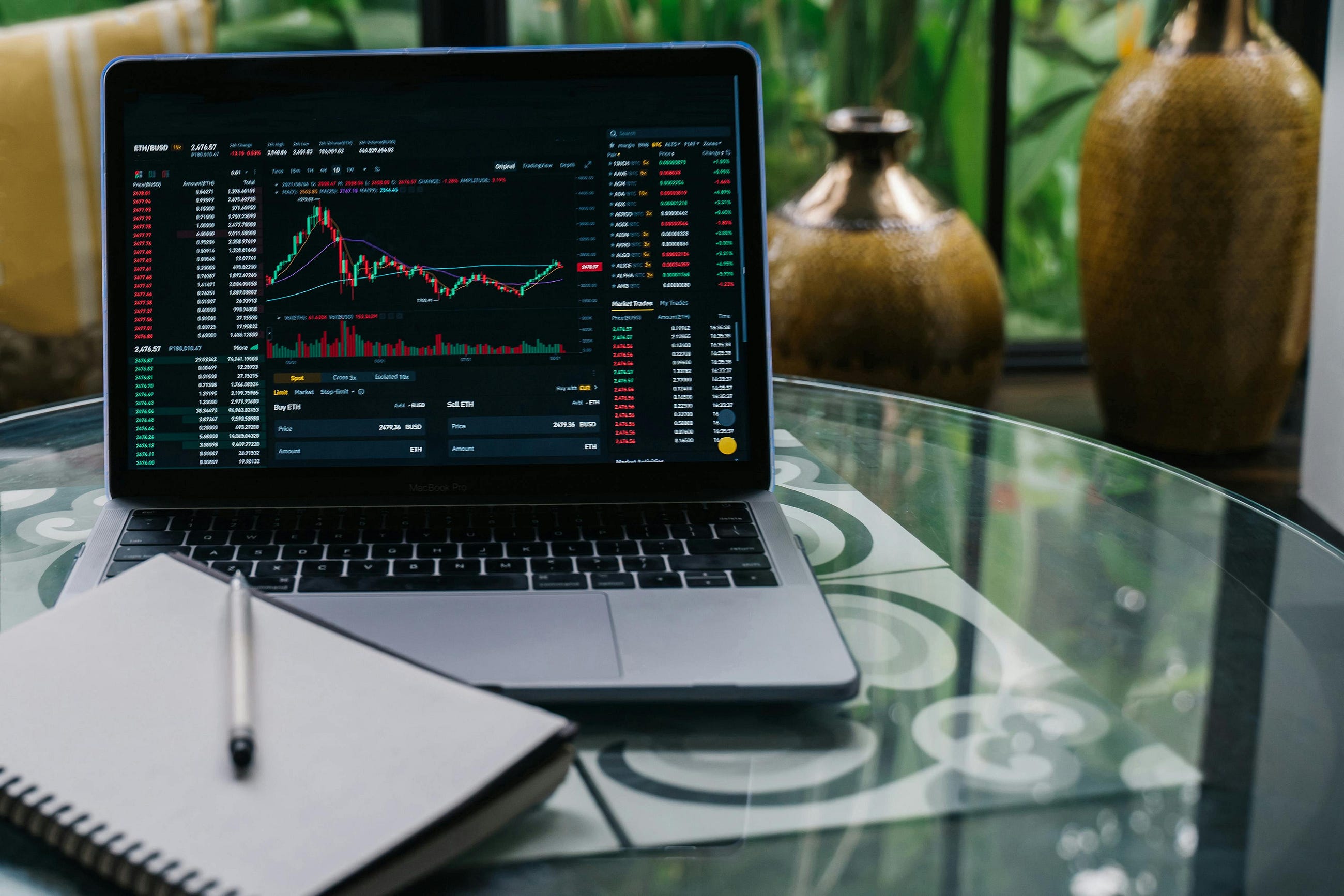
High returns in risky places aren’t a signal. They’re a bribe.

When it comes to climate change, Chief Science Advisor to Barack Obama, John Holdren, said it best:
“We basically have three choices: mitigation, adaptation, and suffering. We’re going to do some of each. The question is, what the mix is going to be?
— John Holdren
Most coverage still treats mitigation as the only story. Cut emissions, sign treaties, build renewables. All essential, all largely outside your personal control. What you do directly control is your share of adaptation vs suffering. That is the gap I write to fill: practical tools for finding your climate haven and building a real adaptation plan.
Even with tools in hand, most people end up stalled at the same two mental hurdles:
“I believe you. I appreciate the resources and I plan on using them, but we’re talking 2050–2070 here. I’ve got a good thing going. I can’t uproot my life, not now! Besides, my family and friends need me here.”
or for the gamblers and the skeptics in the room:
“If climate risk were really that serious, the market would show it. The fastest growing economies are in the ‘Global South’. In America, the sunbelt is booming. If the scientists were right, that real estate would be bleeding money. I will only consider moving if, and when, these places turn unprofitable.”
If this sounds like you, or someone you know, you are in the right place. The first objection is emotional. The second is a math problem. This article tackles the second one head-on. Here’s why waiting for markets to “prove it” means putting your entire nest egg on the chopping block.
“Smart” Money
At the core of the investment statement is an age-old argument. An argument to cede individual decision making to a supposed higher intelligence.
We do this a lot more than we realize. More often than not, this deference actually does yield the right answer. It’s one of nature’s most efficient strategies. It lets us conserve resources while accelerating decision making. An absolute necessity when, so often, failing to quickly act carried a death sentence. This is why yawns and laughs are contagious. Why the concept of “uncanny valley” is so widely recognized. Why certain fears like insects, snakes, heights, and even trypophobia (not linking that one) are practically universal.

Relying on ancestral knowledge is one of the competitive advantages of our species. It’s a reason we’ve made it this far. Arguably, the entire idea behind Free Market Capitalism is to leverage human nature at scale. PhD economist Arthur Brooks certainly believes this. The “invisible hand” of the market functions much like a hive-mind for the whole economy. It usually makes decisions better than individuals. Even better than the smartest folks with the best data too.
So why does it “usually” lead to the right answer, instead of “always”? Knowingly or not, we inherently make assumptions whenever we outsource our thinking. These can be about another individual, a group, generational wisdom, or even an AI model. Among others, we assume:
- The third party is aligned with our interests / goals
- It’s using the most up-to-date information
- The information / “training data” it’s based on accurately reflects our situation

I honestly don’t think this concept would’ve landed with most before AI use became widespread. Yet, AI is only the latest iteration of intelligence outsourcing.
Markets do a halfway decent job with the first two assumptions. However, during times of fundamental or rapid change, they tend to stumble over the last one. What about Consensus Intelligence then? It can take the form of a law, a “best practice”, a piece of “common sense”, or a socially agreed-upon paradigm. These are useful bedrocks, but are inherently slow to adjust. Even individuals fall to this fallacy, if they aren’t careful. It’s the whole meaning behind the cautionary phrases: “The map is not the territory”, “The word is not the thing”, and “The menu is not the meal”.
Yet, these are precisely the situations when the dissenting opinion prevails over consensus. Usually in spectacular ways.
(Old Habits) Die Hard
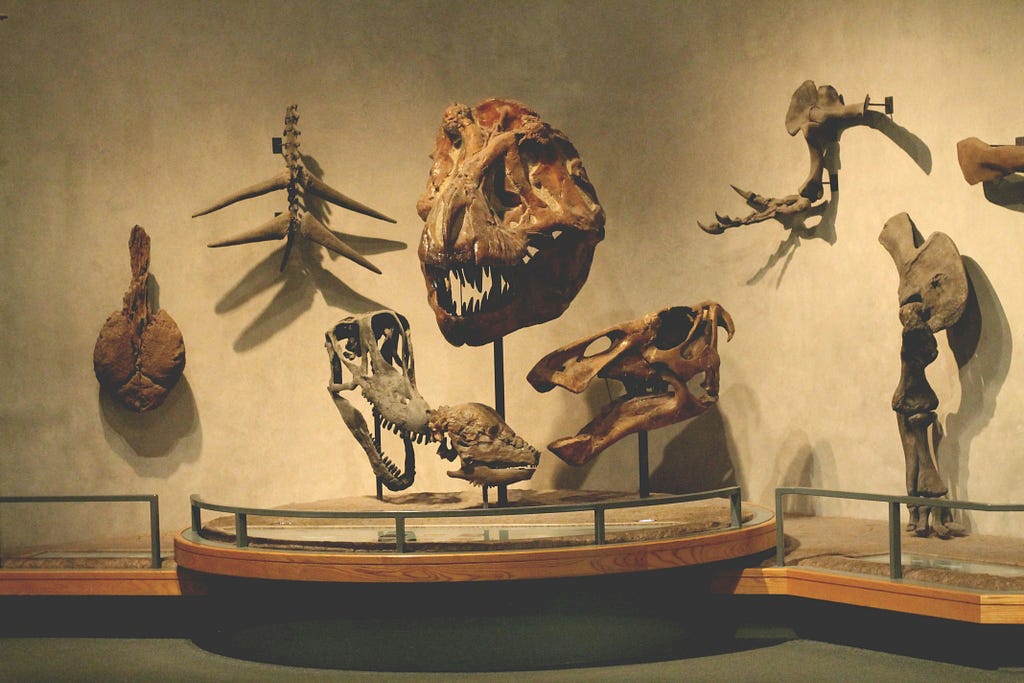
Netflix and Amazon are prime (pun always intended) examples. At their debut, most analysts thought their profit margins were too low. Their reinvestments: unlikely to ever pay off. They didn’t stand a chance against the huge incumbents in their industries. This outdated conventional wisdom persisted a shockingly long time. These conclusions were still repeated a full decade after the companies’ founding. Even after they proved the territory had fundamentally shifted, consensus still lagged.
Kodak is a perfect example from the other side. They invented the world’s first digital camera but purposefully mothballed their own invention. Why? To protect their existing film-based business. Conventional wisdom, at the time, was that digital cameras were of low quality. They could never compete with high fidelity film. Six years on, an internal investigation revealed that digital cameras would replace film within a decade. Despite competitors’ digital investments, Kodak doubled down on the outdated consensus. Habits die hard, even in the face of clear data.
Consensus Intelligence is right, until suddenly, it’s dead wrong.
These are case studies on the inherent short-term bias in markets at large. Quarterly reports regularly win out over decades-long investments. “Short-termism” is was what led to the demise of Blockbuster and diminishment of Kodak. Even future-oriented sectors are more shortsighted than you might think. Election cycles are two to four years. Private Equity typically doesn’t look past six. A Venture Capital fund’s lifecycle is ten years.
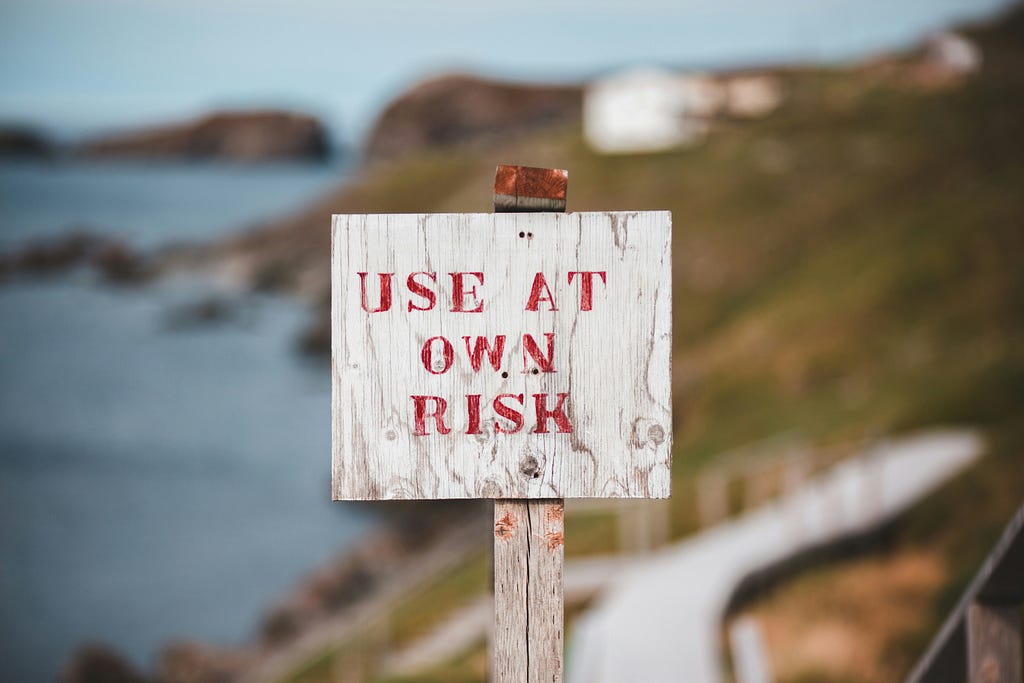
Paradoxically, climate risks play into WHY returns in these areas are high, at least in part. For those that slept through Finance 101, let’s recall two key concepts. Risk = reward and no such thing as a free lunch. Another way to say that: something that looks too good to be true, probably is. In practice, if you’re reaping above average returns, you’re also taking on above average risk. Your conscious awareness of them (or lack thereof), doesn’t change the math. Crypto folk know this all too well by now.
Let me put this in plain English:
Miami is such a hot market right now because you’re taking on the risk of your building flooding any given year.
States like Texas need to offer perks, like a 0% income tax rate, to be competitive. People need an incentive to endure the drought, heat waves, and power outages. Unfortunately, these just come with the territory, and are only getting worse. The full brunt of climate risk isn’t yet priced in. However, its effect is present and will only grow over time; eventually we will reach a tipping point.

Let me be clear, this is not the time nor place for brinksmanship. At least not for the average person. In return for a decade (maybe less) of quick gains, you risk the entire nest egg.
Do Not Pass Go; Do Not Collect $200
Fundamentally, people are not businesses. They do not have the same needs and do not behave in the same way. Relying on the business sector to guide your personal livelihood decisions is a category error. It’s a violation of the first assumption of outsourced intelligence we discussed earlier.
Look, I get it, “concentration of risk” and “cognitive frameworks” are all too abstract. So, let’s bring it back down to earth… to your mortgage.

The average person’s largest asset is their home. A full 92% of individuals own their homes for at least six years, with 47%+ owning their homes over a decade. In certain regions, the average can be as high as 19 years.
Neither your time horizon nor risk profile is the same as an institutional investor’s.
Consider that, for most people, 15–30 year mortgages are the norm. Lenders have the legal right to force you to insure their loan. That should tell you everything you need to know. You take an existential risk by staying put in a climate danger zone. Your largest asset could become uninsurable, unsaleable, or non-existent… overnight. The tightening noose of a mortgage, without an asset, leads straight to bankruptcy.
We’ve seen it all before, most recently with the 2025 Palisades Fire in LA.

State Farm, the largest insurer in California, looked at their data and saw the writing on the wall. By May 2023, they stopped accepting new policies in the fire-prone neighborhoods. The following year, they canceled over 72,000 policies in those areas. 1,500 cancellations for homes in the Pacific Palisades… mere months before the largest fire in state history. Louisiana fared even worse in 2021 after Hurricane Ida. At least 11 insurance companies went bankrupt after that storm.
That’s 60,000 people left without their home and largest asset, with payments still due next month.
It’s a cold calculus that every insurance company is obliged to make. Yet, it glosses over the human cost: the families on the other side of that equation. Their home, most of their belongings, and their vehicles destroyed… without compensation. On top of their literal (and sometimes figurative) underwater mortgage, they now also owe rent. Bankruptcy becomes the only way out.
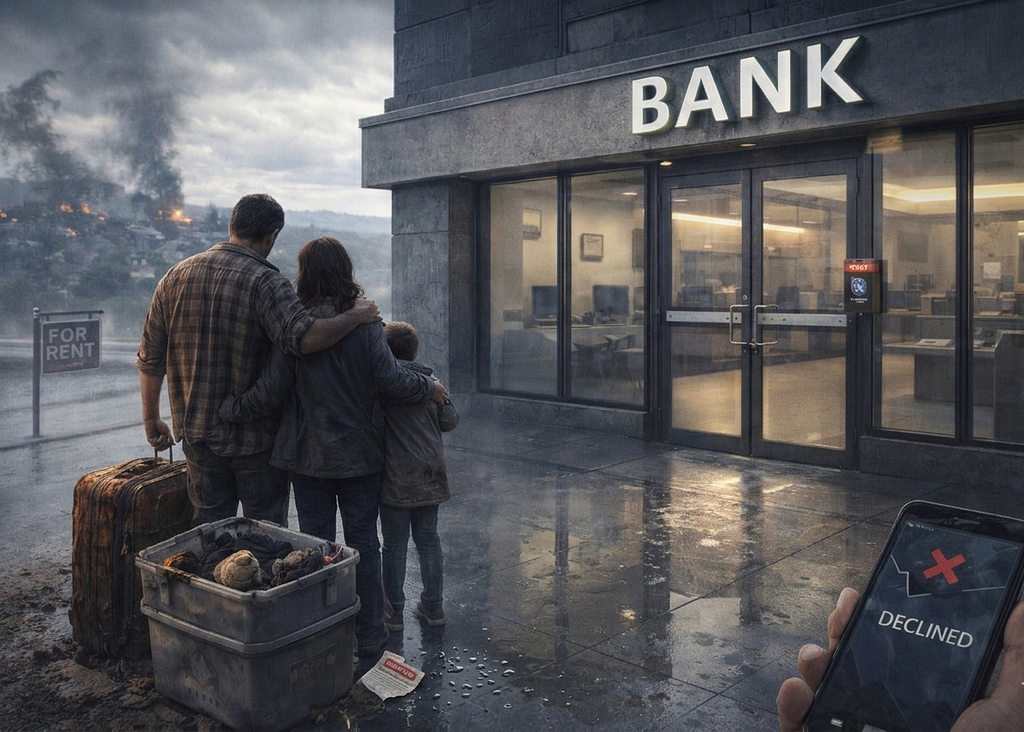
As if adding salt to the wound, their credit is destroyed as well. The real injustice is that this all happens at their moment of greatest need. Credit was their lifeline to relocate to safety and reestablish their lives; it too now lies in ruins. Let’s take a moment to remember that:
A bank is a place that will lend you money if you can prove that you don’t need it.
— Bob Hope
Life comes at you pretty damn fast sometimes. I know, because a version of this story played out in my own family.
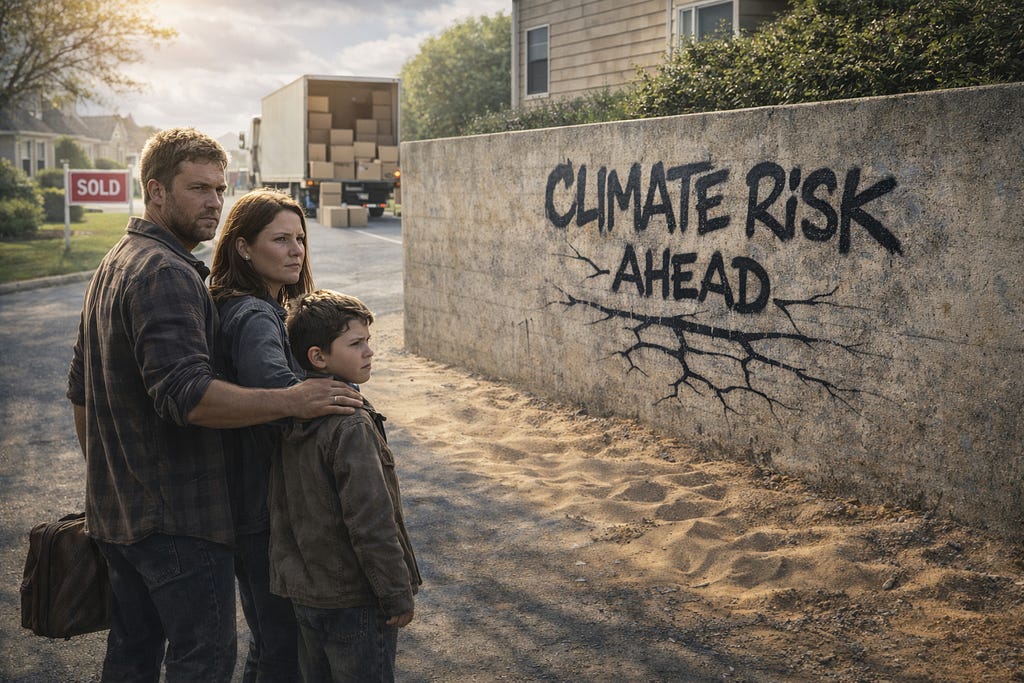
Yet, an entirely different version of these events could’ve transpired. What if, even a year prior, they would’ve realized their nest egg was built on climate quicksand? They would’ve been able to sell their house, potentially even for a handsome profit. Build the courage to look at the writing on the wall, even if the consensus is to look away. It may be the only thing between your family and utter ruin.
“Be fearful when others are greedy, and greedy only when others are fearful.”
— Warren Buffett
Survivor’s Guilt
We may be tempted to think that those the disaster passed by are lucky. The remaining households are breathing a sigh of relief today. However, I promise you it’s not all sunshine and daisies in the neighborhood. Tomorrow, they must shoulder the burden. In the wake of a disaster, like Hurricane Ida, insurance rates hike up to 82%.
I’ve talked about “doom loops” and Derailment Risk before, especially about the interplay between debt and climate. Today, however, I’m referring you to the authority on the subject. That would be Hamilton Nolan, an award-winning journalist for The Guardian and The Times. He describes exactly how disasters are crippling state-run insurers of last resort and the federal government. His concluding thoughts from years of research are nothing short of chilling:
These disasters will ultimately force a re-shaping of American culture as we know it.
Those links are all great reads, but in short, he describes a death spiral which looks something like this:
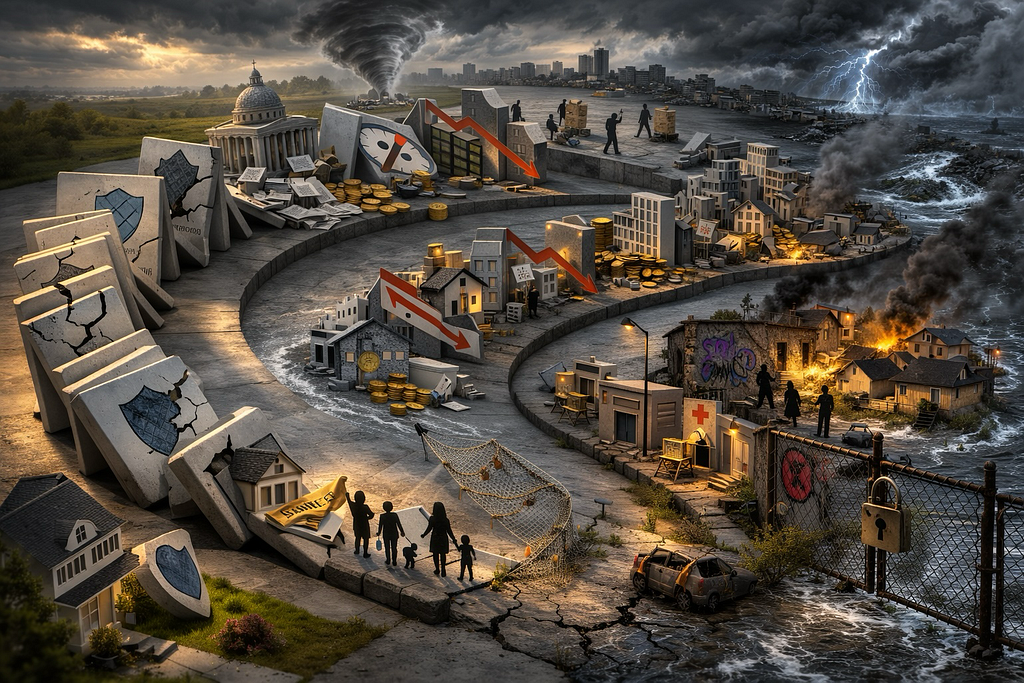
- Climate change forces private insurers to leave or go bankrupt.
- State Insurers of Last Resort are forced to pick up the pieces.
- State insurers face catastrophic losses exceeding their capacity.
- Remaining insurers raise costs; governments raise taxes to fund bailouts.
- More insurers, and now wealthier individuals, leave the market.
- House prices plummet due to foreclosure and a mismatch of supply vs. demand.
- An already strained state and local government loses its tax base.
- Social safety nets, state insurance, and public services are cut.
- Families left unemployed or bankrupt by storms lose their remaining income and protection.
- Gangs, drugs and violence take root in the vacuum.
- Remaining residents are locked into continually worsening conditions.
Rise and Fall
This isn’t just conjecture; it’s precisely what happened in Detroit at the turn of the century. These days, it’s hard to imagine Detroit synonymous with anything other than urban decay. However, in the 1950’s, it was America’s 4th largest metro and the beating heart of economic opportunity. Droves of young people were flocking there in a new age gold rush. Echoes of this era are still visible today, but only if you know where to look.

“Colossus” isn’t an exaggeration here. You’re looking at the largest cast bronze statue commissioned since the Italian Renaissance, complete with a 45 foot tall marble backdrop. Just think of the optimism this city must’ve had to build it.
Yet, by 2010, Detroit had lost over a million residents. One in three properties sat boarded up and foreclosed. House prices plummeted by -82% in two years. Tax bills, based on the prior values, amounted to 15x the current value of the home. The truth is:
If it happened in one of the largest cities, in the richest country on earth, it can happen anywhere.
There’s a reason why cyberpunk cornerstones like Robocop and even the reboot of Deus Ex are set here. This genre is well known for its unfiltered (if not over-the-top) warnings.
Keep in mind that Detroit only faced one crisis: an economic one. Today, the “Too Big to Fail” cities of the American (and Global) South are not so lucky. They’re facing a climate disaster AND an economic one in its wake. Yet, most continue to bet their livelihoods on a game of Russian Roulette.

Vote With Your Feet
Playing financial brinksmanship with a looming existential threat is not a winning gambit. Sustainable gains only come from stable, well collateralized regions. Debt is a double edged sword. When deployed carefully, strategically, it’s a force multiplier that creates class mobility. It also magnifies losses and can destroy a fortune faster than you can think. What happens when debts are called and the assets backing them are found lacking? They become impaired, too high risk to insure, and the entire system collapses. Knowingly or not, this IS the fire you’re playing with living in a high climate risk area.
It’s one thing if you’re well diversified: own businesses across states and countries; but most are not so lucky. It’s another thing entirely when an underwater mortgage spells “game over” for you and your family. Being locked into an increasingly dangerous area, with ever fewer opportunities, is a death knell. Yet today’s economy is such, that most of us can only afford to keep our eggs in a single basket, while still making ends meet.
For the average person, a base in a climate secure region is by far their best bet.

That bet starts with building a Plan C (for climate, obv), before the doom loop comes a knocking.
Just remember that financial risks are only the tip of the iceberg. My next article is about the rest of them. We still have our first question to address, after all. It’s the unspoken barrier that prevents so many from taking their future into their hands. Stay tuned, especially if you’re still amongst the hesitant.
The TL;DR
- You don’t control the world’s mitigation pace.
- You do control how much of your future is adaptation vs suffering
- Each day waiting is a vote for more suffering
- Markets are a lagging indicator, insurance is a leading indicator.
- Markets are inherently short term biased, and historically anchored
- Insurers only survive with strong predictions, grounded in reality
- High returns in risky regions aren’t a contradiction.
- They’re incentive for taking climate risks, only some of which are priced in today.
- The doom loop is the real danger.
- You can’t diversify away a blown-up primary asset.
- Treat relocation as risk management.
- Build a “Plan C” early enough that you sell on your terms.
This article is the seventh of an ongoing series that demystifies climate science, its impacts, and provides tangible tools for individuals to take action. You can read the other articles below.
List: Your Personal Guide to the Climate Crisis | Curated by Stanislav Sinitsyn | Medium
The Climate Housing Trap was originally published in DataDrivenInvestor on Medium, where people are continuing the conversation by highlighting and responding to this story.