The Battery That Married Itself!!
Uncle Rwamiti explains why some unions create light, others only heat — and why wholeness must come before partnership.
--
There was laughter in the workshop that morning.
A young mechanic named Ssenfuma had just seen a story on his phone about a woman in the city who had held a ceremony and “married herself.” He nearly dropped a spanner from amusement.
“Uncle Rwamiti,” he shouted, wiping grease from his hands, “have people now become transformers? How can someone marry herself?”
The other men laughed. Even the tea boy smiled.
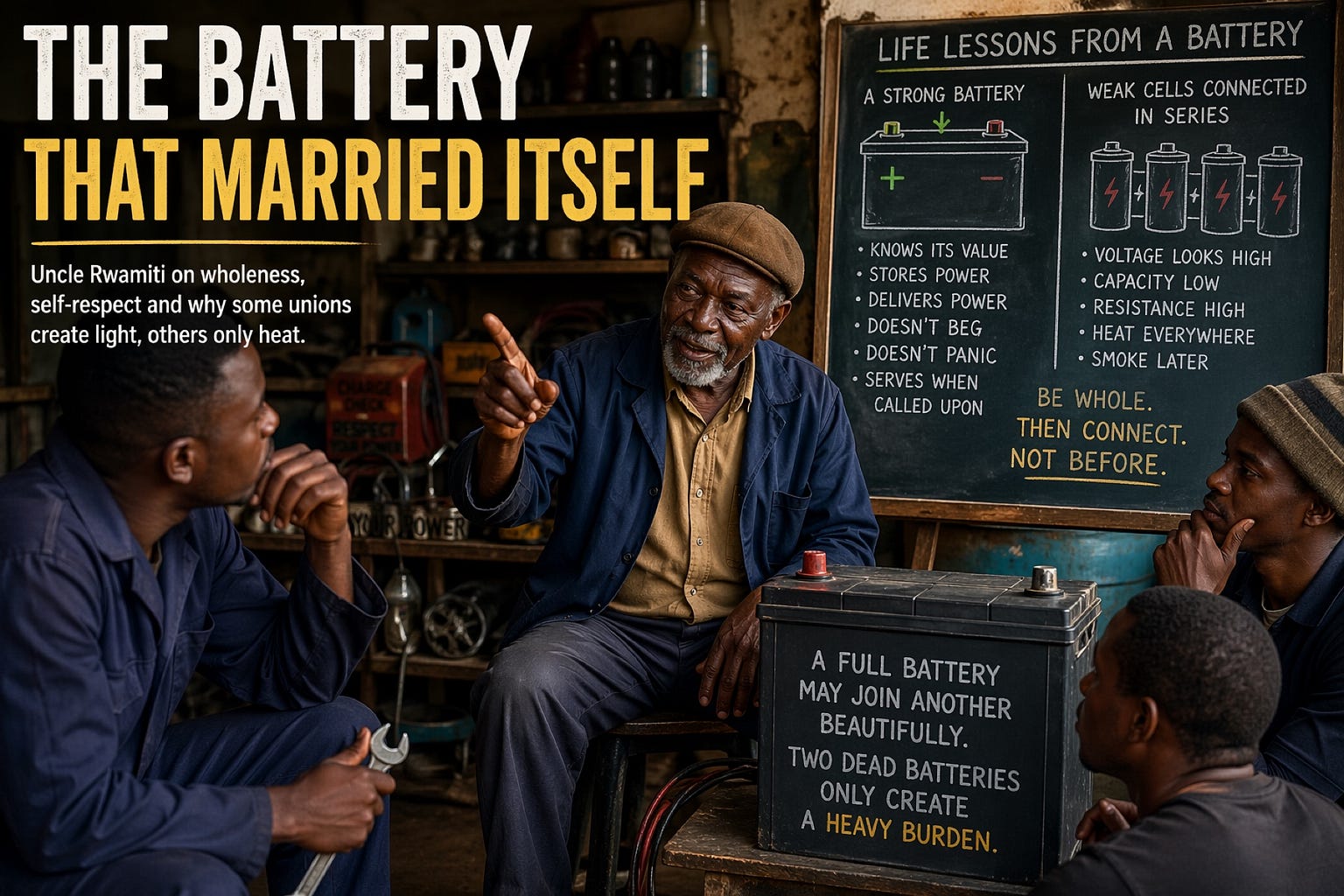
Uncle Rwamiti, who had been seated quietly on an upturned battery crate, did not laugh. He merely adjusted his cap, sipped tea slowly, and looked toward the row of batteries charging in silence.
“My sons,” he said at last, “the mouth runs faster than the mind.”
That usually meant trouble — or wisdom.
He pointed at a large battery bank recently brought in from a lodge outside Kampala. It was expensive, imported, powerful, and spotless.
“Tell me,” he said, “does that battery beg another battery in order to exist?”
The workshop became quiet.
“No,” said one mechanic.
“Does it cry at night because no inverter has praised it?”
Laughter again.
“No, Uncle.”
“Does it reduce its voltage because the neighbouring battery has rejected it?”
Now they were grinning.
Uncle Rwamiti nodded.
“That battery knows its value. It stores power. It delivers power. It serves when called upon. It does not panic because it is standing alone.”
He tapped the casing gently.
“Some people are like this battery. Complete. Stable. Useful. Calm.”
Ssenfuma smirked. “But Uncle, people are not batteries.”
“Exactly,” said Rwamiti. “People are worse. Batteries at least know when they are drained.”
Even the tea boy laughed loudly at that.
He continued.
“Many people rush into relationships like weak cells connected in series. The voltage looks impressive from outside. Wedding photos. Loud music. Matching outfits. But inside? Capacity low. Resistance high. Heat everywhere.”
The men burst out laughing.
“One partner is insecure. The other is dishonest. One wants money. The other wants rescue. Yet they announce to the world they are a powerhouse.”
He paused.
“Then six months later, smoke.”
The workshop shook with laughter.
Ssenfuma, now listening seriously, asked, “So what is this self-marriage then?”
Uncle Rwamiti leaned back.
“It is not about rejecting love. It is about ending self-neglect.”
He pointed again to the battery bank.
“A wise owner first checks the health of each cell before connecting it to another. But many humans do the opposite. They enter union hoping the other person will repair what they themselves have ignored.”
He raised one finger.
“A lonely person marries for escape.”
Second finger.
“A wounded person marries for healing.”
Third finger.
“A confused person marries for identity.”
Then he spread all five fingers.
“And later blames marriage for failing.”
Silence settled over the workshop.
“So when someone says, ‘I marry myself,’” Rwamiti continued, “perhaps what they mean is this: I choose to honour myself. I will become whole. I will stop abandoning my own life while waiting for someone to complete it.”
He smiled.
“A full battery may join another battery beautifully. But two dead batteries only create a heavy burden.”
The tea boy nearly spilled the cups laughing.
Ssenfuma scratched his head.
“So Uncle… should people never marry?”
Rwamiti chuckled.
“Who said that? Even batteries work better in the right system.”
He stood slowly and dusted his trousers.
“Marriage can be beautiful. Partnership can multiply joy. But union is sweetest when entered by two people who already have current.”
He began walking away, then turned back.
“Remember this also: being alone is not the same as being empty. And being married is not the same as being charged.”
The workshop fell silent.
Even the old alternator in the corner seemed to agree.
That afternoon, no one mocked the woman from the city again.
And Ssenfuma, for the first time in his life, tested his own battery before laughing at another person’s wiring.
Edited by Tanmoy Das