In Max Barry’s scathing satirical thriller Jennifer Government, the world has been privatized.
The United States government has been reduced to a vestigial organ. It has no tax revenue, no army, and no power. The real power lies with the Corporations.
The world is divided into two massive trade blocs: US (the Americas) and Australian (the rest of the world). But the borders that matter aren’t geographic; they are corporate.
In this world, your job isn’t just what you do; it is who you are. Literally.
Citizens take the surname of their employer.
· If you work for Nike, your name is John Nike.
· If you work for the Police (which is a privatized mercenary firm), your name is Hackett Police.
· If you are unemployed, you take the surname of the government, which marks you as a pariah. You become a Government.
The plot kicks off when John Nike, a high-ranking marketing executive, decides to launch a new line of sneakers ($2,500 Mercurys). To ensure the launch is a success, he decides to generate “street cred.” He hires a low-level employee to assassinate teenagers who buy the shoes.
His logic is cold, corporate, and terrifyingly sound: If people are dying to get the shoes, the shoes must be valuable.
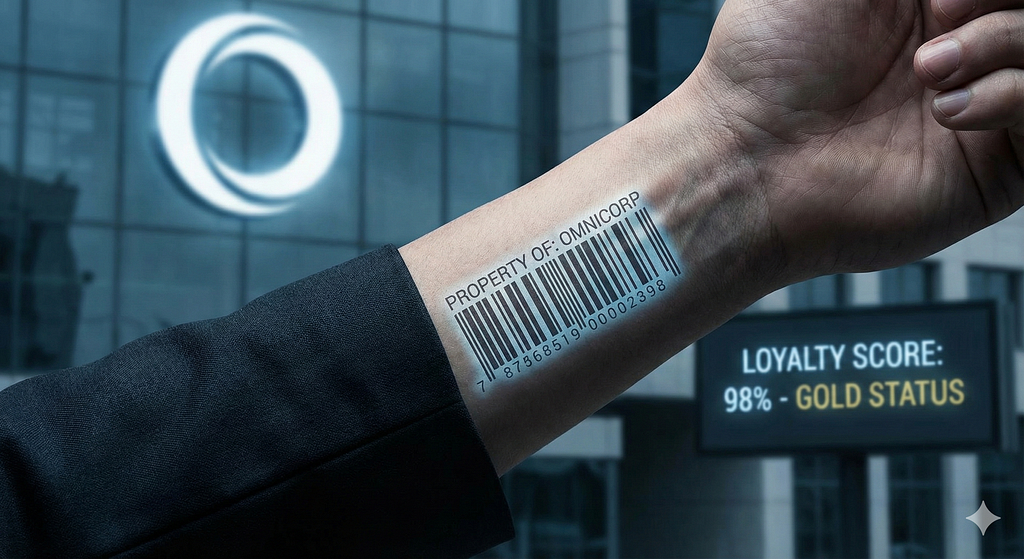
Opposing him is the titular character, Jennifer Government. She is a relentless agent with a barcode tattoo under her eye. She is the last remnant of civic duty in a world that only values shareholder value. But even she is hamstrung; in this world, the police only investigate crimes if the victim (or the victim’s family) can foot the bill. Justice is a premium subscription service.
I find Jennifer Government to be the most prophetic dystopian novel of the 21st century.
We aren’t taking our employer’s surnames yet. But we are getting close.
We are witnessing the rise of Corporate Feudalism.
· We see Tech Giants building “Company Towns” (Google Bay View, Amazon HQ2) that provide housing, food, healthcare, and transportation.
· We see “Lifestyle Brands” that demand total ideological alignment from their employees.
· We see AI systems that track our health (“Wellness Programs”) and dictate our behavior.
We are entering an era where the Corporation is trying to replace the State. They don’t just want your labor; they want your Citizenship. They want you to be a “Googler” or an “Amazonian” first, and a human being second.
Here is why the “John Nike” mindset is a trap, and why you must maintain a separation of Church (Self) and State (Company).
1. The Surname Problem (Identity Capture)
The genius of Barry’s satire is the surname rule. It makes the subtext text.
When you introduce yourself as “John Nike,” you are declaring that your primary allegiance is to the brand. Your biological family, your history, and your individuality are secondary to the corporate entity that signs your check.
The Corporate Reality: The “Cult” of Culture
I see this Identity Capture happening in Silicon Valley and beyond.
Companies are no longer satisfied with “Employee Engagement.” They want Identity Fusion.
· The Language: We use cult-like terminology. “We are a family.” “We bleed blue.” “Once a Marine, always a Marine.”
· The Swag: Employees wear branded hoodies, drink from branded bottles, and decorate their laptops with branded stickers. They are voluntarily branding themselves like cattle.
· The “Campus”: By providing 3 meals a day, gyms, nap pods, and laundry service, the company ensures you never have to leave. They are creating a womb.
The Strategic Risk: The Loss of the Dissenter
If your name is John Nike, you cannot criticize Nike. To criticize the company is to criticize yourself.
· The Blind Spot: When employees merge their identity with the corporation, they lose the ability to see ethical failures. They rationalize bad behavior (like the shoe assassinations in the book) because “It’s for the good of the Family.”
· The Fragility: When a “John Nike” gets laid off, they don’t just lose a job. They lose their name. They experience a total psychological collapse because they have no “Self” left outside the office.
The Fix: The “Mercenary” Mindset
As a leader, you should actually discourage total identity fusion.
· The Shift: Encourage employees to have “Side Hustles,” hobbies, and public identities that have nothing to do with your company.
· The Logic: You want a team of confident, independent professionals who choose to work for you, not a cult of dependent drones who are afraid to leave the compound.
2. The Loyalty Program as Citizenship (The Ecosystem Trap)
In the book, your social status is determined by your “Customer Loyalty.”
There are VIP lounges for people with high status. There are slums for people with low status. Your access to the world is gated by which brands you subscribe to.
The Corporate Reality: The Walled Garden
We are rapidly moving toward a world where your Digital Ecosystem determines your rights.
· Apple vs. Android: This is a soft version of the US/Australia trade blocs. If you are in the Apple ecosystem (Blue Bubbles), you have a different social experience than if you are out (Green Bubbles).
· Amazon Prime: This is effectively a tax you pay for access to the logistics infrastructure of the modern world.
· De-Platforming: If Google locks your account, you don’t just lose your email. You lose your photos, your documents, your calendar, and your identity. You become a non-person.
We are trading “Civil Rights” (guaranteed by the state) for “User Agreements” (granted by the corporation).
The Strategic Risk: Algorithmic Exile
In the book, if you don’t have the money to pay the police, you have no justice.
In 2026, if you trigger an AI flag, you have no recourse.
· The Scenario: An AI algorithm at a bank flags your business for “Suspicious Activity.” Your assets are frozen.
· The Reality: You cannot call the government; they can’t help. You cannot call the bank; there is no human to talk to. You are at the mercy of the Terms of Service.
The Fix: Diversified Citizenship
· The Personal Rule: Never let one company own your Identity (Email), your Memory (Photos), and your Wealth (Bank). Diversify.
· The Corporate Rule: Do not build your business entirely on someone else’s platform (e.g., a business that only exists on Facebook or TikTok). If you do, you are a serf on their land.
3. The “Guerilla” Marketing (The Algorithm of Violence)
The most shocking plot point in Jennifer Government is the marketing plan.
John Nike doesn’t want to kill kids because he hates them. He wants to kill them because Violence creates Value.
He knows that if the news reports “Kids are killing each other for these shoes,” the desire for the shoes will skyrocket. He is hacking the human desire for scarcity and danger.
The Corporate Reality: Rage Farming
We aren’t shooting kids in malls (usually), but we are engaging in Algorithmic Rage Farming.
· The Social Media Model: The algorithms of Facebook, Twitter/X, and TikTok are designed to amplify “High Arousal Emotions.” The highest arousal emotion is Anger.
· The Incentive: To sell ads (shoes), these platforms deliberately show users content that makes them furious, radicalized, and depressed.
· The Result: We have teenage depression epidemics, political violence, and polarization.
John Nike is alive and well. He is just an algorithm now. He is promoting “Digital Violence” because it increases “Time on Site.”
The Strategic Lesson
Growth at any cost is a suicide pact.
· The Question: If your marketing strategy relies on making people feel inadequate, angry, or afraid, you are John Nike.
· The Pivot: You must measure “Negative Externalities.” If your engagement numbers are up, but your userbase is miserable, you are building a fragile brand. Eventually, Jennifer Government comes for you.
4. The Privatization of Truth (The Verification Checkmark)
In the novel, truth is a commodity.
If a crime happens, it didn’t “really” happen unless you can pay the police to write a report. The official record is a ledger of transactions.
The Corporate Reality: The “Blue Check” Economy
We are seeing the privatization of Truth and Verification.
· On Twitter/X and Meta, “Verification” (being a real person) is now a paid feature.
· The Implication: If you pay, you are real. If you don’t pay, you are a bot/peasant. Your voice is suppressed by the algorithm.
Furthermore, we are moving to a world where AI defines the Truth.
· If ChatGPT says something happened, millions of people believe it.
· But who owns ChatGPT? A private corporation.
· Therefore, a private corporation decides what is true.
The Strategic Risk: The Distortion Field
If you rely on a corporate AI to tell you the truth about the market, you are seeing a curated reality.
· The Scenario: You ask an AI, “What are the risks of using this software?”
· The Bias: If the AI is owned by the company that makes the software (e.g., Microsoft Copilot analyzing Azure), will it tell you the whole truth? Or will it give you the “Marketing Approved” truth?
The Fix: Independent Audits
· The Rule: Never trust a vendor’s AI to audit the vendor’s performance.
· The Need: We need “Public Libraries” of AI: open-source, non-profit models that serve as a check against the corporate narrative.
5. The Gig Economy of Ethics (The Subcontractor)
John Nike doesn’t pull the trigger himself.
He hires a desperate, low-level employee named Hack Nike. He subcontracts the violence.
This gives him Plausible Deniability. “I didn’t kill anyone. I just approved a marketing budget. What the contractor did is on him.”
The Corporate Reality: The AI Shield
This is the exact function of Algorithmic Management.
· The Scenario: Uber doesn’t want to pay a minimum wage. So, it uses an algorithm to “nudge” drivers. If the driver makes below minimum wage, Uber says, “They are independent contractors. The algorithm sets the price, not us.”
· The Scenario: An insurance company uses AI to deny claims. When patients die because they were denied care, the CEO says, “The model made the decision based on the data. It wasn’t me.”
We are using AI as the “Hack Nike.” We are using it to do the dirty work (firing, denying, surveilling) so that we can keep our hands clean.
The Strategic Lesson
You cannot outsource ethics.
· The Principle: If your algorithm does it, you did it.
· The Law: Regulations (like the EU AI Act) are catching up. The “John Nike Defense” (It wasn’t me) will not hold up in court much longer.
· The Fix: You must be able to explain why the decision was made. If the AI is a “Black Box,” you cannot use it for high-stakes decisions.
Conclusion: Don’t Take the Name
The hero of the book is Jennifer Government.
She is flawed. She is broke. She has a barcode tattoo under her eye (a remnant of a past mistake).
But she has one thing John Nike doesn’t: A Code.
She believes that some things (justice, safety, truth) cannot be bought. She believes that a person is more than their job title.
The climax of the book isn’t a gunfight; it’s a choice. The characters have to decide whether to buy into the system or break it.
As we navigate the AI revolution, we are being offered a “John Nike” contract.
· The contract says: “Give us your data, and we will give you convenience.”
· The contract says: “Give us your identity, and we will give you status.”
· The contract says: “Let the AI decide, and you will never have to worry.”
It is a seductive offer. It is the offer of the Company Town.
But the cost is your name.
As leaders, we must build organizations that respect the boundary between the Human and the Brand.
· We must build companies that create value, not just extraction.
· We must use AI to serve the citizen, not to control them.
And as individuals, we must remember the most important lesson of the barcode tattoo:
Your job is what you do. It is not who you are.
Don’t let them put the barcode on your soul.
Don’t take the name.
The Barcode Tattoo: What Jennifer Government by Max Barry Teaches Us About Corporate Feudalism was originally published in DataDrivenInvestor on Medium, where people are continuing the conversation by highlighting and responding to this story.