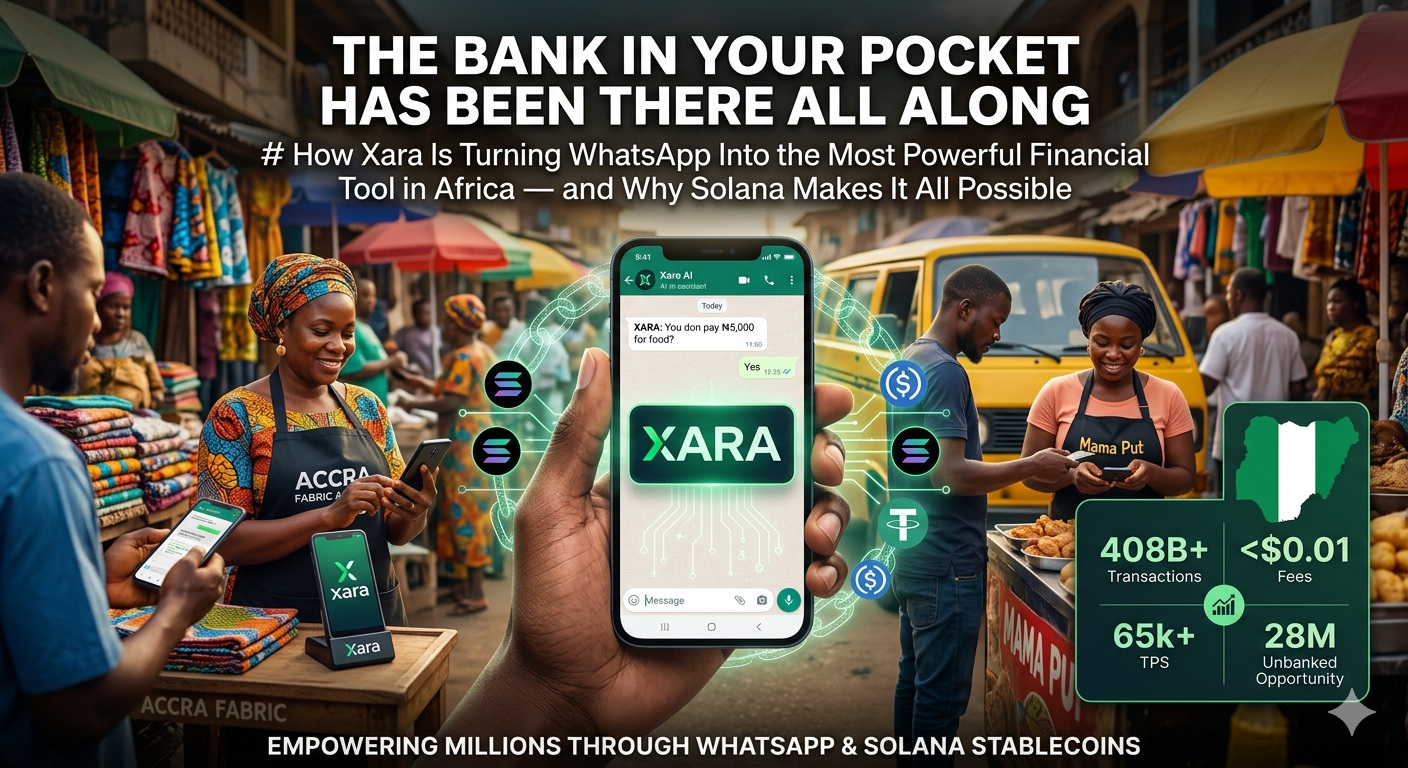
The Bank in Your Pocket Has Been There All Along
--
How Xara Is Turning WhatsApp Into the Most Powerful Financial Tool in Africa — and Why Solana Makes It All Possible
By Ridwanullahi Omotosho Adam
There is a moment — unremarkable, almost invisible — that happens millions of times a day across Nigeria.
Someone needs to pay for lunch. Or settle a debt. Or send money to a relative three states away. They pick up their phone, navigate to a banking app, wait for it to load, battle a cluttered interface, enter account numbers twice, confirm a transfer, and wait — hoping it goes through.
This process, which banks describe as “seamless,” takes between 3 and 8 minutes on a good day. On a bad one, you’re staring at a spinning wheel, wondering if your ₦20,000 just vanished into the ether.
Sulaiman Adewale, a Nigerian software engineer, watched this happen one too many times. Not in a boardroom. Not in a product discovery workshop. In real life, watching ordinary people wrestle with the supposedly modern infrastructure built to serve them. His response was not to build a better banking app. It was to ask a more radical question: What if the bank could come to where people already are?
The answer was Xara.
The Insight Nobody Was Looking For
Here is a fact so obvious it becomes invisible: WhatsApp is the operating system of Nigerian social life.
Not Instagram. Not TikTok. WhatsApp. The app where market women coordinate supply orders. Where families keep group chats spanning three generations. Where churches broadcast sermon notes and mechanics send voice notes confirming repair prices. Of Nigeria’s 31.6 million social media users, 95% are on WhatsApp. Including, crucially, the grandmother who has never downloaded a banking app but has been sending voice notes since 2019.
Adewale saw what most fintech builders missed: the interface wasn’t the problem; the destination was. Every bank in Nigeria was asking users to come to them. Xara decided to go to the users; right into the chat window they already had open.
Launched in June 2025, Xara is a multimodal AI banking assistant that lives entirely inside WhatsApp. You add its number like you’d add a friend. Then you talk to it. “Send ₦10,000 to Abubakar for breakfast.” “Pay my electricity bill.” “How much did I spend on food last week?” Xara understands. Xara acts. Xara responds.
In its first two weeks, the platform registered 10,000 users and processed over ₦135 million in transactions. Demand was so fierce the team had to temporarily pause new sign-ups to scale their backend. That is not a product struggling to find product-market fit. That is a product that arrived exactly where it was needed.
What Xara Actually Does (And Why It Matters)
The feature list sounds almost absurdly simple, which is precisely the point.
Send money to any Nigerian bank. Not just a few partner banks; 50+ institutions. You can type the request, snap a photo of an account number written on a piece of paper, or send a voice note in Nigerian Pidgin. Xara reads it, interprets it, confirms the details, and sends. No app switching. No copy-pasting. No loading screens.
Track and understand your spending. Xara categorises your transactions — transport, food, utilities, personal care — and presents them back to you in language that makes sense. Not pie charts buried in a dashboard. Just a message: “You’ve spent ₦45,000 on food this month, which is ₦12,000 more than last month.” Insight delivered as conversation.
Pay bills without the call centre. Airtime. Data. Electricity. All through chat. No hold music. No chatbot that only understands three keywords. Xara is smart enough to handle ambiguity, ask for clarification, and keep the transaction moving.
Context memory. This is the feature that separates Xara from every voice assistant that forgets you the moment you exit. Xara remembers. If you paid your NEPA bill last month through a particular distributor, it remembers. If you always send money to the same four people, it knows their details. The experience becomes progressively more personal — like a financial assistant who has been working with you for years, not weeks.
The platform is trained on multimodal data, which means it can process text, images, and voice. It handles accented Nigerian speech patterns. It understands Pidgin. It is currently expanding to Hausa and Yoruba. This is not a product built for a generic African user. It was built for specific Nigerian lives, in specific Nigerian contexts, in the languages Nigerians actually use.
Security: The Quiet Rebellion Against 419 Paranoia
Nigeria’s fintech landscape carries a particular kind of weight: the weight of distrust. Decades of financial fraud, failed apps, and vanished balances have made Nigerians cautious with their money in ways that make perfect psychological sense. Early Xara users voiced exactly this concern.
Adewale’s response was to build security that fits Nigerian realities — not just compliance checkboxes.
Every transaction requires a custom PIN set during onboarding. Biometric authentication guards the app itself. The entire Xara chat can be hidden inside a locked folder, accessible only by fingerprint or face ID; useful on a continent where phones are shared, borrowed, or simply seen by others in close quarters. If a phone is lost or stolen, accounts can be frozen from any WhatsApp device, instantly.
Xara is now certified by Nigeria’s Data Protection Commission (NDPC). It runs on WhatsApp’s own end-to-end encryption. And critically, Adewale has stated publicly that the only data the platform retains is transaction records for dispute resolution — not personal banking details.
What builds trust in a low-trust environment? Transparency, consistency, and time. Adewale described a pattern emerging among new users: “I’ve seen a lot of users put ₦1,000 first, then ₦5,000, then ₦10,000. After a few days, they start relying completely on the system.” Trust is earned incrementally. Xara is earning it.
Now Add Blockchain. Not as Hype but as Infrastructure.
This is where the story shifts from clever to consequential.
Xara now supports USDT and USDC deposits via Solana. For some readers, this sentence will feel like a non-sequitur — a crypto flourish appended to a real-world banking story. It is not. It is, in fact, the most important sentence in this piece.
Let me explain why by starting with a problem you already know.
If you have ever tried to receive money from someone outside Nigeria; a diaspora relative, a client in the UK, a partner in the US, you know the friction intimately. Traditional international transfers through legacy banking rails are slow (2–5 business days), expensive (fees ranging from 5–10 percent), and opaque. By the time the money arrives, something has been shaved off by an intermediary you never agreed to work with.
Stablecoins which is a digital currencies pegged to the US dollar, like USDT and USDC solve this at the infrastructure level. They move in seconds. They cost fractions of a cent. They are borderless. And Solana, the blockchain on which Xara’s crypto support is built, is the fastest, most cost-efficient public blockchain currently operating at scale.
Here are the numbers that matter: Solana processes transactions at speeds that outpace most legacy payment networks, with fees that are negligible by design. It has completed over 408 billion transactions since its 2020 mainnet launch. Its consensus mechanism which is a combination of Proof-of-Stake and a novel Proof-of-History model; allows it to validate transactions in parallel rather than sequentially, eliminating the bottlenecks that plague older chains.
Ghana’s president, speaking at the African Fintech Summit, said it plainly: over 60 percent of Africa’s population remains unbanked. Blockchain technology especially Solana offers an opportunity to redefine financial access. He was pointing at exactly what Xara is quietly building.
Why Solana and Xara Were Built for Each Other
The compatibility between Xara and Solana is not cosmetic. It is structural.
Xara’s core promise is simplicity at the surface, power underneath. The user never has to understand how the plumbing works. They just send a message. But the plumbing must be fast, cheap, and reliable, because any friction in the backend becomes friction in the chat.
Solana delivers exactly this. Its infrastructure allows Xara to offer stablecoin-denominated transactions without the wait times and gas fees that make blockchain interactions feel clunky in other ecosystems. When a user deposits USDC through Xara, the settlement is near-instant. The cost is negligible. The transaction is verifiable and transparent on a public ledger which is a meaningful security feature in a market where opacity breeds fraud.
There is also a deeper alignment worth naming. Solana’s ecosystem in Africa is not just technical but it is communal. SuperteamNG, the Nigerian arm of the global Solana community, has been a central force in onboarding Nigerian builders, developers, and creatives into the Solana ecosystem. This bounty itself; the vehicle through which this article exists is a product of that community. The fact that Xara chose to integrate Solana and launch this campaign through SuperteamNG is a statement about where they see their place in the ecosystem. Not as an extractive player parachuting crypto into Africa, but as a builder rooted in the community, building with it.
The Users Xara Is Actually For
There is a tendency in technology writing to celebrate platforms for their technical sophistication and forget to talk about the actual humans they serve. Let me correct that.
Stella Adeboye works at a restaurant in Ilorin. She described a daily headache: customers who need to pay by transfer have to look up at the account number written on the wall, copy it, navigate their banking app, and make a transfer; while she waits, and the queue behind them grows. She told TechCabal that if Xara could let customers snap the account number and send payment through WhatsApp, “it would help us and also make payments much easier for customers.”
This is not a Silicon Valley problem statement. It is a ₦2,000 rice-and-stew problem statement. It is the kind of problem that sophisticated fintech products routinely miss because they are designed in Lagos tech hubs by people who never wait in queues.
Then there are the 28 million Nigerians the Central Bank identifies as financially excluded including people in rural communities, low-income households, and older demographics for whom the current banking infrastructure is not just inconvenient but genuinely inaccessible. WhatsApp works on low-end smartphones. WhatsApp works on low-bandwidth connections. WhatsApp and by extension, Xara reaches people that download-heavy banking apps do not.
Adewale described two distinct user profiles emerging from Xara’s growth. The first: Gen Zs drawn to the novelty; voice-note payments, instant confirmations, AI-powered spending insights. The second: older adults who don’t find it futuristic at all. They just find it easier. Easier than everything else they’ve ever used.
Both profiles represent the same truth: the best technology feels like less technology. Xara’s success is measured not in downloads but in how quickly users stop thinking about the tool and start just living their financial lives through it.
Three Things Worth Remembering
Before this piece closes, three observations that tend to get buried in the excitement of product launches.
First: Xara is solving for trust, not just usability. Nigeria’s fintech graveyard is full of apps that were genuinely useful but failed because users never fully committed. Xara’s gradual trust-building model; the ₦1,000 test, then ₦5,000, then ₦10,000 is not a design choice. It is a cultural insight. You earn trust in Nigeria the same way you earn it everywhere: slowly, through consistency, never through promises.
Second: The Solana integration is a preview, not a product. USDT and USDC deposits via Solana are the beginning of what could become a comprehensive stablecoin-powered financial layer for Xara users. Cross-border payments. Yield on idle balances. Programmable transfers. The conversational interface of WhatsApp, combined with Solana’s programmable blockchain, creates a surface area for financial innovation that traditional banking apps cannot replicate. The chat window is not just a UX choice — it is an API to the future of money.
Third: This is an African story, not a copy of a Western one. The tendency to frame African fintech as “developing markets catching up” misses something important. WhatsApp banking does not exist at scale anywhere in the developed world. Multimodal AI financial assistants trained on local dialects do not exist at scale anywhere in the developed world. Xara is not a Nigerian version of something that already exists. It is something that does not exist elsewhere; built for conditions that don’t exist elsewhere and it will likely export ideas, not just import them.
The Bigger Picture
Money has always moved through the channels of least resistance. In medieval trade networks, it moved through merchant guilds. In the 20th century, through wire transfers and correspondent banks. In the early 21st century, through mobile money. And now, in a moment where artificial intelligence has become fluent and blockchain has become fast, money is learning to move through conversation.
Xara is not just a product. It is an argument; a living, functional argument that the interface for financial services in Africa should feel as natural as talking. Not clicking. Not swiping. Not navigating menus. Talking. In your language. At your speed. With a system smart enough to keep up.
Solana is not just a blockchain. It is the rails on which that argument becomes economically viable; cheap enough to be accessible, fast enough to be practical, open enough to be built upon.
Together, they represent something that deserves a better name than “fintech.” This is financial infrastructure designed for human lives, not human lives designed around financial infrastructure.
That distinction is everything.
Xara is available on WhatsApp. Visit usexara.ai to get started.
#XaraXSolana | #StableCoinsOnXara | #XaraBounty