A 47-person team was drowning in backlog. An AI agent system that handles the routine 83%. And the humans who finally had time for the work that actually requires expertise.

Every series needs a finale that earns its place. Over the past seven articles, we’ve built something together, a shared vocabulary for understanding agentic AI. We started with the evolution from chatbots to agents, dissected agent anatomy, explored multi-agent collaboration, got our hands dirty building a first agent, designed the Promise/Work orchestration pattern, went deep on memory systems, and confronted the hard math of ROI analysis. Theory, architecture, patterns, economics, all of it leading here.
This capstone ties it all together with a real-world case study, a composite drawn from multiple enterprise deployments I’ve been involved with, that shows what happens when you take these patterns from architecture diagrams to production. Not the sanitized vendor success story. The real one, with the failures and the surprises and the things nobody warned us about.
The Problem: 47 People, 12,000 Claims Per Week
Meridian Financial Services (a composite; details changed to protect the actual organizations) processes insurance claims. Not the simple ones, but the complex commercial claims that involve multiple policy documents, coverage determinations, damage assessments, regulatory compliance checks, and payment calculations. The kind of claims that require a human to read 40–80 pages of documentation, cross-reference policy terms, apply state-specific regulations, and make judgment calls about coverage.
Their claims processing department had 47 people. Average processing time per claim: 3.2 hours. Weekly volume: roughly 12,000 claims. Backlog: growing by about 800 claims per week because volume was outpacing hiring. Average time from claim submission to first response: 11 days. Customer satisfaction: declining. Regulatory compliance: one audit finding in the last year for processing delays.
The backlog math was brutal. Twelve thousand claims per week at 3.2 hours each requires 38,400 person-hours. Forty-seven people working 40-hour weeks provide 1,880 person-hours, but nobody operates at 100% utilization. Realistic throughput was about 11,200 claims per week, hence the 800-per-week backlog growth. At that rate, the backlog doubles every three months. Hiring couldn’t keep up because training takes six months for complex claims.
The CEO’s mandate was clear: process claims faster without proportionally growing headcount. The CTO’s translation: build an AI system that can handle the routine claims autonomously and route the complex ones to humans with pre-analyzed context.
The Architecture: Four Agents, One Orchestrator
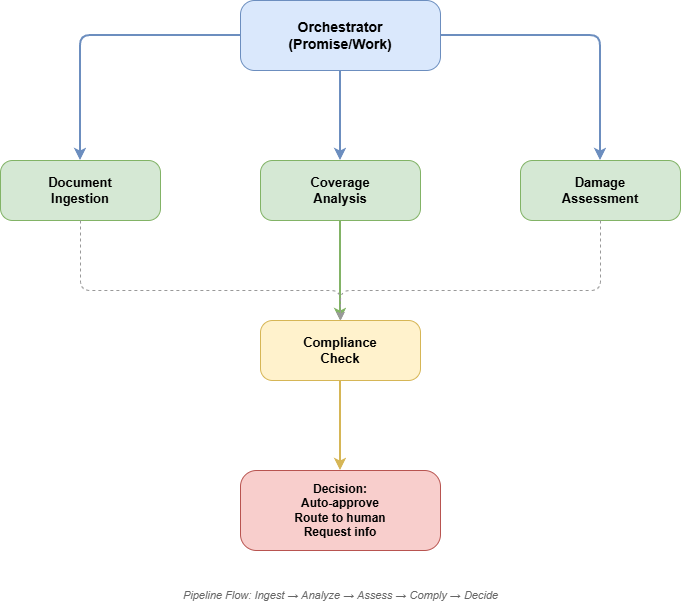
The team designed a multi-agent system (Part 3) with four specialized agents coordinated by an orchestrator.
The Document Ingestion Agent handles the first stage: receiving claim submissions (PDFs, emails, scanned documents, structured forms), extracting text via OCR and document parsing, classifying document types (policy document, damage report, medical record, invoice, correspondence), and structuring the extracted data into a normalized claim record. This agent uses a fine-tuned document classification model plus GPT-4o for extraction from unstructured text. Document classification accuracy was 94% out of the box with GPT-4o, but jumped to 98.5% after fine-tuning on 2,000 labeled examples from Meridian’s historical claims. The fine-tuning cost was minimal (about $200 in compute), but the accuracy improvement was critical because misclassified documents cascade into wrong coverage determinations downstream.
The Coverage Analysis Agent takes the structured claim record and determines coverage. It retrieves the relevant policy documents from the policy database, identifies applicable coverage sections, checks exclusions and limitations, applies state-specific regulatory rules, and produces a coverage determination with confidence scores. This is the most complex agent; it needs to reason about policy language, which is notoriously ambiguous. The team used RAG (retrieval-augmented generation) with a vector database of policy documents and regulatory guidelines.
The Damage Assessment Agent evaluates the claimed damages. For property claims, it analyzes photos and repair estimates. For liability claims, it reviews medical records and invoices. For business interruption claims, it analyzes financial documents. It produces a damage valuation with supporting evidence and flags discrepancies between claimed amounts and assessed values.
The Compliance Agent runs the final check: regulatory compliance, fraud indicators, and audit trail completeness. It verifies that the coverage determination follows state regulations, checks for known fraud patterns (duplicate claims, suspicious timing, inflated amounts), and ensures the claim file is complete enough to survive an audit.
The Orchestrator coordinates the four agents using a pattern similar to the Promise/Work model from Part 5. It manages the workflow: Document Ingestion → Coverage Analysis → Damage Assessment → Compliance Check → Decision. At each stage, the orchestrator evaluates confidence scores. If any agent’s confidence drops below the threshold, the claim is routed to a human reviewer with the agents’ analysis as context.
The orchestrator’s confidence threshold was the most debated design decision. Too high (98%) and almost nothing gets auto-processed, which defeats the purpose. Too low (80%) and you get unacceptable error rates. They started at 95% and tuned down to 92% over the pilot as they gained confidence in the agents’ accuracy. The 92% threshold was the sweet spot: it captured 83% of claims while maintaining 96.3% accuracy on the auto-processed subset.
The Memory System: Learning From Every Claim
The memory architecture (Part 6) was critical. The system needed three types of memory:
Short-term memory (within a single claim): The context accumulated as each agent processes the claim. The Coverage Analysis Agent needs to see what the Document Ingestion Agent extracted. The Compliance Agent needs to see what Coverage and Damage Assessment determined. This was implemented as a shared claim context object passed through the orchestrator, essentially a growing JSON document that each agent reads from and writes to.
Long-term memory (across claims): Patterns learned from processing thousands of claims. Which policy clauses are commonly disputed? Which damage types are frequently over- or under-estimated? Which fraud patterns are emerging? This was implemented as a vector database (Pinecone) that stores embeddings of processed claims, coverage determinations, and human reviewer corrections. When the Coverage Analysis Agent encounters an ambiguous policy clause, it retrieves similar past determinations to inform its reasoning.
Episodic memory (human corrections): When a human reviewer overrides an agent’s determination, that correction is stored with full context: what the agent decided, what the human decided, and why. This feedback loop is the most valuable data in the system. Over six months, the team accumulated 4,200 correction episodes that measurably improved agent accuracy.
The episodic memory implementation was surprisingly simple: a structured log entry for each human override containing the claim context, the agent’s determination and reasoning, the human’s determination and reasoning, and the delta between them. These entries are embedded and stored in Pinecone alongside the claim embeddings. When the Coverage Analysis Agent processes a new claim, it retrieves the five most similar correction episodes and includes them in its prompt as “lessons learned.” This is basically few-shot learning with real production corrections, and it was the single biggest driver of accuracy improvement over the six-month deployment.
The Pilot: Three Months of Controlled Chaos
The team ran a three-month pilot with a carefully designed rollout:
Month 1: Shadow mode. The agent system processed every claim in parallel with the human team. Agents produced determinations but didn’t act on them. The team compared agent outputs to human decisions. Results: 71% agreement rate on coverage determinations, 68% agreement on damage assessments. Not good enough for autonomous operation, but the disagreements were informative. Many were cases where the agent was actually more consistent than the humans (who varied in their interpretation of the same policy language).
The 71% agreement rate was initially demoralizing. The team almost killed the project. But when they analyzed the disagreements, they found that 40% were cases where the agent and human reached different but defensible conclusions, the kind of ambiguity where two human reviewers would also disagree. The “real” disagreement rate (cases where the agent was clearly wrong) was closer to 17%. That’s a much more tractable problem.
Month 2: Assisted mode. The agent system processed claims first and presented its analysis to human reviewers. Reviewers could accept, modify, or reject the agent’s determination. Processing time dropped from 3.2 hours to 1.4 hours per claim. The agents were doing the tedious document reading and cross-referencing, and humans were making the final judgment calls. Reviewer satisfaction was high: “It’s like having a really thorough research assistant.”
Month 3: Autonomous mode for simple claims. Claims classified as “routine” (clear coverage, straightforward damage, no fraud indicators, high confidence scores across all agents) were processed autonomously. Complex claims continued in assisted mode. The threshold for “routine” was set conservatively: only claims where all four agents had confidence scores above 92% were auto-processed. This captured about 35% of the volume.
The Numbers: Six Months In
Six months after the pilot, here’s where things stood:
Volume handled autonomously: 83% of claims (up from 35% at the end of the pilot). The improvement came from the episodic memory system; as human corrections accumulated, agent accuracy improved, and the confidence threshold captured more claims.
Processing time: Average 4.2 minutes for autonomous claims (down from 3.2 hours). Average 52 minutes for human-assisted claims (down from 3.2 hours). Blended average: 31 minutes per claim.
Accuracy: 96.3% agreement with human reviewers on a random audit sample. The remaining 3.7% were edge cases involving ambiguous policy language, the kind of cases where two human reviewers would also disagree.
Staffing: The 47-person team was restructured to 19 people in higher-value roles. 12 senior reviewers now focus exclusively on complex claims with agent assistance, the kind of nuanced judgment work that drew most of them to the field in the first place. 4 people manage the agent system (prompt engineering, model updates, quality audits), roles that didn’t exist before, and command higher compensation. 3 people handle escalations and customer communication, work that requires empathy and relationship skills no agent can replicate. The remaining 28 positions were phased out through attrition and internal reassignment over 8 months. Nobody was fired on day one, which mattered enormously for organizational buy-in.
Cost analysis (using the framework from Part 7):
https://medium.com/media/0597c786fec72bcbd980c603aee3f913/hrefThe $18,000 per month in LLM API costs breaks down roughly as: Document Ingestion at $3,000 (mostly OCR and classification), Coverage Analysis at $8,000 (the most token-intensive agent, requiring full policy documents in context), Damage Assessment at $4,000 (photo analysis and document review), Compliance at $2,000 (shorter prompts, rule-based checks), and the Orchestrator at $1,000 (routing logic). The Coverage Analysis Agent alone accounts for 44% of API costs because it needs to include full policy documents in context.
Annual savings: approximately $2 million. Implementation cost: $1.8 million (8 months of development, infrastructure, training). Payback period: 10.8 months.
That’s a solid ROI, but notice it’s not the 10x improvement that the initial pitch deck promised. The LLM API costs, infrastructure, and engineering maintenance eat into the labor savings. The 35% cost reduction is real and meaningful, but it’s not transformative. It’s incremental. The real transformation was in processing speed (11-day backlog eliminated) and customer satisfaction (first response time dropped from 11 days to under 4 hours).
What Broke (And How They Fixed It)
No production system survives contact with reality unscathed. Here’s what went wrong:
The hallucination problem. In month 2, the Coverage Analysis Agent confidently cited a policy exclusion that didn’t exist. It had generated a plausible-sounding exclusion clause based on patterns in similar policies, but the specific policy didn’t contain that language. The claim was incorrectly denied. The customer complained. The error was caught in review, but it exposed a fundamental risk: the agent could generate convincing but fabricated policy references.
The fix was a grounding verification step. After the Coverage Analysis Agent produces its determination, a separate verification pass checks every policy citation against the actual policy document using exact text matching, not semantic similarity. For each citation the agent produces (something like “Per Section 4.2.1 of the policy, flood damage is excluded”), the verifier does a fuzzy text search in the actual policy document. If it can’t find a match within a similarity threshold of 0.85, the citation is flagged, and the claim is routed to human review. This added about 8 seconds of processing time per claim but eliminated fabricated citations entirely. The overhead is worth it; one wrongly denied claim can cost more in legal fees than a month of compute.
The adversarial input problem. In month 4, the fraud detection team noticed that a small number of claims were being submitted with carefully crafted language that seemed designed to trigger favorable coverage determinations from the agent. Someone had figured out that certain phrasings in damage descriptions led to higher assessments. This wasn’t sophisticated prompt injection. It was more like SEO for insurance claims. People were optimizing their claim language for the AI.
The fix was a combination of adversarial input detection (flagging claims with unusual linguistic patterns) and regular rotation of the assessment prompts so that gaming strategies had a shorter shelf life. The team also added a statistical anomaly detector that flags claims where the assessed value is significantly higher than historical averages for similar claim types.
The model update disaster. In month 5, OpenAI released a model update that subtly changed GPT-4o’s behavior on policy interpretation tasks. The Coverage Analysis Agent’s accuracy dropped from 96% to 89% overnight. The team didn’t notice for three days because their monitoring tracked overall throughput and error rates, not accuracy against human baselines.
The fix was a continuous evaluation pipeline. A random sample of 50 claims per day is processed by both the agent and a human reviewer. The agreement rate is tracked on a dashboard with alerting. If the agreement drops below 93%, the system automatically increases the human review rate until the issue is diagnosed. This monitoring costs about $4,000 per month in human reviewer time (50 claims × 20 working days, at roughly $10 per claim). That’s 22% of the total LLM API cost. But it caught the model update regression within 24 hours of implementation, compared to the three days it took without monitoring. Those two extra days of degraded accuracy affected roughly 2,000 claims. The monitoring pays for itself.
The edge case explosion. The 17% of claims that still require human review aren’t random. They cluster around specific policy types, damage categories, and regulatory jurisdictions. Some state regulations are so complex that the agent’s accuracy on those claims is below 80%. The team initially tried to improve agent performance on these edge cases but eventually accepted that some claim types are better handled by humans. They built a smart routing system that identifies these claim types early and routes them directly to human reviewers, skipping the agent analysis entirely. This reduced wasted compute on claims the agent couldn’t handle and improved human reviewer efficiency by giving them claims matched to their expertise.
The Organizational Impact Nobody Expected
The technical challenges were solvable. The organizational challenges were harder.
The expertise drain. When 28 people transitioned out of the department, they took institutional knowledge with them. The remaining 12 senior reviewers were the best, but they couldn’t cover every specialty. The team discovered that the agent system had become a single point of failure for institutional knowledge. If the agent’s training data didn’t cover a scenario, and the human expert for that scenario had moved on, nobody knew the answer.
The fix was a knowledge capture program: before anyone transitioned, they spent two weeks documenting their decision-making process for edge cases, which was fed into the agent’s long-term memory. This was the most underestimated workstream of the entire project. It took three months and cost about $150,000 in dedicated time. But without it, the system would have had blind spots that no amount of model tuning could fix. Domain expertise that exists only in people’s heads is the hardest thing to replicate with AI, and the easiest thing to lose during a workforce transition.
The trust calibration problem. Human reviewers initially over-trusted the agent’s analysis. In assisted mode, reviewers were supposed to critically evaluate the agent’s determination, but many were rubber-stamping it, especially under time pressure. The agreement rate between reviewers and agents was suspiciously high (98%) until the team ran a calibration test with intentionally incorrect agent outputs. Only 60% of reviewers caught the errors. The fix was mandatory disagreement quotas (reviewers must override at least 5% of agent determinations) and regular calibration exercises with known-incorrect outputs.
The customer communication gap. Customers who received agent-processed claim decisions had questions that the agent couldn’t answer. “Why was my claim denied?” is a reasonable question, but the agent’s reasoning chain, while technically accurate, wasn’t written for a customer audience. The team had to build a separate explanation generation layer that translated the agent’s technical determination into customer-friendly language. This was harder than expected and required its own prompt engineering effort.
Lessons Learned: The Series in Practice
Looking back at this deployment through the lens of the entire series:
From Part 1 (Chatbots to Co-Workers): The evolution from chatbot to agent was real but gradual. The system started as an assisted tool (chatbot-level) and evolved to autonomous operation over months. The “co-worker” framing was useful for organizational buy-in. People accepted an AI co-worker more readily than an AI replacement.
From Part 2 (Agent Anatomy): The planning-memory-tool-use framework held up. The Coverage Analysis Agent’s planning capability (breaking a complex claim into sub-determinations) was the most valuable architectural decision. Without structured planning, the agent tried to make coverage decisions in a single pass and accuracy was terrible.
From Part 3 (Multi-Agent Systems): Four specialized agents outperformed a single general-purpose agent by a wide margin. The single-agent approach topped out at 78% accuracy. The multi-agent system reached 96%. Specialization works.
From Part 4 (Building Your First Agent): The practical guide’s emphasis on starting simple was validated. The team’s first prototype was a single agent that just classified documents. They added capabilities incrementally over 8 months. Teams that tried to build the full system at once failed.
From Part 5 (Promise/Work Pattern): The orchestration pattern was essential for managing the multi-agent workflow. The ability to retry failed agent steps, route to humans at any point, and maintain state across the pipeline made the system operationally manageable. Without structured orchestration, the system would have been a debugging nightmare.
From Part 6 (Memory Systems): Episodic memory (human corrections) was the single most impactful feature. The system’s accuracy improved from 71% to 96% primarily because it learned from its mistakes. Without memory, the system would have plateaued at 80–85% and never reached autonomous operation thresholds.
From Part 7 (ROI): The full cost stack analysis was essential for honest ROI reporting. The initial pitch claimed 70% cost reduction. The actual result was 35%. Still strong, but the gap between promise and reality would have killed the project if leadership had been expecting 70%. Setting realistic expectations using the full cost framework saved the project politically.
What They’d Do Differently
Hindsight is a luxury, but it’s also the most useful thing a case study can offer. When the Meridian team looks back at the deployment, four decisions stand out as things they’d change if they could start over:
Start the knowledge capture program on day one. The team waited until people were already leaving to begin documenting institutional knowledge. By then, some experts had mentally checked out, and the urgency made the documentation rushed. If they’d started knowledge capture in month one (framing it as “training the AI” rather than “preparing for your departure”), they’d have gotten better documentation, less organizational anxiety, and a head start on the episodic memory system that ultimately drove accuracy from 71% to 96%.
Build the continuous evaluation pipeline before going autonomous. The model update disaster in month 5 cost them three days of degraded accuracy on 2,000 claims. The evaluation pipeline they built afterward should have been a prerequisite for autonomous operation, not a reaction to a failure. You don’t let a system make unsupervised decisions without a way to continuously verify those decisions are correct. That seems obvious in retrospect.
Set the initial confidence threshold higher and lower it gradually. They started at 95% and tuned down to 92%. In hindsight, they should have started at 98% (processing almost nothing autonomously at first) and lowered the threshold as accuracy data accumulated. Starting conservative and expanding is psychologically easier for the organization than starting aggressive and pulling back. The first autonomous error matters more than the hundredth because it sets the narrative.
Invest more in the customer explanation layer from the start. The team treated customer communication as an afterthought, something to solve after the core system worked. But customers don’t care about your architecture. They care about understanding why their claim was approved or denied. Building the explanation layer in parallel with the decision system would have prevented the customer satisfaction dip they experienced in months 3–4 when agent-processed decisions started going out without adequate explanations.
The Honest Assessment
Is this a success story? Yes, with caveats.
The system processes claims faster, more consistently, and at lower cost than the previous all-human operation. Customer satisfaction improved. The backlog is gone. The ROI is positive. And the people still in the department are doing more interesting, higher-judgment work than they were before.
But it’s not the revolution that the vendor pitch decks promise. It’s an incremental improvement, a significant one, but incremental. The system still needs human oversight. It still makes mistakes. It still requires ongoing engineering investment.
And the transition wasn’t painless. Twenty-eight positions were phased out. The team handled it as humanely as possible: eight months of transition, internal transfers where available, retraining stipends, and generous severance for those who moved on. Nobody was blindsided. But workforce transitions are hard even when they’re managed well, and it would be dishonest to gloss over that. The remaining 19 roles are higher-skilled and higher-paid (senior reviewers, ML engineers, system architects). The work is more engaging, the expertise more valued, the career paths more durable. That’s a genuine improvement for the people in those roles. The harder question, the one every organization deploying agentic AI needs to answer honestly, is what happens to the people whose routine work the agents now handle. Meridian invested in retraining and internal mobility. Not every organization will.
The real story here isn’t “AI replaced a department.” It’s that AI absorbed the repetitive, high-volume work that was burning people out and burying the team in backlog, and freed the remaining team to focus on the complex judgment calls, the customer relationships, and the edge cases where human expertise genuinely matters. The agents handle the 83% that’s routine. Humans handle the 17% that requires wisdom.
The organizations that will get the most value from agentic AI are the ones that approach it like Meridian did: start with a specific, high-volume problem. Build incrementally. Measure honestly. Invest in memory and feedback loops. Plan for the organizational impact. And frame the goal not as replacing people, but as giving people the space to do work that’s actually worth their expertise.
That’s the series. Eight articles, eight months of writing, and one core conviction: agentic AI is real, it works, and it matters, but only if you approach it with the same rigor you’d bring to any other engineering system. With clear eyes, honest measurement, and respect for both the technology’s potential and its limitations.
If you’ve followed along from Part 1, thank you. Genuinely. Writing a series like this is a conversation, even when it doesn’t feel like one, and knowing that people are reading, building, and thinking critically about these ideas is what made it worth doing. If you’re building agent systems, or deciding whether to, I hope these articles gave you something more valuable than enthusiasm: a practical foundation, a realistic framework, and the confidence to ask the hard questions before the easy ones.
The teams that will succeed with agentic AI aren’t the ones with the best models or the biggest budgets. They’re the ones that acknowledge what they don’t know, measure what matters, and never forget that the humans in the system, the ones building it, the ones working alongside it, and the ones whose work is changing because of it, are the hardest part to get right. And the most important.
Resources:
- Gartner: Agentic AI Adoption Survey 2025
- McKinsey: The State of AI in 2025
- OpenAI Cookbook: Building Agents
- LangChain Documentation
- Pinecone: Vector Database for AI
Series Navigation
Previous Article: Agentic AI ROI: The Real Numbers Behind the 79% Adoption Rate (Part 7)
Full Series Index
- From Chatbots to Co-Workers: Understanding the Agentic AI Revolution
- The Anatomy of an AI Agent: Planning, Memory, and Tool Use
- Multi-Agent Systems: When AI Agents Collaborate
- Building Your First Agentic AI System: A Practical Guide
- The Promise/Work Pattern: Kubernetes-Style Orchestration for AI Agents
- Memory Systems for AI Agents: Beyond Context Windows
- Agentic AI ROI: The Real Numbers Behind the 79% Adoption Rate
- The Agent That Handled the Backlog: How AI Let a Claims Team Focus on What Matters (You are here)
This is the final article in the Agentic AI series. Thank you for reading.
About the Author: Daniel Stauffer is an Enterprise Architect who believes the best AI systems don’t replace human judgment. They remove the noise so human judgment can finally be heard.
Tags: #AgenticAI #CaseStudy #EnterpriseAI #AIArchitecture #MultiAgentSystems #ProductionAI #AIStrategy #HumanAICollaboration
The Agent That Handled the Backlog: How AI Let a Claims Team Focus on What Matters was originally published in Level Up Coding on Medium, where people are continuing the conversation by highlighting and responding to this story.