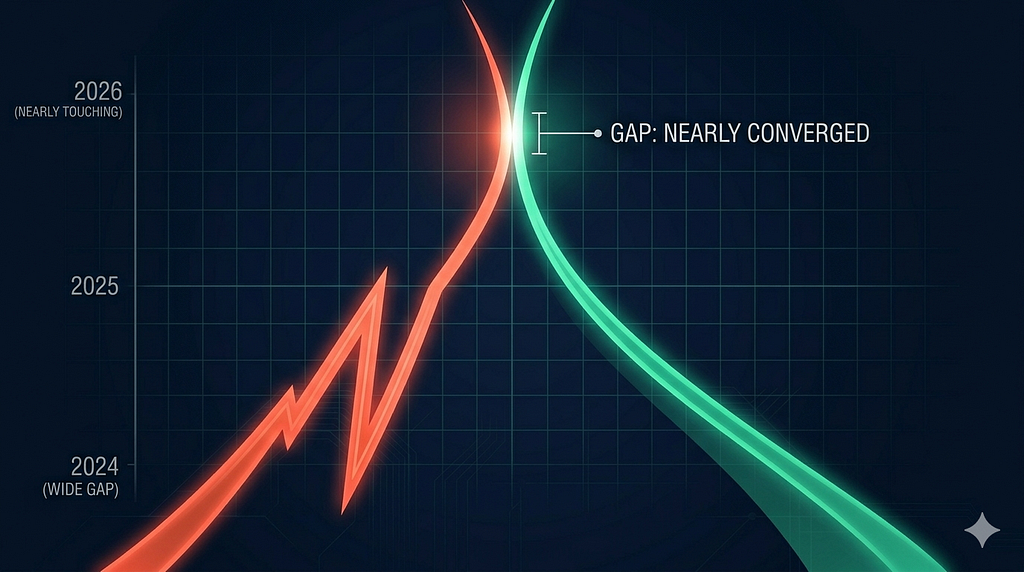
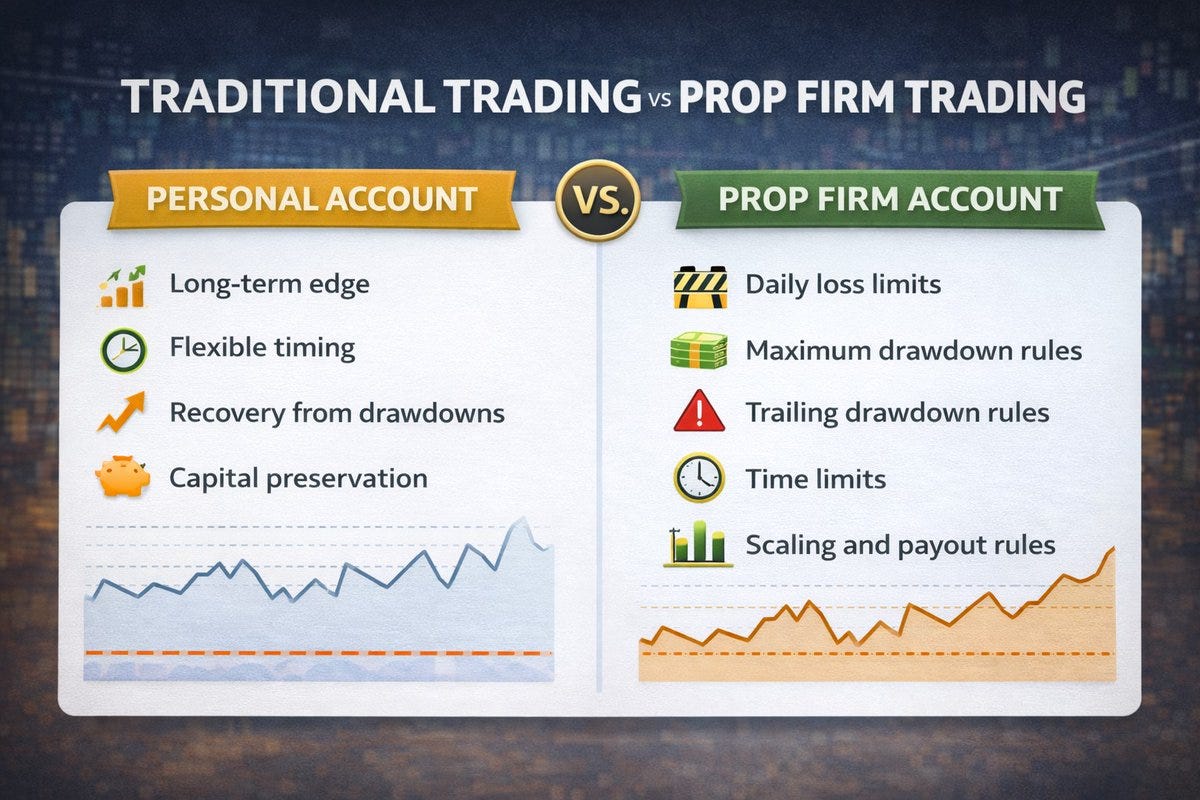
From Proprietary Monoliths to Agile, Open-Source Trading Frameworks
The evolution of FinLLMs is transforming Wall Street from a reactive arena into a proactive, AI-generated reality.
Before I was navigating the intricate labyrinth of Responsible GenAI, my discipline was forged on the quarterdeck of a naval ship and inside the ropes as a national-level kickboxer. If there is one thing you learn from both facing a 100-foot rogue wave and dodging a roundhouse kick to the head, it’s this: You cannot simply react to the world; you have to anticipate and shape it.
For decades, the financial industry has been stuck in “react” mode. But today, my friends, the game has fundamentally changed. We are crossing an ontological threshold from just reading the market to literally generating its realities. Let me explain how artificial intelligence went from a glorified bouncer to a Wall Street mastermind.
I. The Hook (Introduction and Thesis)

Discriminative AI acts like a bouncer checking a list, while Generative AI is the mastermind redesigning the club’s blueprints.
Imagine you’re trying to get into an exclusive nightclub. The guy at the door, “Bouncer Bob,” looks at your ID, checks his list, and grunts “Approve” or “Deny.” For twenty years, financial AI was exactly like Bouncer Bob. We call this discriminative AI. It looked at a loan application or a credit score and merely classified it: Default or No Default.
But what if, instead of a bouncer, you had Danny Ocean from Ocean’s Eleven? He doesn’t just read the guest list — he redesigns the club’s blueprints, sweet-talks the guards in four languages, prints out perfectly forged VIP passes, and orchestrates a flawless heist. That is Generative AI. It’s no longer just reading data; it is synthesizing high-fidelity market realities, drafting code, and orchestrating live algorithmic trades.
This monumental shift is happening because Financial Large Language Models (FinLLMs) are maturing, synthetic data generation (Diffusion models) is booming, and we are successfully fusing language models with Reinforcement Learning (RL). But here is the ultimate kick to the ribs (my thesis): Deploying probabilistic, “black box” models in a highly regulated, deterministic market introduces existential systemic risks. The future of quantitative finance won’t be won by the firms scaling the biggest models, but by those who master architectural discipline, epistemic interpretability, and rigorous governance.
“You never change things by fighting the existing reality. To change something, build a new model that makes the existing model obsolete.” — R. Buckminster Fuller
Trivia / Fact Check: Did you know that before 2023, standard natural language processing (NLP) in finance relied on basic bag-of-words models and static lexicons? The idea of an AI drafting a legally compliant derivatives contract from scratch was considered science fiction just 36 months ago!
II. The Stakes (Context / Why This Matters Now)

With synthetic data unlocking new capabilities, regulators are closely watching how AI interprets and decides.
So, why is the financial world suddenly losing its collective mind over this?
Historically, the biggest problem in algorithmic trading wasn’t the algorithm; it was the data. High-quality quantitative data was heavily paywalled by massive institutions, wildly imbalanced, or locked down tighter than Fort Knox due to GDPR and privacy laws. Generative AI is obliterating this bottleneck by creating synthetic data — fake data that mathematically behaves exactly like the real thing, without exposing any personal information.
Furthermore, we are experiencing insane operational velocity. Quant desks aren’t just using AI to see if a news article is “happy” or “sad” anymore. Thanks to autonomous function-calling, these models are writing their own Python scripts, querying live order books, and running backtests. Human personnel are shifting from rote coders to high-level system supervisors (Boston Consulting Group [BCG], 2023).
But here comes the “Suit Cops.” Global regulators, wielding frameworks like the EU AI Act and US Fair Lending laws, require strict explainability (European Securities and Markets Authority [ESMA], 2024). If your AI rejects a mortgage, you legally have to explain why. If the industry doesn’t adopt Responsible AI frameworks right now, it is going to slam into a massive regulatory brick wall.
“With great power comes great regulatory scrutiny.” — (Slightly modified) Uncle Ben
ProTip: Don’t use GenAI to replace your human analysts; use it to give them superpowers. The goal is to elevate your workforce from executing tasks to orchestrating systems.
III. Deep Dive 1: The Linguistic Paradigm Shift (The 3 Phases of FinLLM Evolution)
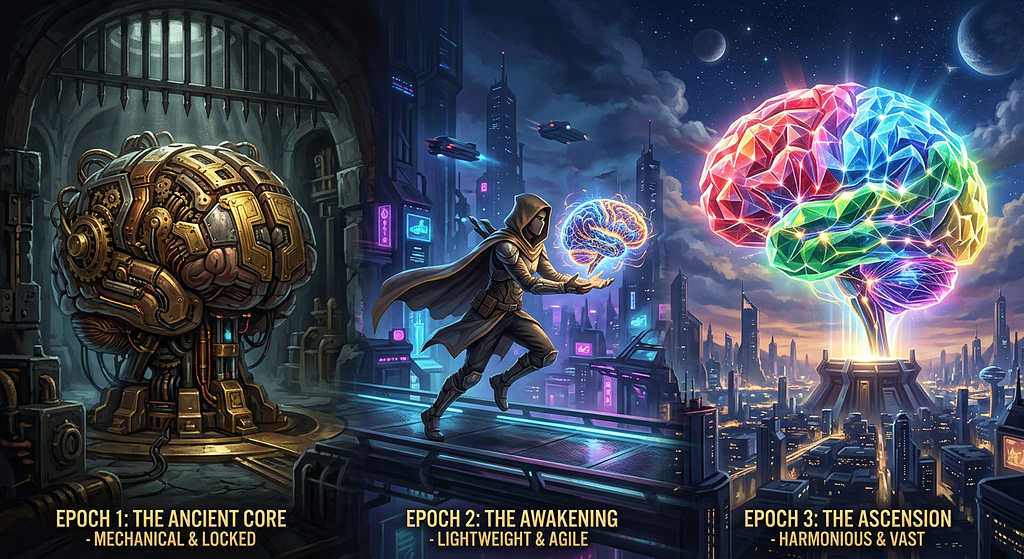
FinLLMs have evolved from heavy, proprietary monoliths to agile, parameter-efficient multi-expert systems.
Let’s meet our characters. The evolution of FinLLMs happened in three dramatic phases:
Phase 1: Proprietary Monoliths (The Trillion-Dollar Bespoke Suit) When generic AI models (like early GPTs) tried to read Wall Street news, they failed miserably. Financial jargon is a completely different language. Enter BloombergGPT (Wu et al., 2023). Bloomberg locked an AI in a room with a “FinPile” — 363 billion tokens of proprietary financial news, SEC filings, and press releases. They trained a massive 50-billion parameter monolith from scratch. It proved that domain-specificity works, but it also reinforced data monopolies. Only the mega-rich could play.
Phase 2: Democratization & Data-Centric Agility (The Robin Hood Era) Financial data decays faster than a banana in the sun. A statically trained monolith is obsolete the day it’s finished. Enter FinGPT (Liu et al., 2023) and the open-source rebellion. Instead of spending millions training an AI from scratch, these researchers used Parameter-Efficient Fine-Tuning (PEFT), specifically a method called LoRA. Analogy time: Imagine sending a brilliantly educated scholar (a generic LLM) back to kindergarten to learn finance (pre-training). That’s expensive. PEFT is like giving that scholar a specialized, lightweight cheat sheet that instantly adapts their brain to Wall Street. Suddenly, nimble developers on consumer-grade laptops were beating the giants. Standardized benchmarks like PIXIU (Xie et al., 2023) kept these agile models honest.
Phase 3: Multi-Expert & Multimodal Systems (The Avengers Assemble) Today, we are in Phase 3. Pure language models are out. We are building Multimodal Financial Foundation Models (MFFMs) (Liu, Cao, & Deng, 2025). Models like Ploutos (Tong et al., 2024) and DISC-FinLLM (Chen et al., 2023) isolate their skills. They are multi-expert systems where one part of the brain reads the candlestick charts, another listens to the nervous quiver in a CEO’s voice during an earnings call, and an overarching “LLM Manager” strings it all together to explain its final decision in plain English.
“The future is already here — it’s just not evenly distributed.” — William Gibson
Trivia / Fact Check: Bloomberg’s “FinPile” dataset was so massive that it accounted for over 50% of the entire training data for BloombergGPT, ensuring the model essentially “spoke” Wall Street as its native tongue.
IV. Deep Dive 2: Solving Data Scarcity (From GANs to Thermodynamic Diffusion)
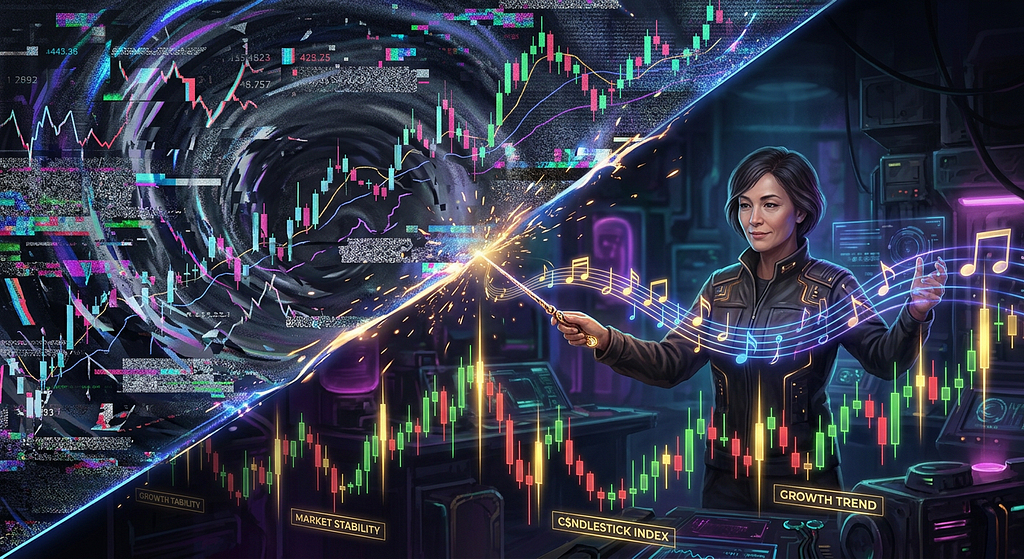
Diffusion models act like master audio engineers, reverse-engineering chaotic noise back into crystal-clear market scenarios.
Financial data is a hot mess. It suffers from volatility clustering, extreme tail events, and complex correlations. As an ex-cybersecurity guy, I know the pain of needing threat data but not being legally allowed to touch actual customer data.
The GAN Era (The Arguing Artists): Initially, we solved this with Generative Adversarial Networks (GANs), like TimeGAN (Yoon et al., 2019). Think of a GAN as two rookie artists. The Generator tries to paint a fake financial dataset, and the Discriminator plays art critic, trying to spot the forgery. They argue until the fake looks real. But GANs have a flaw: “mode collapse.” Sometimes the generator figures out that drawing a simple stick figure always fools the critic, so it only draws stick figures. In finance, this means the AI completely misses “black swan” events (like market crashes).
The Thermodynamic Shift (The Master Engineer): The industry has now moved toward Denoising Diffusion Probabilistic Models (DDPMs), like FinDiff (Sattarov et al., 2023) and Diffolio (Cho et al., 2025). Analogy time: Imagine a master audio engineer taking a crystal-clear recording of a Mozart symphony and slowly adding static until it’s pure noise. Then, they train an AI to perfectly reverse-engineer that static back into music. By learning how to reverse the chaos (a concept borrowed from non-equilibrium thermodynamics), Diffusion models create highly stable, resilient models capable of generating flawless, realistic market “what-if” scenarios without missing the tail risks.
“Chaos is merely order waiting to be deciphered.” — José Saramago
ProTip: If you are stress-testing a trading portfolio in 2026, ditch the standard Monte Carlo simulations. Generative Diffusion models capture the messy, cross-sectional correlations that traditional math misses.
V. Deep Dive 3: Algorithmic Trading & Quantitative Orchestration

The fusion of LLMs and Reinforcement Learning creates an unstoppable duo: the strategic Portfolio Manager and the tactical Execution Trader.
This is where the magic happens. For years, we used Reinforcement Learning (RL) to build trading bots. But RL bots are notoriously myopic. They look at raw price vectors and execute trades like a hyperactive day trader on their third energy drink. They might optimize a micro-trend perfectly but remain entirely blind to the macro reality — like a surprise Fed rate hike.
The state-of-the-art solution? Fusing the cognitive reasoning of LLMs with the mathematical execution of RL. Frameworks like Trading-R1 (Xiao et al., 2025) and FLAG-Trader (Xiong et al., 2025) represent the ultimate fusion.
It works through hierarchical abstraction (Darmanin & Vella, 2025). The LLM acts as the “Portfolio Manager” — it kicks back, reads the global news, defines the strategic investment thesis, and sets the risk boundaries. It then hands the playbook down to the RL agent, who acts as the “Execution Trader,” optimizing the micro-second tactics to buy or sell while minimizing slippage. Brains and muscle, working in perfect, automated harmony.
“Strategy without tactics is the slowest route to victory. Tactics without strategy is the noise before defeat.” — Sun Tzu
Trivia / Fact Check: Advanced architectures now use “Agentic RL,” meaning models don’t just output text; they literally hit “Enter” on database APIs to execute workflows autonomously.
VI. Debates and Limitations (Systemic Risk and The “Black Box”)

Algorithmic herding and the use of identical foundation models could trigger a synchronized, multi-institutional crash.
Now, let’s put my Responsible AI hat on. As much as I love this tech, deploying it recklessly is like handing a live grenade to a toddler.
First, there is the “Turing Trap” (Aziz, 2025) — the dangerous temptation to entirely replace human analysts with AI. When deep learning models make decisions (like denying a loan), they act as epistemic “black boxes.” If you can’t explain the causal logic behind a financial decision, you are violating regulatory compliance.
Second is Metric Failure. Standard AI benchmarks (like BLEU scores) are useless in non-stationary financial markets. An AI might look like a genius in a backtest during a low-interest regime and then catastrophically blow up your portfolio when the market shifts to high inflation.
But the most terrifying macroeconomic threat? Model Homogeneity and Algorithmic Herding (Xu et al., 2025). Analogy time: Imagine every single driver in a bustling city using the exact same GPS app. If the map glitches and identifies a fake roadblock on the highway, every single car will simultaneously swerve onto the exact same tiny side street. The result? Instant, catastrophic gridlock. If hundreds of massive banks all use the exact same foundation model (like GPT-4), and that model hallucinates a false reading on a Federal Reserve statement, it could trigger a synchronized, multi-institutional algorithmic sell-off. A flash crash caused by a single rogue line of text.
“The biggest risk is not taking any risk… In a world that is changing really quickly, the only strategy that is guaranteed to fail is not taking risks.” — Mark Zuckerberg
ProTip: Never evaluate a financial AI solely on traditional NLP metrics like cross-entropy loss. You must evaluate it on volatility-adjusted financial metrics (like the Sharpe ratio) in live, adversarial sandboxes.
VII. The Path Forward / Implications

The future of finance AI relies on architectural discipline, transparent models, and rigorous human oversight.
So, how do we survive this brave new world? The answer is not building bigger models; it is building smarter constraints.
- Architectural Discipline over Parameter Scaling: Bigger isn’t better. Multi-expert, interpretable models are the future.
- Retrieval-Augmented Generation (RAG): We must make RAG mandatory. This forces the AI to fetch real-time, factual market data and cite its sources, creating an auditable data lineage.
- The AI Use Case Risk Register: Adopt rigorous Model Risk Management (MRM) frameworks (Bain & Company, 2023; PwC, 2025). For high-stakes capital allocation, there must always be a “human-in-the-loop.”
- Mathematical Market Constraints: We have to embed economic physics and liquidity bounds directly into the AI’s loss functions. Literally program the AI so it mathematically cannot execute impossible or hyper-leveraged trades.
“Discipline equals freedom.” — Jocko Willink
Trivia / Fact Check: Leading MRM frameworks now classify Generative AI not just as software, but as “synthetic personnel,” subjecting them to audit trails conceptually similar to human employee compliance!
VIII. Conclusion
Generative AI has unequivocally broken the constraints of quantitative finance. We’ve solved data scarcity, democratized Wall Street-level sentiment analysis, and given birth to autonomous trading agents that can read, reason, and react in milliseconds.
But my friends, epistemic humility is absolutely required. Integrating probabilistically generated knowledge into deterministic, highly regulated financial markets is playing with fire. For executives, developers, and policymakers, the mandate is clear: Innovate aggressively, but govern rigorously.
The future belongs to those who can build the smartest engines, not just the loudest ones. Keep your guard up, stay disciplined, and I’ll see you in the next round.
“It is not the strongest of the species that survive, nor the most intelligent, but the one most responsive to change.” — Charles Darwin
ProTip: The true competitive advantage in the next five years won’t be your AI’s predictive power — it will be your AI’s interpretability. Regulators will shut down the black boxes; the transparent boxes will inherit the market.
IX. References
Financial Large Language Models (FinLLMs)
- Chen, W., Wang, Q., Long, Z., Zhang, X., Lu, Z., Li, B., … & Wei, Z. (2023). DISC-FinLLM: A Chinese financial large language model based on multiple experts fine-tuning. arXiv preprint arXiv:2310.15205. https://arxiv.org/abs/2310.15205
- Liu, X.-Y., Cao, Y., & Deng, L. (2025). Multimodal financial foundation models (MFFMs): Progress, prospects, and challenges. arXiv preprint arXiv:2506.01973. https://arxiv.org/abs/2506.01973
- Liu, X.-Y., Wang, G., Yang, H., & Zha, D. (2023). FinGPT: Democratizing Internet-scale data for financial large language models. arXiv preprint arXiv:2307.10485. https://arxiv.org/abs/2307.10485
- Tong, H., Li, J., Wu, N., Gong, M., Zhang, D., & Zhang, Q. (2024). Ploutos: Towards interpretable stock movement prediction with financial large language model. arXiv preprint arXiv:2403.00782. https://arxiv.org/abs/2403.00782
- Wu, S., Irsoy, O., Lu, S., Dabravolski, V., Dredze, M., Gehrmann, S., Kambadur, P., Rosenberg, D., & Mann, G. (2023). BloombergGPT: A large language model for finance. arXiv preprint arXiv:2303.17564. https://arxiv.org/abs/2303.17564
- Xie, Q., Han, W., Zhang, X., Lai, Y., Peng, M., Lopez-Lira, A., & Huang, J. (2023). PIXIU: A large language model, instruction data and evaluation benchmark for finance. arXiv preprint arXiv:2306.05443. https://arxiv.org/abs/2306.05443
Synthetic Data & Generative Architectures
- Cho, S.-Y., Kim, J.-Y., Ban, K., Koo, H. K., & Kim, H.-G. (2025). Diffolio: A diffusion model for multivariate probabilistic financial time-series forecasting and portfolio construction. arXiv preprint arXiv:2511.07014. https://arxiv.org/abs/2511.07014
- Sattarov, T., Schreyer, M., & Borth, D. (2023). FinDiff: Diffusion models for financial tabular data generation. arXiv preprint arXiv:2309.01472. https://arxiv.org/abs/2309.01472
- Yoon, J., Jarrett, D., & van der Schaar, M. (2019). Time-series generative adversarial networks. Advances in Neural Information Processing Systems, 32. https://arxiv.org/abs/1912.12440
Algorithmic Trading & Corporate Finance Operations
- Boston Consulting Group (BCG). (2023). Generative AI in the finance function of the future. BCG Insights. https://www.bcg.com
- Darmanin, A., & Vella, V. (2025). Language model guided reinforcement learning in quantitative trading. arXiv preprint arXiv:2508.02366. https://arxiv.org/abs/2508.02366
- Xiao, Y., Sun, E., Chen, T., Wu, F., Luo, D., & Wang, W. (2025). Trading-R1: Financial trading with LLM reasoning via reinforcement learning. arXiv preprint arXiv:2509.11420. https://arxiv.org/abs/2509.11420
- Xiong, G., Deng, Z., Wang, K., Cao, Y., Li, H., Yu, Y., … & Xie, Q. (2025). FLAG-Trader: Fusion LLM-agent with gradient-based reinforcement learning for financial trading. arXiv preprint arXiv:2502.11433. https://arxiv.org/abs/2502.11433
Responsible AI, Governance, & Systemic Risk
- Aziz, A. (2025). Leveraging the promise of generative AI for financial risk management. SS&C Technologies. https://www.ssctech.com
- Bain & Company. (2023). Responsible by design: Five principles for generative AI in financial services. Bain Insights. https://www.bain.com
- European Securities and Markets Authority (ESMA). (2024). Leveraging large language models in finance: Pathways to responsible adoption. https://www.esma.europa.eu
- PricewaterhouseCoopers (PwC). (2025). Responsible AI in finance: 3 key actions to take now. PwC Insights. https://www.pwc.com
- Xu, R., Balestriero, R., He, J., Lee, Y., Wang, Z., Yu, Y., & Han, Y. (2025). Generative AI in Finance Workshop. Advances in Neural Information Processing Systems (NeurIPS) 2025. https://neurips.cc/Conferences/2025
Disclaimer: The views expressed in this article are personal. AI assistance was utilized in the research, drafting of this article, and generating images. Licensed under CC BY-ND 4.0.
The 3 Phases of FinLLM Evolution was originally published in DataDrivenInvestor on Medium, where people are continuing the conversation by highlighting and responding to this story.