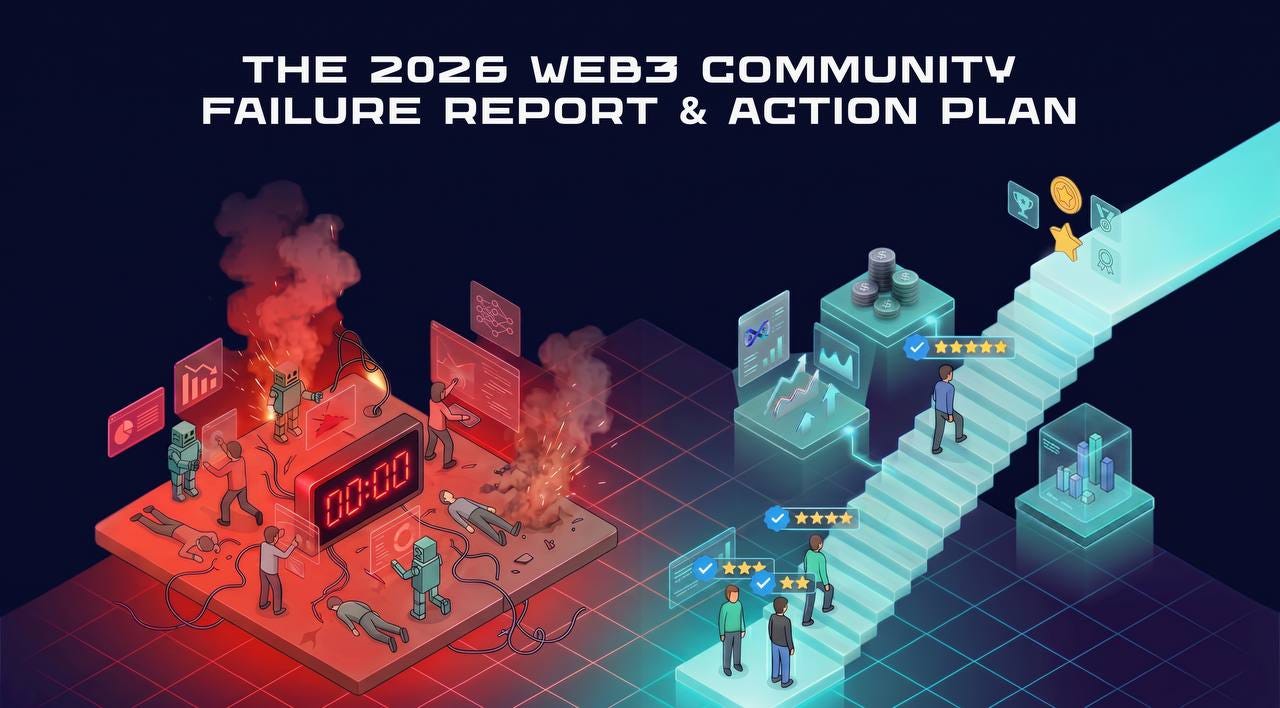
The 2026 Web3 Community Failure Report & Action Plan
 Eternex5 min read·Just now
--
A breakdown of real data from the first Eternex quest and an honest look at an industry problem
The crypto industry has a convenient habit of measuring success by numbers that look good in presentations. Hundreds of thousands of testnet participants. Millions of transactions. A huge community. Behind these numbers often lies a completely different reality — bot farms, hired “farmers,” and people who clicked “Retweet” and will never use the product again.
When we completed the first quest on the Eternex platform, a picture emerged that is difficult to ignore. The data is small in scale, but revealing enough to highlight a systemic problem.
What Our First Quest Showed
As part of the “Onboarding Campaign,” we ran all participants through a segmentation process: standard social tasks plus an actual educational course. And here is what we saw at the end:
- 100% of wallets: Met the basic conditions for access to tasks on Galxe for subsequent participation in the reward distribution. Essentially, they registered and subscribed to the project on the platform.
- ~47%: Completed all social tasks: subscriptions, reposts, clicks. This is exactly the figure most projects show to investors as “successful marketing.” Moreover, immediately after the quest ended, this figure was higher, meaning some participants unsubscribed right after the results were announced.
- Only ~8%: Completed the educational course to the end, confirmed their knowledge, and fulfilled all conditions.
This data does not claim to be statistically representative of the entire industry. However, it well illustrates a trend that is also confirmed by larger studies. The conclusion is simple: as soon as a user is required not just to click, but to actually delve into the product, the conversion rate drops significantly.
This does not mean the remaining 92% are bots. It means that, at the very least, they are not interested in understanding the product — and will never become its actual users. A separate problem is that a significant portion of “social” participants in crypto quests is indeed automated. According to a number of analysts, on major platforms up to 40–50% of activity comes from scripts and professional farmers (sources: DailyCoin, CoinLaw). The exact figure is difficult to verify: it depends on the specific platform and quest mechanics, but the order of magnitude is confirmed by studies on major airdrops.
Why Drive Bots in the First Place?
If the traffic is such garbage, why do projects continue to spend money on it? The answer is uncomfortable: because many teams simply do not need real users at the launch stage.
The typical scheme looks like this:
- Gathering a maximum number of participants through quests and airdrops — without any filtration. The main thing is to get as many as possible and obtain attractive numbers.
- Next, using these numbers as an argument in negotiations with investors and exchanges for listing.
- Creating short-term hype at the TGE (Token Generation Event).
- Professional farmers dump their tokens in the very first hours of trading. Most of those who entered at an early stage repeat after them, as they do not want to be left with worthless tokens.
- Meanwhile, retail investors who bought from the market during the hype and those who believe in the project count their losses and wait for the next growth phase.
The result: liquidity disappears, altcoins hit the bottom, and no recovery is in sight. Major investors are disappointed in Web3, and most projects have turned into “ghost towns.”
Real Examples: Even Major Projects Are Not Immune
The problem is not limited to small teams without a budget. Even fundamental projects suffer from the general market sentiment:
- Arbitrum (ARB): Following the hype around the airdrop, the token lost 95% of its peak values. ARB reached ~$2.39 and is currently trading significantly lower — at around $0.1 per coin (source: CoinGecko).
- Starknet (STRK): One of the most technologically advanced ZK-rollups faced a massive dump — the price fell by 98% from its peak values! (source: CoinGecko)
- SUI: Experienced an 80% drop from its peak, despite its fundamental value. (source: CoinGecko)
These are top-tier projects with real technologies and capitalizations in the hundreds of millions. Smaller teams lack such budgets to maintain liquidity and the reputational margin of safety to recover.
Airdrop data also speaks for itself. According to a report by Dune Analytics: after the snapshot for the LayerZero airdrop, network activity plummeted by approximately 90%. In the case of zkSync, over 71% of the largest recipients began dumping the asset immediately after receiving it. (Exact figures vary depending on the analysis methodology, but the order of magnitude is confirmed by independent researchers.) (source: The Block)
What We Do Differently at Eternex
The logic of the Eternex platform is built on three elements:
- Dynamic rating as an asset: User actions (both on-chain and off-chain) are converted into a rating that unlocks access to exclusive project allocations and other activities.
- LMS as a cognitive filter: An educational system with various tasks also operates as a tool for project engagement.
- Segmentation module for projects: Enables projects to flexibly segment their audience based on dozens of parameters and subsequently work with each segment individually.
For founders, marketers, and projects that want to break this vicious cycle, we have compiled all our experience and market analytics into one document — The 2026 Token Launch Report & Action Plan.
This is not just statistics, but a specific guide to action: how to filter junk traffic, retain attention, and build launches that do not end in failure.
👉 You can review the report and step-by-step plan via the link: Read The 2026 Token Launch Report