--
Understanding Support and Resistance in Forex Trading
In the world of Forex and financial trading, support and resistance are two of the most important concepts every trader must understand. They help traders identify possible entry points, exit points, and market direction. Whether you are a beginner or an experienced trader, mastering support and resistance can greatly improve your trading decisions.
TO LEARN EVERYTHING ABOUT FOREX TRADING JOIN OUR FREE CLASS USING THE LINK BELOW.
What is Support?
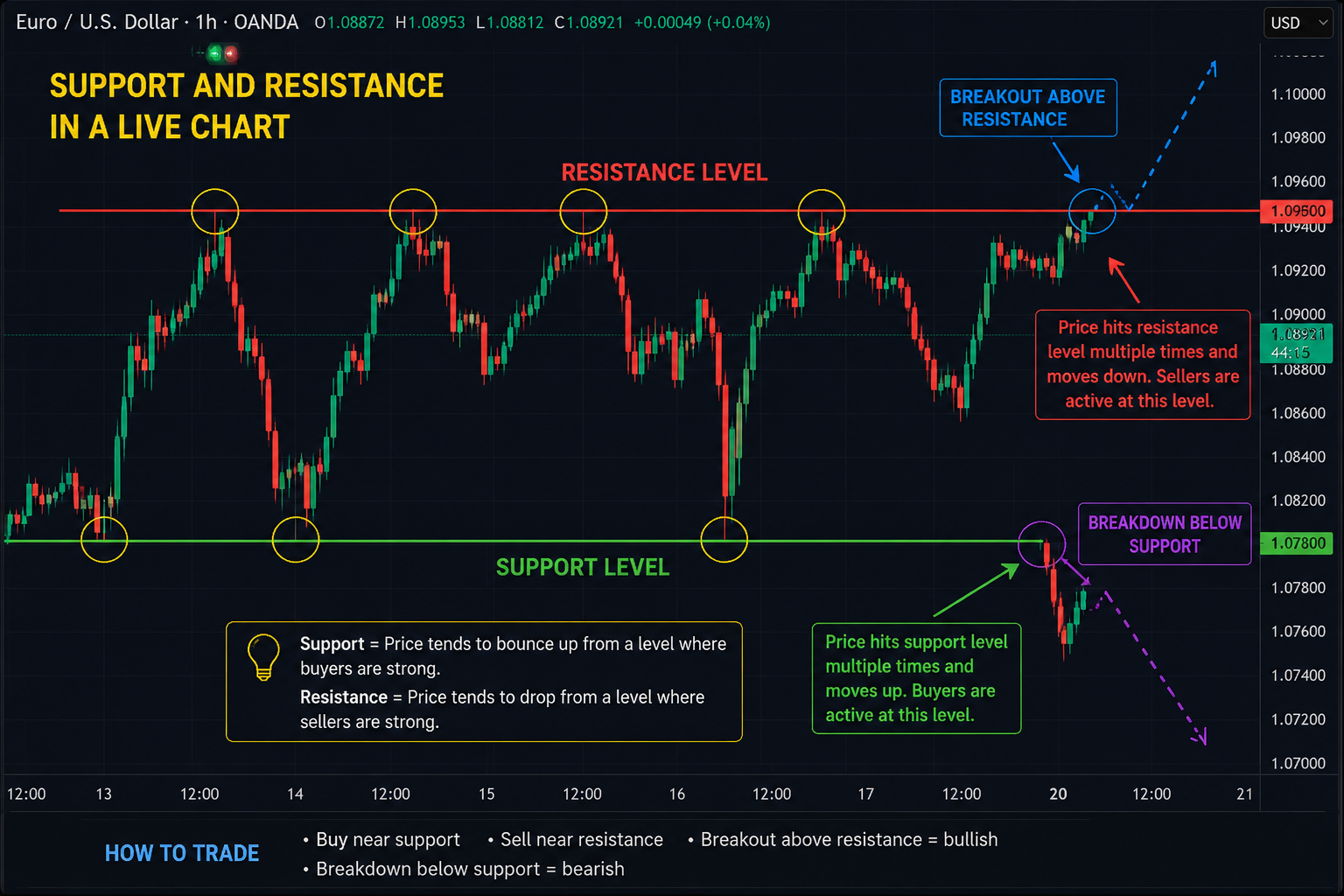
Support is a price level where a currency pair or asset tends to stop falling and may reverse upward. It acts like a “floor” in the market because buyers become more active at that level, preventing price from moving lower.
For example, if EUR/USD repeatedly drops to 1.1000 and bounces back upward, that level is considered a support zone.
Why Support Happens
Buyers believe the price is cheap and start buying.
Sellers begin taking profits.
Market demand increases around that area.
What is Resistance?
Resistance is the opposite of support. It is a price level where the market tends to stop rising and may reverse downward. It acts like a “ceiling” because sellers become stronger at that level.
For instance, if GBP/USD repeatedly rises to 1.3000 and falls back down, that level becomes resistance.
Why Resistance Happens
Traders believe the price is too high.
Sellers enter the market aggressively.
Buyers begin closing trades.
How Traders Use Support and Resistance
1. Finding Entry Points
Traders often buy near support and sell near resistance because these zones have a higher probability of causing reversals.
2. Setting Stop Loss and Take Profit
Stop losses are usually placed below support or above resistance.
Take profits are often targeted near the next support or resistance level.
3. Identifying Breakouts
When price breaks above resistance or below support with strong momentum, it may signal the start of a new trend.
Types of Support and Resistance
Horizontal Support and Resistance
These are straight price levels formed by repeated highs and lows.
Dynamic Support and Resistance
These move with the market and are usually created by moving averages or trendlines.
Psychological Levels
Round numbers like 1.2000 or 150.00 often act as strong support or resistance because many traders focus on them.
Importance of Confirmation
Support and resistance should not be traded blindly. Traders often combine them with:
Candlestick patterns
RSI or MACD indicators
Trend analysis
Volume confirmation
This helps reduce false signals and improves accuracy.
Common Mistakes Traders Make
Ignoring market trends
Entering trades too early
Treating support and resistance as exact lines instead of zones
Trading without confirmation
Conclusion
Support and resistance are the foundation of technical analysis. They help traders understand market psychology and make better trading decisions. By practicing how to identify these zones and combining them with proper risk management, traders can improve consistency and confidence in the market.
A successful trader does not simply predict the market — they react intelligently to key price levels.
Simple Image Description of Support and Resistance
Imagine a trading chart where the price moves up and down between two horizontal lines:
The bottom line is labeled Support because price keeps bouncing upward from that level.
The top line is labeled Resistance because price keeps rejecting downward from that level.
Candlesticks move between these zones repeatedly.
An upward arrow appears from support showing buying pressure.
A downward arrow appears from resistance showing selling pressure.
Eventually, the price may break above resistance or below support, signaling a breakout.
JOIN OUR FREE CLASS ON : https://shorturl.at/YpqJu