Stagflation Risk: What Traders Should Watch When Oil, Inflation, and Growth Collide
 Otet Markets6 min read·Just now
--
Stagflation is one of those words that gets thrown around fast the moment oil jumps and inflation turns ugly. But traders should be careful with it.
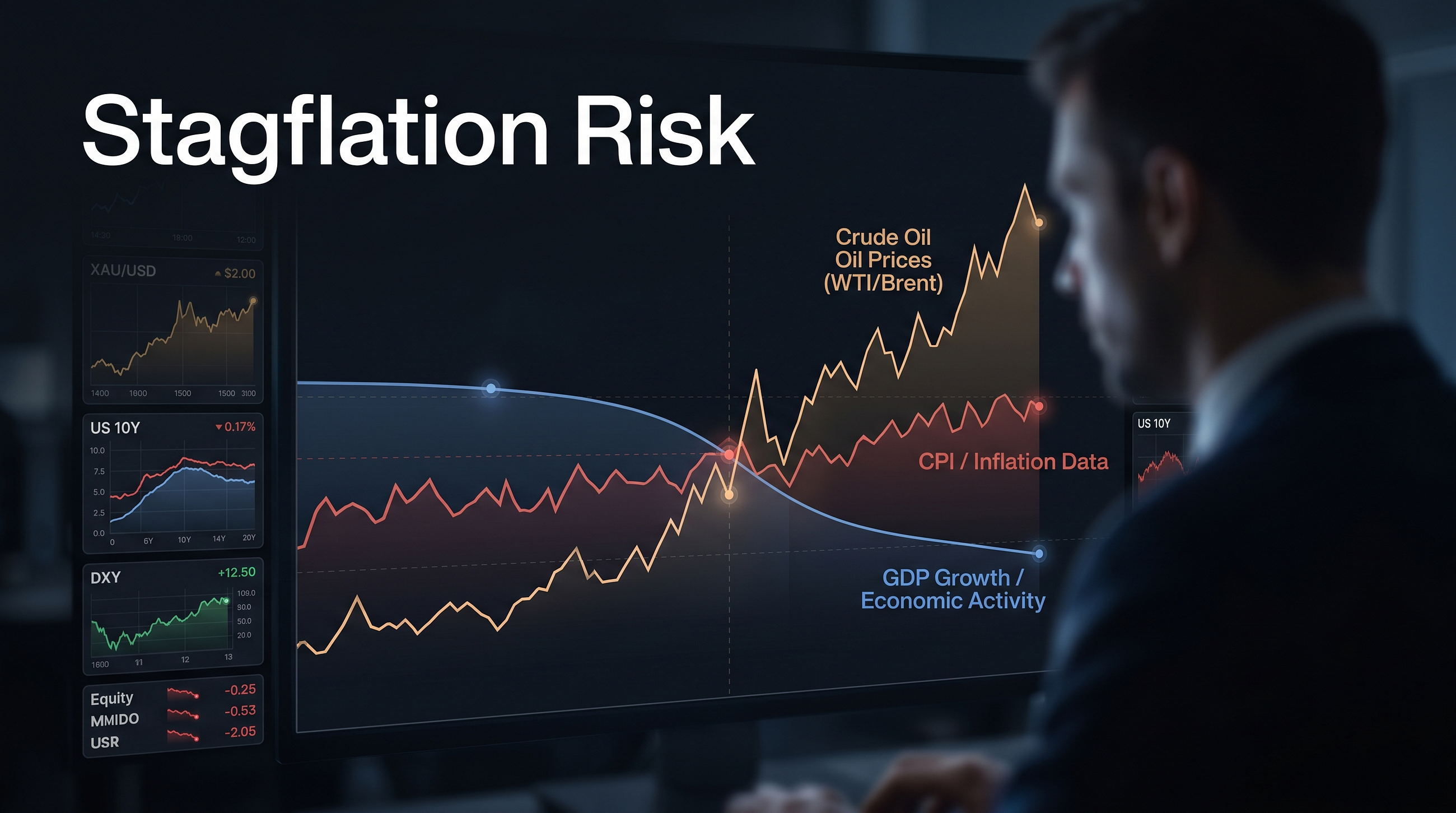
The better way to think about stagflation right now is not as a dramatic label, but as a risk framework. In the current market, inflation has clearly become more uncomfortable again, while growth looks softer and more fragile than it did a few months ago. That does not automatically mean the economy is fully stuck in a 1970s-style stagflation regime. It does mean traders now have to think in a world where inflation risk stays alive even as growth momentum weakens.
That framework matters because the latest data is pulling in two directions at once. U.S. March CPI rose 3.3% year over year, with the energy index up 10.9% on the month and gasoline up 21.2%. At the same time, March payrolls still rose 178,000 and unemployment held at 4.3%, while weekly jobless claims remained low at 207,000 in the latest Reuters report. Inflation is hot again, but the labor market has not cracked cleanly. That is exactly why the stagflation conversation has become relevant without yet becoming a settled conclusion.
Why the inflation side of the story is real
The inflation shock is not theoretical anymore.
The BLS said March energy prices posted their biggest monthly increase since 2005, led by the largest monthly gasoline jump since that series began in 1967. Reuters also reported that Brent crude was still around $98 a barrel on April 17, even after falling on ceasefire hopes, and that oil had surged about 50% in March because of the conflict and the disruption around the Strait of Hormuz. In other words, even if oil is no longer at the panic highs, the price shock has already worked its way into inflation data and pricing psychology.
That matters because inflation was already not fully solved before the energy shock. Reuters reported that February PCE inflation ran at 2.8% year over year, with core PCE at 3.0%, which means March’s oil spike landed on top of an already sticky backdrop rather than a clean disinflation trend. That is one reason traders are treating inflation risk more seriously again.
Why the growth side is getting weaker
The growth side of the picture is less dramatic than the inflation side, but it is becoming harder to ignore.
Reuters reported that U.S. manufacturing output unexpectedly dipped 0.1% in March, while the Fed’s Beige Book said firms are becoming more hesitant to invest or hire because of energy-driven uncertainty. Abroad, Reuters reported that Germany cut its 2026 growth forecast to 0.5% from 1.0% while raising its inflation forecast, and the IMF warned that Asia’s growth could slow from 5.0% in 2025 to 4.4% in 2026, with a worse scenario knocking off 1 to 2 percentage points cumulatively while inflation rises. That is the classic macro tension traders need to understand: growth is being revised down at the same time inflation is being revised up.
This is why “stagflation risk” is a better phrase than “stagflation certainty.” The current data does not show a full collapse in activity. It shows a world where growth is getting marked down, business confidence is softening, and central banks have less room to respond because inflation is still misbehaving. That is enough to change how markets trade, even if it is not enough to declare a full-blown regime shift with certainty.
Why central banks hate this setup
Central banks can handle weak growth more easily when inflation is cooling. They can handle high inflation more easily when growth is strong. What they hate is when inflation stays too high while growth gets weaker.
Reuters reported that New York Fed President John Williams said the war is already pushing inflation into other parts of the economy and expects inflation to stay above 3% in the near term, while also seeing unemployment rise to around 4.25% to 4.5% this year with only moderate growth. On the ECB side, Reuters reported that Olli Rehn said policymakers could look through the oil shock if it stays temporary, but warned that if second-round effects show up through wages and inflation expectations, a stronger response could be needed. That is the central-bank dilemma in one sentence: do too little and inflation broadens, do too much and growth gets squeezed harder.
That is also why the Fed path looks less clean now. Reuters reported today that Deutsche Bank no longer expects any Fed cuts in 2026, while other major houses still expect easing later in the year. When the market cannot agree on whether the next step is cuts, no change, or even renewed tightening risk, that is usually a sign the macro backdrop has become genuinely uncomfortable.
What traders should actually watch
The first thing to watch is oil, because it is still the most obvious trigger behind the inflation shock. If oil keeps easing, some of the headline inflation pressure may cool later. If it stays elevated or spikes again, the inflation story becomes much harder for policymakers to dismiss. Reuters’ latest reporting still shows Brent well above pre-conflict levels even after the recent pullback.
The second thing to watch is the split between headline inflation and underlying inflation. Energy can distort the top line, but the bigger danger is when energy spills into wages, transport, services, and broader expectations. That is exactly the second-round effect ECB officials are worried about.
The third thing to watch is growth sensitivity. If hiring, manufacturing, and confidence weaken further while inflation stays elevated, markets will start taking the stagflation risk more seriously. That is when price action in yields, the dollar, and equities can become much more unstable, because the market stops trusting the idea of a simple soft landing.
What this means for the dollar, yields, gold, and equities
For the dollar, stagflation risk can be supportive in the short run if it pushes back rate-cut expectations and keeps U.S. yields elevated. For Treasury yields, the reaction depends on which side of the story is winning: sticky inflation tends to keep yields high, while a sharper growth scare can eventually pull yields lower. Reuters’ April 9 poll captured exactly that split, with strategists nudging yield forecasts higher while still debating whether softer growth will win later.
For gold, the story is mixed. Inflation fear and geopolitical stress can support it, but higher real yields and a firmer dollar can cap it. For equities, this is where the setup gets nastier. Stocks can usually handle higher yields if growth is strong, or weaker growth if cuts are coming. They do much worse when growth slows but inflation blocks easy policy relief. That is why stagflation risk matters so much for broader risk sentiment.
The bigger takeaway
Stagflation risk is not just “high inflation plus bad growth.” For traders, it is the moment when inflation stays stubborn enough to limit central-bank flexibility, while growth weakens enough to damage confidence and make markets more fragile.
That is the environment markets are moving closer to right now. Inflation has reaccelerated. Oil risk has not fully gone away. Growth forecasts are being marked down in major economies. Central banks are sounding more cautious, not more comfortable. None of that proves full stagflation has arrived. But it does mean traders need a framework that takes both inflation pressure and growth weakness seriously at the same time.
In a market like this, the question is not whether to panic. It is whether you are reading the collision between oil, inflation, and growth clearly enough before the rest of the market fully reprices it.
Follow Otet Markets for practical market insights, trading education, and macro analysis.