Smart Contracts: If Code Is the Judge, Who Still Calls the Shots?
 Exworth5 min read·Just now
--
Why “code is law” in blockchain doesn’t mean the end of human control — but the start of a very different kind of contract.
In traditional commerce, agreements live on paper (or PDFs):
“You pay; I ship. If something goes wrong, we call lawyers, raise a dispute, or ask the bank to reverse the payment.” Here, trust is centralized in institutions: banks, courts, and payment processors.
On the blockchain, a new idea has emerged:
Smart contracts — programmable agreements that execute themselves once conditions are met.
The slogan “code is law” captures this vision: if the rules are written in code and the deal runs on the blockchain, the system enforces them automatically, reliably, and (in theory) impartially. But the more we lean into that phrase, the more urgent the question becomes:
If code is the judge, who still gets to change the rules?
The vending-machine deal
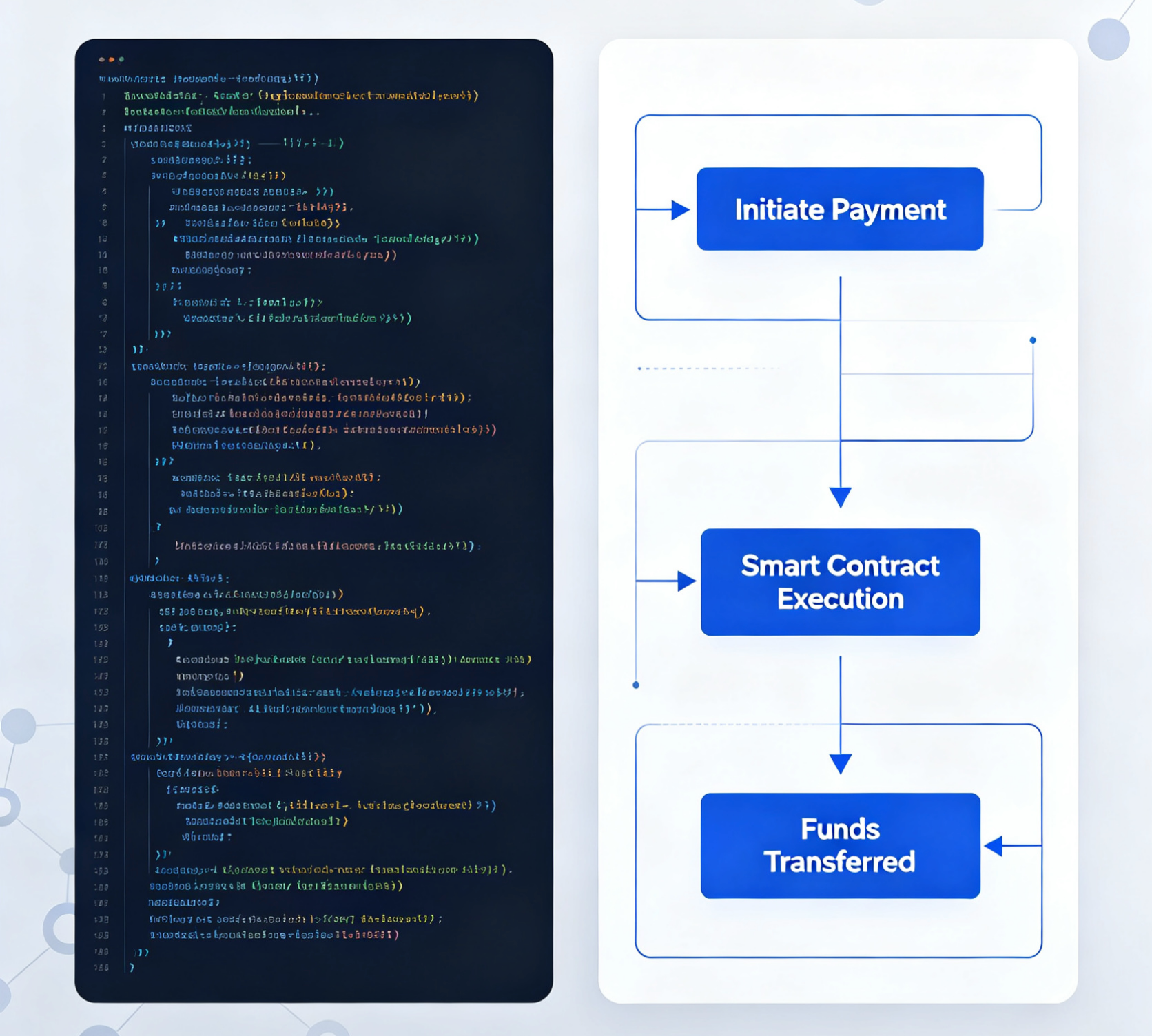
The simplest way to grasp a smart contract is the blockchain vending machine.
Imagine this scenario:
- You select an item (or service) online.
- You send money to a smart contract.
- The contract automatically verifies:
- Is the payment correct?
- Is it on time?
- Are the conditions satisfied?
If yes, the system delivers the product or service instantly.
If not, the funds are returned (or held, depending on how the contract is written).
Unlike a traditional website, there’s no manual “approve payment” button in the background.
There’s no human operator who can secretly pause your order or overcharge you.
There’s no bank gatekeeper who can decide, “We don’t trust this merchant,” and freeze the transaction. The contract executes according to the code.
Period.
This is exactly what the phrase “code is law” promises:
The contract, written in code, becomes the final authority.
You pay, it ships, and the system enforces the deal automatically.
In the ideal world, this reduces fraud, delays, and hidden approvals because the rules are transparent, deterministic, and tamper‑resistant.
Why “automatic execution” is both powerful and risky
The power of smart contracts lies in what they prevent:
- No arbitrary cancellations (once conditions are met, the outcome is locked in).
- No manual chargebacks after the deal is fulfilled.
- No need for a central platform to babysit every transaction.
This makes them ideal for use cases like:
- Automated payouts (e.g., staking rewards, yield farms, royalties).
- Tokenized assets (where ownership transfers only when the correct payment is registered on‑chain).
- Subscription payments (where a smart contract renews your subscription if your balance is sufficient).
In each of these examples, the contract does something that would normally require a human or institution to approve or trigger.
Instead, the outcome is encoded:
“If X, then Y.”
No ambiguity. No discretion.
At least, in theory.
The risk is the same:
If the code is law, then flawed code is flawed law.
If a bug or vulnerability exists in the contract, the system will still execute it faithfully. Security audits, formal verification, and safer design patterns (like multisig upgrades) try to mitigate that risk, but they don’t eliminate it.
The line between “cannot be stopped” and “cannot be changed.”
The vending‑machine model works best when both parties understand the rules up front and trust the code.
But in the real world, contracts sometimes need to adapt:
- What if the item is broken or never arrives?
- What if the price was mispriced due to an error?
- What if regulations change, and the original contract becomes non‑compliant?
Here, the “code is law” philosophy reaches its limits. If a smart contract is immutable and truly unstoppable, it cannot be “paused,” “rolled back,” or “patched” without breaking the very idea of trustless execution.
In practice, the industry is evolving toward a middle ground:
- Upgradable contracts
Some systems allow trusted governance or multisig signers to upgrade a contract, fixing bugs or adjusting parameters — but this reintroduces human control. - Dispute layers
Markets and protocols are being built on top of blockchains to handle disputes, arbitration, or insurance when something goes wrong. - Hybrid contracts
In many real‑world applications, “smart contracts” actually sit alongside oracles, off‑chain data, and human moderation. The code is still the execution engine, but it doesn’t operate in complete isolation.
So in practice, “code is law” rarely means “no humans allowed.”
It means “humans are pushed further upstream” — into design, deployment, and governance, not into every individual transaction.
Who writes the judges’ instructions?
The real question behind “code is law” is not how the contract executes, but who writes it — and who can change it.
If a centralized team can:
- Upgrade logic,
- Pause withdrawals,
- Adjust fees, or
- Introduce new constraints,
and then the code is still very much shaped by human will, even if the individual deals are automated.
This is why the slogan often feels both powerful and dangerous.
It highlights the promise of tamper‑resistant, automated execution, but it also hides the reality that:
- Every contract is designed by someone.
- Many contracts are controlled by a small group of developers or entities.
- Upgrades and governance mechanisms are built into the system, not removed from it.
In that sense, “code is law” is less a statement about technology than a negotiation between automation and trust. It’s a design decision that says: “We’re moving human judgment out of the transaction‑by‑transaction space and into the architecture and governance.”
The future: executive power, not a magic wand
If the early dream of “code is law” was a fully autonomous, unstoppable contract, the more realistic future is this: Smart contracts are powerful executive tools, not magical, self‑standing judges. They automate what can be automated and clearly defined, but they still sit inside a broader ecosystem of:
- Governance,
- Audits,
- Dispute resolution, and
- Off‑chain coordination.
So the next time you hear “code is law,” ask:
- Who wrote the code?
- Who can change it?
- What happens when something goes wrong but the contract still “works correctly”?
In a world where you pay, and the system ships automatically — with no one able to “press delete” — the code may indeed be the judge. But the people who write the code become something else entirely: the architects of the court.