Shattering the Line-Drawing Myth: An Institutional Framework for Supply/Demand Zones and Liquidity Sweeps
 BBX | Tokenized Equities Research6 min read·Just now
--
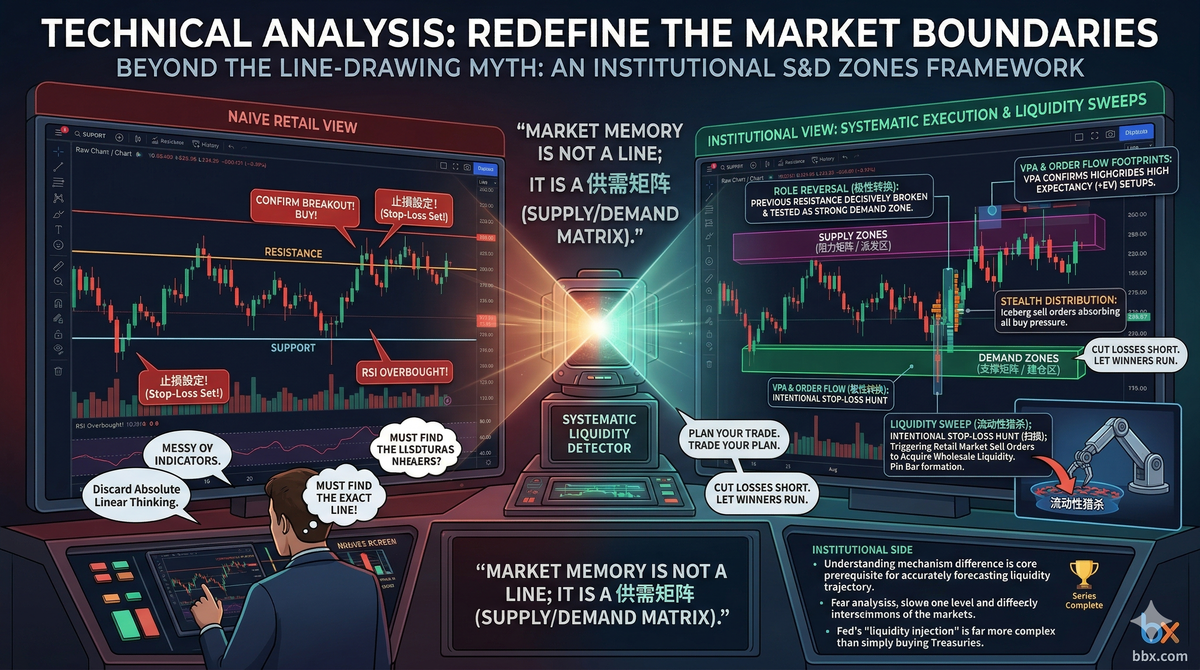
Why do your support lines constantly get pierced? Break free from retail linear thinking. Dive into the microstructure of institutional Order Flow, reconstruct Supply & Demand (S&D) Zones, and decode the underlying mechanics of Role Reversal and Liquidity Sweeps (Stop Runs).
TL;DR (Core Summary): Traditional Support and Resistance form the skeleton of technical analysis. Yet, 90% of retail traders turn these concepts into fatal trading traps due to their rigid obsession with “drawing geometric lines.”Discard Absolute Linear Thinking: True financial markets do not respect bounce lines calculated to the second decimal point. Support and resistance are inherently Supply/Demand Zones-broad areas with actual depth where institutional capital deploys Iceberg Orders.The Principle of Polarity: A historical “ceiling,” once breached with heavy volume, frequently morphs into a future “floor.” This is not mysticism; it is a massive Order Flow Reconstruction driven by the Cognitive Dissonance and P&L psychology of market participants (trapped shorts and sidelined bulls).Liquidity Sweeps (Stop Runs): Massive clusters of retail stop-loss orders inevitably accumulate just below obvious support lines. Smart Money intentionally pierces these critical boundaries to trigger these Stop-Loss Pools, utilizing the resulting Liquidity to build their own positions at wholesale prices.
Introduction: Why Your Retail “Support Lines” Are Defenseless
In the preliminary stages of technical analysis, traders love to find two historical swing lows on a chart, connect them with a straight line, and enshrine it as an impenetrable “Support Line.” Subsequently, they go all-in on a long position and meticulously place their Hard Stop-Loss just pennies below that exact line.
However, the most classic tragedy in live trading usually follows: The price slices through this support line like a hot knife through butter, precisely triggering the retail stop-loss (forcing a market sell), only to immediately print a long lower wick and violently reverse into a massive uptrend. Retail traders often walk away fuming, convinced that their accounts were “targeted by market makers.”
The brutal truth is: Institutions are not monitoring your specific account; your linear thinking has exposed your hand. Support and resistance stripped of their Order Flow Microstructure are nothing more than psychological placebos on a chart. Today, we will entirely reconstruct this core concept through the institutional lens of Liquidity Boundaries.
I. Cognitive Upgrade: From “1D Lines” to “2D Supply & Demand Matrices”
Retail traders seek absolute precision, but the Price Discovery Mechanism is fundamentally a blurry, dynamic auction process.
Suppose an asset has a strong technical consensus at $100.00. Retail traders will rigidly place limit buy orders exactly at $100.00. However, a Wall Street institution managing billions of dollars absolutely cannot fulfill its massive Accumulation needs at a single, absolute price point (doing so would cause catastrophic Slippage). They must distribute their Limit Orders like a wide net across a broader Price Band, for example, between $98.00 and $102.00.
Therefore, a professional trading system must upgrade the concept of support and resistance into Supply and Demand Zones (S&D Zones), or Order Blocks (OB), which possess actual depth:
- Demand Zone (Support Matrix): When price drops into this matrix, institutional buying-perceiving the asset to be at a “deep discount”-floods in. When Marginal Buying entirely absorbs and overwhelms the selling pressure, the price halts its decline and reverses upward.
- Supply Zone (Resistance Matrix): When price rallies into this matrix, institutional selling (including profit-taking and strategic shorting)-perceiving the asset to be at an “extreme premium”-begins to unload. This massive Selling Pressure forms an invisible wall, forcing the price back down.
Execution Discipline: Immediately delete the “Horizontal Line” tool from your charting software and replace it with the “Rectangle” tool. Box in the clusters of dense candlestick real bodies along with their extreme wicks to construct your true Buffer Zones.
II. Market Memory and Psychological Warfare: The Principle of Polarity (Role Reversal)
One of the most fascinating and high-win-rate characteristics of support and resistance is their ability to swap roles. In technical analysis, this is known as the Principle of Polarity or Role Reversal: “A major resistance zone, once decisively broken with volume, will highly likely transform into a strong support zone during future pullbacks; and vice versa.”
This phenomenon is not a coincidence. Its underlying driver is human Loss Aversion coupled with capital’s instinct for profit:
Suppose a persistent Supply Zone (Resistance) sits at $50:
- Trapped Shorts: Traders who initiated short positions near $50 are plunged into deep floating losses and psychological pain once the price breaks out to $60 on high volume. When the price finally retraces to $50 weeks later, they will frantically cover their shorts just to “break even” (Short Covering = Market Buy Orders).
- Sidelined Bulls: Capital that hesitated and missed the initial breakout experiences extreme FOMO (Fear Of Missing Out) as the price skyrockets. When the market graciously offers a “second chance” to get on board at $50, they will aggressively slam massive capital into the market.
The combination of “Buy orders from short-covering” PLUS “New buy orders from FOMO bulls” generates an immensely powerful Upward Momentum. The original resistance “ceiling” is thus paved with real capital into an impenetrable support “floor.” Identifying confirmations of this polarity shift is the core of building a Positive Expected Value (+EV) trading system.
III. The Institutional Trump Card: Liquidity Sweeps (Stop Runs)
This is the “deep water” zone where retail win rates are mercilessly crushed, and it is the ultimate key to understanding institutional Order Flow.
Following the teachings of traditional technical analysis books, millions of retail traders globally will mechanically place their Hard Stop-Loss Orders directly beneath highly visible support zones. On the order book heatmaps of Smart Money, this area glows blindingly bright-it is known as a Stop-Loss Pool or Liquidity Pool.
When institutions intend to build a massive long position, simply sweeping the order book at market price would trigger a violent price spike, drastically raising their own average entry cost. To acquire a sufficient counterparty (sell orders), institutions employ a Liquidity Hunting (Stop Run) strategy:
- Downward Inducement: Institutions utilize a relatively small amount of capital during low-volume hours to intentionally push the price just below the key support zone.
- Triggering the Stop Cascade: Retail traders witness the “support breakdown.” Technical panic spreads, triggering an avalanche of stop-loss orders which instantly convert into a flood of Market Sell Orders.
- Passive Absorption: Institutions, having already opened their jaws just below the line with hidden limit buy orders, passively absorb this entire flood of retail selling. They complete their massive accumulation stealthily and at wholesale prices.
- The V-Shaped Reversal: Once sufficient Liquidity has been absorbed and selling pressure is exhausted, institutions ignite the rally. The price rapidly reverses, printing a long lower wick (like a Pin Bar) and skyrocketing, leaving the shaken-out retail traders standing in the dust.
This is the microstructural reality behind the dreaded Fakeout.
Conclusion: Fortifying Your Sniper Position at High-EV “Geographical Boundaries”
In the asymmetrical warfare of financial markets, Price Action provides the timing to pull the trigger, Volume Price Analysis (VPA) verifies the true intent of capital, and Supply & Demand Zones delineate the only high-value battlefield boundaries worth fighting on.
Elite professional traders never engage in frequent firefights in the “no man’s land” in the middle of a chart. They patiently map out macro liquidity matrices and lie in wait like snipers. They only deliver the lethal strike when the price steps into these core polarity zones, accompanied by clear volume-price confluence (such as a low-volume pullback or a long-wick liquidity sweep). Abandon your obsession with one-dimensional lines, embrace multi-dimensional liquidity thinking, and your trading system will achieve a true paradigm shift.
Disclaimer: This report is for informational purposes only and does not constitute financial advice.