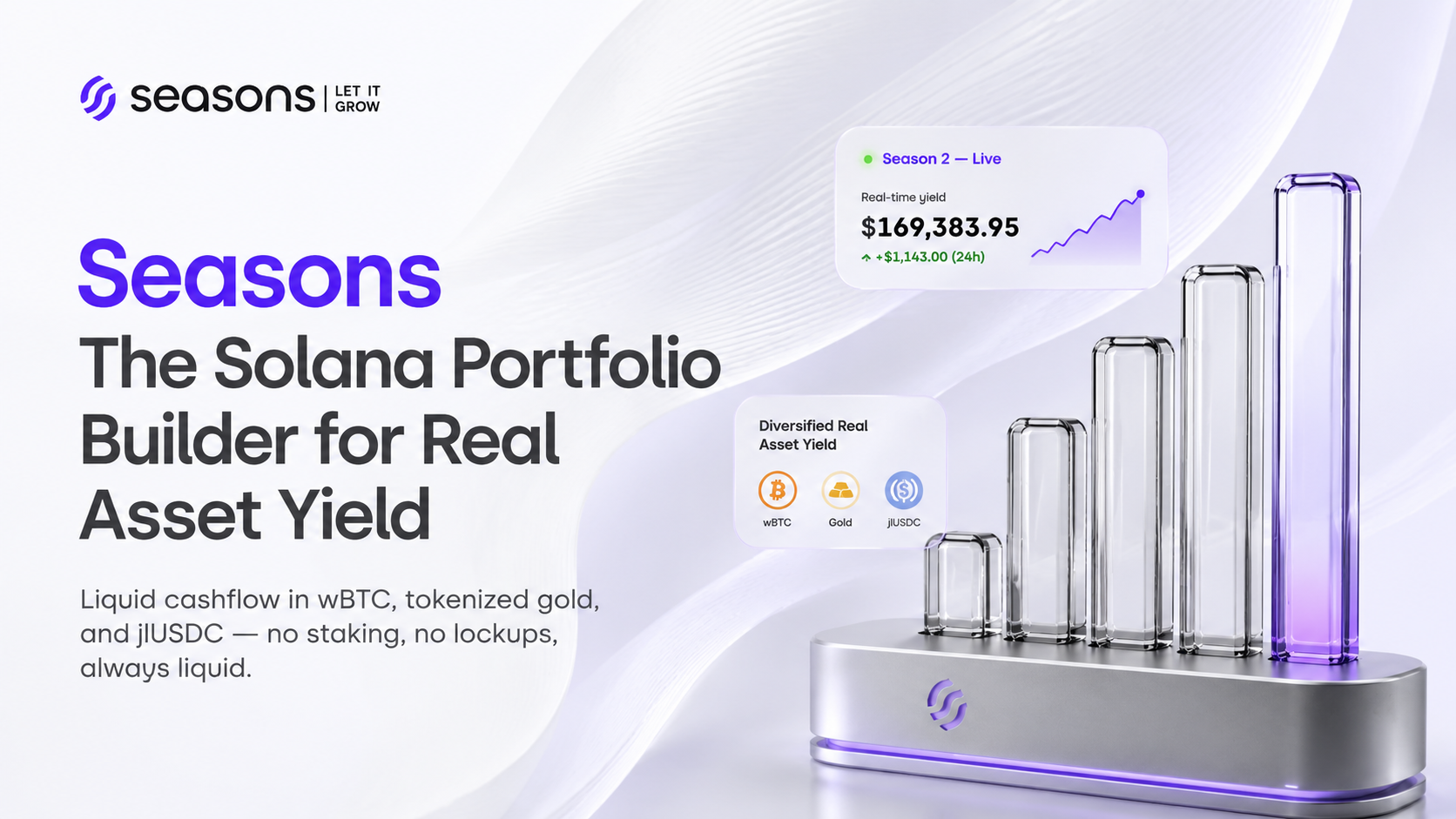
Seasons: The Solana Portfolio Builder Turning Yield Into Real Assets
--
Most people in crypto are still chasing the highest APY.
But that is the wrong question.
The better question is:
Can you earn yield while staying liquid?
Because in DeFi, yield usually comes with a cost.
You stake.
You lock.
You claim.
You compound.
You monitor risk.
You hope the reward token does not collapse before you sell it.
That is not passive income.
That is another job.
Seasons is taking a different approach.
Instead of asking users to lock funds or chase emissions, Seasons lets users hold 10,000+ SEAS in a non-custodial Solana wallet and become a Node.
No staking.
No lockups.
No claiming.
Just hold SEAS and receive liquid cashflow directly to your wallet in real assets:
wBTC.
Tokenized gold.
jlUSDC.
This is why Seasons should not be viewed as just another Solana yield protocol.
It is closer to an automated portfolio builder for onchain users who want real asset yield without giving up liquidity.
The Problem With Old DeFi Yield
DeFi yield has gone through several phases.
First came liquidity mining.
Then came staking rewards.
Then came ve-tokenomics.
Each model helped bootstrap ecosystems, but they also created the same problem:
A lot of yield was not real.
It was paid through inflation.
Protocols printed reward tokens, users farmed them, and everyone hoped there would be enough buyers on the other side.
The result was predictable:
High APY at launch.
Heavy emissions.
Constant sell pressure.
Falling token price.
Lower real returns.
On paper, users were earning.
In reality, many were just being paid in assets that lost value faster than the yield accumulated.
That is why the next stage of DeFi yield has to be different.
It needs to be liquid.
It needs to be non-custodial.
It needs to come from real economic activity.
And it needs to distribute assets people actually want to hold.
This is the gap Seasons is trying to fill.
What Is Seasons?
Seasons is a Solana-native Yield 3.0 protocol built around SEAS, Nodes, and real asset distributions.
The core idea is simple:
When a wallet holds 10,000+ SEAS, it becomes eligible to receive yield distributions as a Node.
The important part?
Your SEAS stays in your wallet.
You are not depositing it into a staking contract.
You are not locking it for a fixed period.
You are not giving custody to a third party.
The model is built around one simple phrase:
Always Liquid. Always Earning.
That is the key difference.
Most yield systems make users choose between earning and liquidity.
Seasons tries to combine both.
Why Seasons Works Like a Portfolio Builder
The strongest part of the Seasons model is not just that it pays yield.
It is what the yield is paid in.
Season 2 distributes yield through a basket of real assets:
30% wBTC
30% tokenized gold / XAUt0
40% jlUSDC
This matters because users are not simply earning more of an inflationary farm token.
They are receiving exposure to three different types of assets:
Bitcoin for long-term digital scarcity.
Gold for defensive value storage.
Stablecoin yield for liquidity and lower volatility.
That turns Seasons into more than a yield protocol.
It becomes a diversified crypto portfolio builder.
Instead of manually deciding when to buy Bitcoin, when to add gold exposure, or when to hold stablecoins, the wallet receives distributions across all three.
Over time, this creates a simple but powerful idea:
Your wallet starts building a real asset portfolio on autopilot.
Why Liquid Cashflow Matters
Liquidity is one of the most underrated features in DeFi.
Many users only look at yield numbers.
But yield without liquidity can become a trap.
A protocol may offer attractive returns, but the user often has to accept:
Locked assets.
Delayed withdrawals.
LP exposure.
Impermanent loss.
Manual claiming.
Complex strategy management.
That might work for advanced DeFi users.
But it does not work for the average long-term holder who simply wants their capital to keep working.
Seasons removes much of that friction.
The user holds SEAS.
The wallet qualifies as a Node.
Yield lands directly in the wallet.
The position stays liquid.
This is why “Always Liquid. Always Earning.” is not just a slogan.
It is the product thesis.
Where Does the Yield Come From?
This is the question every serious DeFi user should ask.
If a protocol pays yield, the first question should never be:
“How high is the APY?”
The first question should be:
“Where does the yield come from?”
Seasons is built around a reflexive fee-harvesting system.
The currently active mechanism is based on transaction fees generated by SEAS activity. Those fees are used to create yield distributions for eligible Nodes.
In simple terms:
SEAS activity creates fees.
Fees are converted into yield assets.
Yield assets are distributed to Node holders.
That is a cleaner model than simply printing more tokens and calling it yield.
It also makes the system easier to understand.
More real activity can support more distributions.
Lower activity can reduce yield.
That is healthy.
Because sustainable DeFi yield should be connected to actual economic activity, not artificial emissions.
Why Real Asset Yield Is a Better Narrative
Crypto users have become more sophisticated.
In 2021, high APY was enough to get attention.
In 2026, users ask better questions.
Is the yield sustainable?
Is it non-custodial?
Is there a lockup?
Is the reward asset useful?
Does the protocol have real activity?
Can I exit if market conditions change?
This is where real asset yield becomes powerful.
When a user receives wBTC, gold exposure, and jlUSDC, the yield feels more tangible.
It is not just “more protocol points.”
It is not just another farm token.
It is a basket of assets that already have strong use cases inside and outside DeFi.
That is why Seasons has a more interesting angle than most passive income protocols on Solana.
It is not only competing on APY.
It is competing on yield quality.
Seasons vs Traditional Staking
Traditional staking is familiar.
You deposit a token.
You lock it or delegate it.
You earn rewards.
You claim or compound.
That model works for some assets.
But it also creates friction.
Seasons uses a hold-to-earn model instead.
The difference is important.
With Seasons:
Your SEAS remains in your wallet.
You do not need to stake.
You do not need to claim.
You do not need to manage a complex strategy.
You receive real asset yield automatically.
This makes the system easier for normal users to understand.
It also makes the wallet itself feel more productive.
Instead of being a static storage tool, the wallet becomes a cashflow layer.
That is a powerful idea for the future of onchain finance.
Why Solana Matters
Seasons is built on Solana, and that choice matters.
A system that distributes yield directly to wallets needs fast settlement, low fees, and smooth user experience.
Solana is one of the few ecosystems where this type of frequent, wallet-level distribution can feel natural.
For users, the experience is simple:
Hold the asset.
Stay liquid.
Receive distributions.
Track everything onchain.
That is exactly the kind of flow DeFi needs if it wants to move beyond power users and reach broader adoption.
The next generation of yield products will not feel like complicated financial dashboards.
They will feel like smart wallets that work in the background.
Seasons fits that direction.
The AI Agent Angle
There is also a bigger future-facing angle here.
As AI agents become more active in crypto, they will need capital management systems.
An AI agent does not want to manually stake, unstake, claim, and rotate capital across dozens of farms.
It needs simple yield infrastructure.
Hold-to-earn models are naturally aligned with this.
An agent can hold an asset, remain liquid, and receive cashflow without complex manual operations.
That is why Seasons’ Yield 3.0 model also fits the emerging agentic economy.
For human users, it means simpler passive income.
For AI-native systems, it could become a capital efficiency layer.
This is still early, but the direction is clear:
Autonomous capital needs autonomous yield infrastructure.
What Users Should Watch
Seasons has a strong narrative, but no DeFi system is risk-free.
Users should pay attention to a few things:
Yield depends on real activity.
If volume rises, distributions can improve.
If volume falls, distributions can decline.
That is not a weakness.
That is how real yield should work.
Users should also track liquidity, smart contract risk, market volatility, and the development of future modules.
The strongest way to evaluate Seasons is not to ask whether it can show the highest APY on a dashboard.
The better question is:
Can it keep distributing real asset yield while preserving liquidity and improving the user experience over time?
That is the metric that matters.
Why Seasons Is Worth Watching
The next wave of DeFi will not be won by the protocol with the loudest APY.
It will be won by protocols that make yield easier, cleaner, and more useful.
Seasons is interesting because it combines several ideas into one simple user experience:
Non-custodial holding.
Liquid yield.
Real asset distributions.
Solana-native execution.
Automated portfolio building.
No staking.
No lockups.
No claiming.
That is a strong product direction.
For users who want a simpler way to build exposure to Bitcoin, gold, and stablecoin yield, Seasons offers a model worth studying.
Not because it removes all risk.
No DeFi protocol does that.
But because it reframes what passive income in crypto can look like.
Less farming.
Less friction.
More liquid cashflow.
Better assets.
That is the future DeFi should be moving toward.
Final Take
Crypto does not need another unsustainable APY game.
It needs better yield design.
Seasons is building around that idea.
By letting SEAS holders receive yield in wBTC, tokenized gold, and jlUSDC without staking or lockups, Seasons turns the wallet into something more powerful:
A liquid, onchain portfolio builder.
For long-term users, that is the real opportunity.
Not just earning yield.
But earning yield in assets that can actually help build a stronger portfolio over time.
Always Liquid. Always Earning.
Learn more: https://seasons.wtf
Follow: @SeasonsDEFI
Join the community: t.me/SeasonsHQ