I’ve been in Bitcoin since 2014. I’ve watched entire cycles come and go. And right now, quietly, the most important thing happening in crypto isn’t getting a tenth of the attention it deserves.
I want to tell you about the moment my whole framing shifted.
Not about crypto, I’d settled that question years ago. But about Real World Assets specifically. For a long time I filed RWAs in the same mental drawer as a lot of ideas in this space: genuinely interesting technology, real vision but just not ready. Smart people building things the world hadn’t caught up to yet.
Then I sat with something long enough to actually understand it.
A 90 day US Treasury bill, the most boring financial instrument in existence, tokenized and fractionalized so that someone with fifty dollars could own a piece of it, earn the yield and sell their position instantly. To anyone, anywhere and at any time. No broker, no account minimum, no settlement delay and no geography restriction.
I’ve spent twelve years believing that open, permissionless systems are better than closed ones. That belief had always felt like a bet on the future. This was the first time I saw it expressed in something so mundane, so undeniable and so obviously correct that I couldn’t file it away anymore.
That was the moment. A fuc*ing T-bill
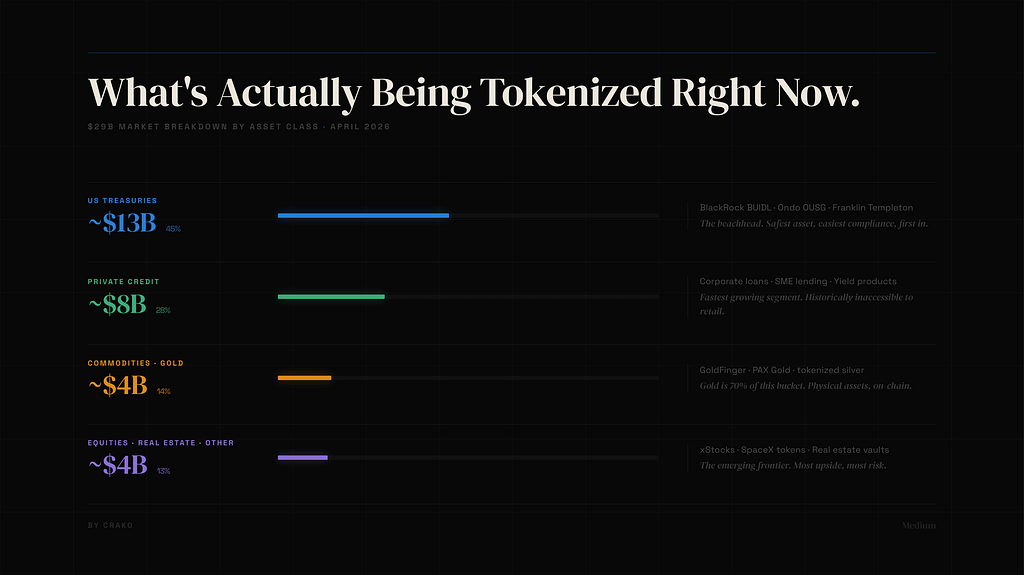
Now Let Me Tell You Why The $29 Billion Is The Punchline
Everyone is celebrating the number. The headlines read: tokenized RWA market hits $29 billion, up 266% year over year, BlackRock is in, the IMF is in and the NYSE is building a tokenized securities platform.
All of that is true. All of it is genuinely significant and all of it is also almost nothing.
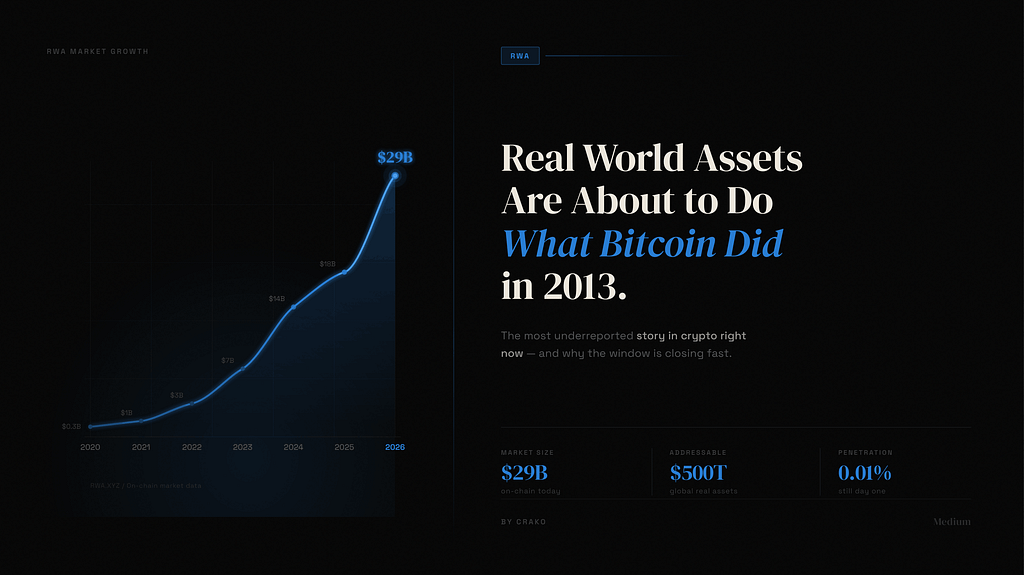
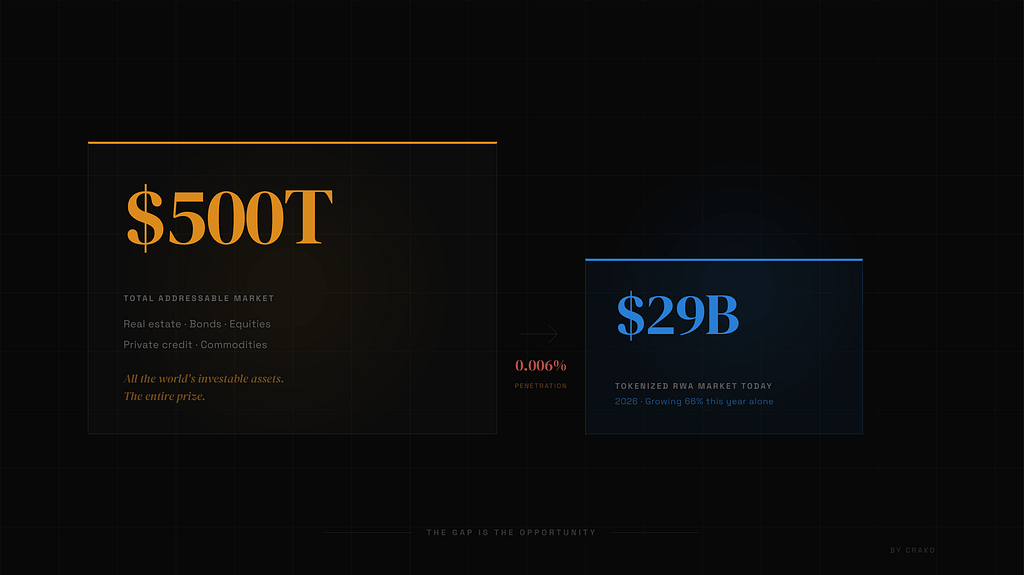
The total addressable market for the assets being tokenized (real estate, equities, bonds, commodities, private credit and infrastructure) sits somewhere between $500 trillion and $900 trillion depending on how you measure it. The current on chain RWA market is $29 billion.
I’ll do that math for you. We are at less than 0.01% penetration of the addressable market.
I’ve been in this space through multiple cycles. I know what it looks like when a technology is at the very beginning of something versus in the middle of it or near the end. The ICO boom of 2017 was a middle and end story, most of the easy money had already been made by the time the retail crowd arrived. DeFi summer in 2020 felt early right up until it didn’t.
This feels different. This feels like 2013 felt for Bitcoin. Real infrastructure, genuine institutional commitment, a problem worth solving and almost no one has actually shown up yet.
The People Who Have Showed Up
Let me be specific because specifics matter when everyone around you is speaking in vibes.
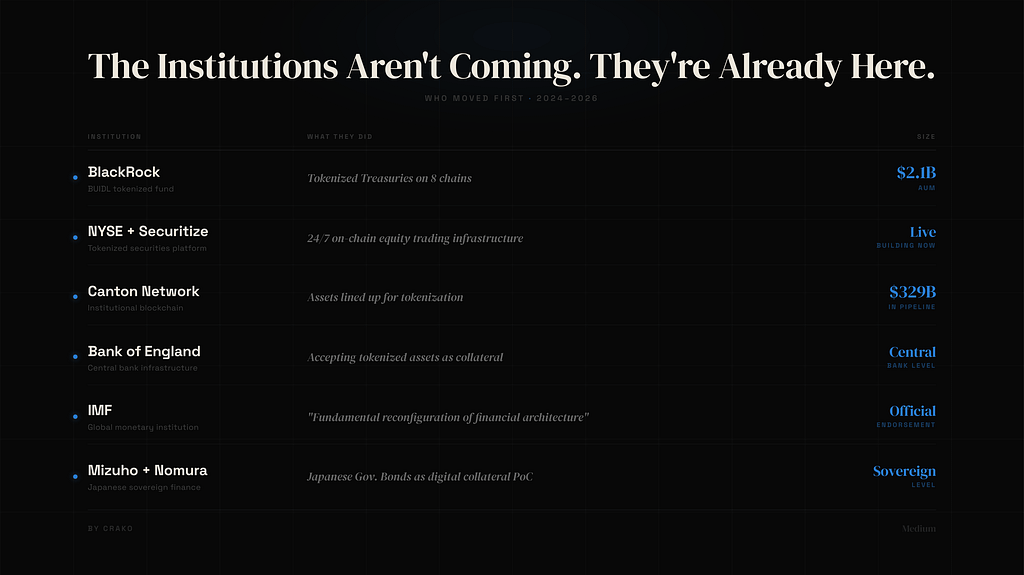
BlackRock’s BUIDL fund, tokenized short duration Treasuries, has $2.1 billion in assets under management running across eight blockchains. BlackRock manages $10 trillion. BUIDL is 0.02% of their book. That’s not a bet. That’s a proof of concept. The bet comes later, when the infrastructure is proven and the compliance teams have run out of reasons to say no.
The New York Stock Exchange is partnering with Securitize to build a tokenized securities platform. The Bank of England is preparing to accept tokenized assets as collateral. Mizuho and Nomura ran a proof of concept using Japanese Government Bonds as digital collateral. Canton Network, (backed by major financial institutions) has $329 billion in assets lined up for tokenization.
And then there’s xStocks (Solana and Mantle): $300 million in assets under management for 24/7 on chain trading of US public equities and ETFs. You can trade Apple stock at 3am on a Sunday from Lagos or Lisbon or Lima with no brokerage account. Someone tokenized SpaceX pre IPO exposure , the kind of deal that used to require being a Silicon Valley insider with a $5 million minimum check.
The IMF published a note in April calling tokenization a “fundamental reconfiguration of financial architecture.” Not an efficiency improvement. A RECONFIGURATION. These are not people who speak loosely.
What I Got Wrong For Longer Than I’d Like To Admit
Here’s the mistake I made for longer than I’d like to admit.
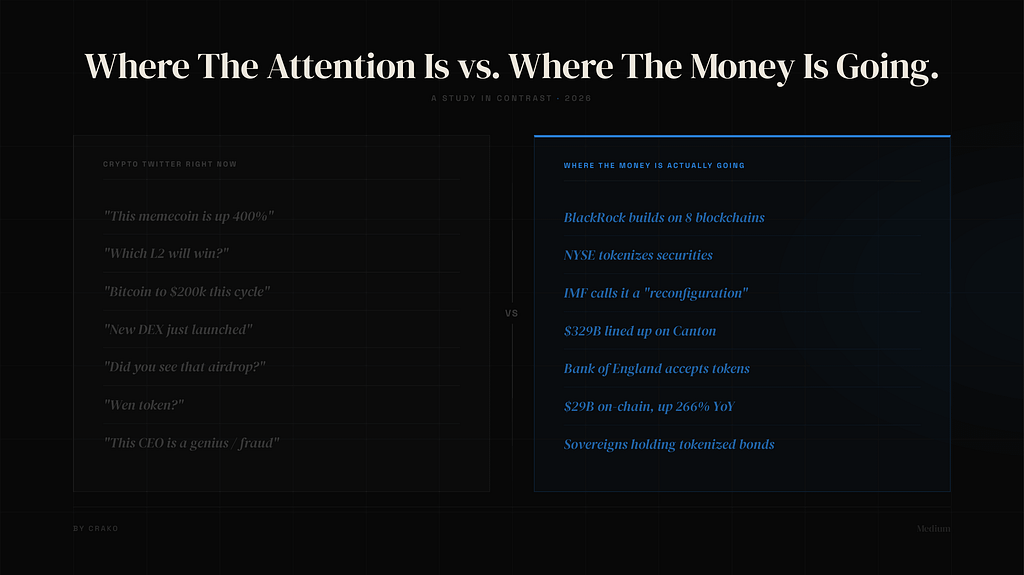
I kept thinking about RWAs as crypto eating TradFi. The blockchain world reaching out and digitizing the traditional finance world, on crypto’s terms, for crypto’s audience.
That framing is backwards. And getting it backwards made me underestimate the timeline and the scale.
What’s actually happening is that TradFi is choosing to rebuild its own infrastructure on blockchain rails. Not because the crypto community convinced them. Because the efficiency gains are too large to ignore and the regulatory environment has finally shifted enough to make it viable.
The SEC and CFTC issued joint guidance in March. The Fed, OCC and FDIC confirmed technology neutral capital treatment for tokenized securities. The GENIUS Act and Clarity Act are moving through Congress. For the first time in the twelve years I’ve been watching this space, the biggest financial institutions in the world and the regulatory bodies that govern them are rowing in the same direction.
That has never happened before. Not for Bitcoin, not for Ethereum and not for DeFi. It is happening now, for this.
When I finally reframed it, from “crypto disrupts TradFi” to “TradFi rebuilds itself on open infrastructure”, the scale of what’s coming became genuinely difficult to sit with.
I have to be Honest…
I’ve written about the patterns I’ve seen over twelve years in this space. One of those patterns is that every compelling narrative has a shadow. RWAs have one too and I’m not going to skip over it.
Right now, more than 90% of tokenized assets are sitting in what analysts are calling liquidity deserts. The assets are on chain. The infrastructure is real. But the secondary market, the ability to trade freely, at fair prices, with genuine depth…barely exists.
Owning a tokenized piece of a commercial real estate portfolio sounds revolutionary until you need to exit on a Thursday afternoon and find three buyers in the entire market, none of them close to your price.
Liquidity is the problem that will separate the genuine infrastructure from the well funded experiments. The projects that crack secondary market liquidity will define this cycle the way Uniswap defined DeFi. The ones that don’t will become footnotes.
The other thing I’ll say honestly: 0.01% penetration of a $500 trillion market sounds like the beginning of everything. It’s also just the beginning. Which means years of building before the payoff, a lot of projects that won’t survive contact with reality, and the near certainty that the assets and platforms that end up mattering most haven’t been launched yet.
I’ve held through twelve years of this space. I know what patience costs and what it returns. Both are real.
Where I’m Putting My Attention
I’m not going to tell you what to buy. I’m going to tell you what I’m watching, which is a different and more honest thing.
I’m not focused on the tokenized assets themselves. I’m focused on the infrastructure underneath them.
Every time this space has created real, lasting value, it wasn’t in the obvious thing. It wasn’t the ICO tokens in 2017, it was Ethereum, the platform they ran on. It wasn’t the yield farms in 2020, it was the AMM protocols underneath them.
The RWA layer is the same story. The picks and shovels are the issuance infrastructure, the oracle networks that connect on chain assets to real-world data, the compliance and KYC layers that make institutional adoption possible and the liquidity protocols that turn tokenized assets from interesting experiments into actually useful financial instruments.
The projects building that infrastructure, quietly and without a lot of nois, are the ones I’m spending time understanding. Not because they’re exciting right now. Because I’ve seen this before.
The First Minute
I started this piece by saying we’re at the very beginning. Let me be honest about what that actually means.
It means most people reading this won’t act on it. The payoff is years away, not months. There will be a period where the narrative gets over hyped, a few bad actors blow things up and someone writes the obituary. There will be a scandal. There will be a crash in a corner of this market that gets extrapolated into the whole thing being fraudulent.
And then it will keep building. Because the underlying logic is too strong and the institutional commitment is too deep and the regulatory environment is too supportive for a setback to reverse the direction.
I’ve watched Bitcoin get declared dead 476 times. I’ve watched every technology in this space go through the same cycle: early conviction, irrational exuberance, catastrophic crash, quiet rebuilding and mainstream adoption.
RWAs are somewhere between early conviction and the beginning of the exuberance. Which means, if the pattern holds (and it usually does), we have a window. Not a long one… bevause the institutions aren’t coming. They’re already here. But the rest of the market hasn’t noticed yet.
I’d rather be paying attention now, during the building, than trying to get in during the noise.
The $29 billion is the proof of concept. The real number hasn’t been written yet.
Stay early.
Found this useful? Follow @crako_0 on X for more.
Sources
- IMF Notes №26/01 — Tokenized Finance, April 2026
- IMF Fintech Note 2025/001 — Tokenization and Financial Market Inefficiencies, 2025
- ChainCatcher — The RWA market size grew 85% year-on-year to $24B, June 2025
- Mintlayer — $16–30 Trillion by 2030: Unlocking the RWA Opportunity, December 2025
- Financial Content — BlackRock’s BUIDL Fund Goes Multi-Chain, November 2025
- Reuters — NYSE teams up with Securitize to develop tokenized securities platform, March 2026
- Reuters — BoE is open to accepting more tokenised assets as collateral, January 2026
- Ledger Insights — Bank of England to clarify tokenized collateral rules for institutional use, January 2026
- Canton Network — Unlocking Collateral Mobility Through Tokenization of RWAs
- The Cryptonomist — Tokenized equities on Mantle: Bybit-Backed 24/7 access, November 2025
- Katten — The SEC and CFTC Provide Crypto Clarity, March 2026
- Crypto News — SEC & CFTC issued regulatory clarity, April 2026
- KuCoin — Bitcoin ‘dying’ for the 476th time?
Real World Assets Are About To Do What Bitcoin Did In 2013. was originally published in Coinmonks on Medium, where people are continuing the conversation by highlighting and responding to this story.