Property Trading Like Gold: The Future of Real Estate in the Digital Era
 Kaushal Sadhu3 min read·Just now
--
How Tokenization Is Turning Real Estate Into a Liquid, Tradable Asset Like Gold
Introduction
Real estate has always been one of the most trusted investment options. People buy property to build wealth, generate rental income, and secure their future. But there is one major problem — real estate is slow and illiquid.
Now compare this with gold.
Today, most investors don’t buy physical gold. Instead, they invest in digital gold, ETFs, or trade it like a financial asset. You can buy or sell gold in seconds without ever touching it physically.
So the question is:
What if real estate could work the same way?
This is where the concept of property paper trading and tokenization comes into play.
What Is Paper Trading (Gold Example)
Gold has already evolved into a digital asset.
Instead of storing physical gold, investors use:
- Gold ETFs
- Digital gold platforms
- Commodity exchanges
In this system:
- Ownership is digital
- Transactions are instant
- Investment is fractional
You can buy a small amount, track price movements in real time, and sell anytime.
This is exactly what is now starting to happen with real estate.
Real Estate Is Entering the Same Phase
Traditionally, property investment has several barriers:
- High capital requirement
- Lengthy paperwork
- Legal complexities
- Low liquidity
But with new technologies, real estate is transforming.
Using blockchain platforms like Ethereum and Polygon, properties can now be:
- Digitized into tokens
- Divided into fractional ownership
- Traded like financial assets
This process is called real estate tokenization.
How Property Becomes Like Gold
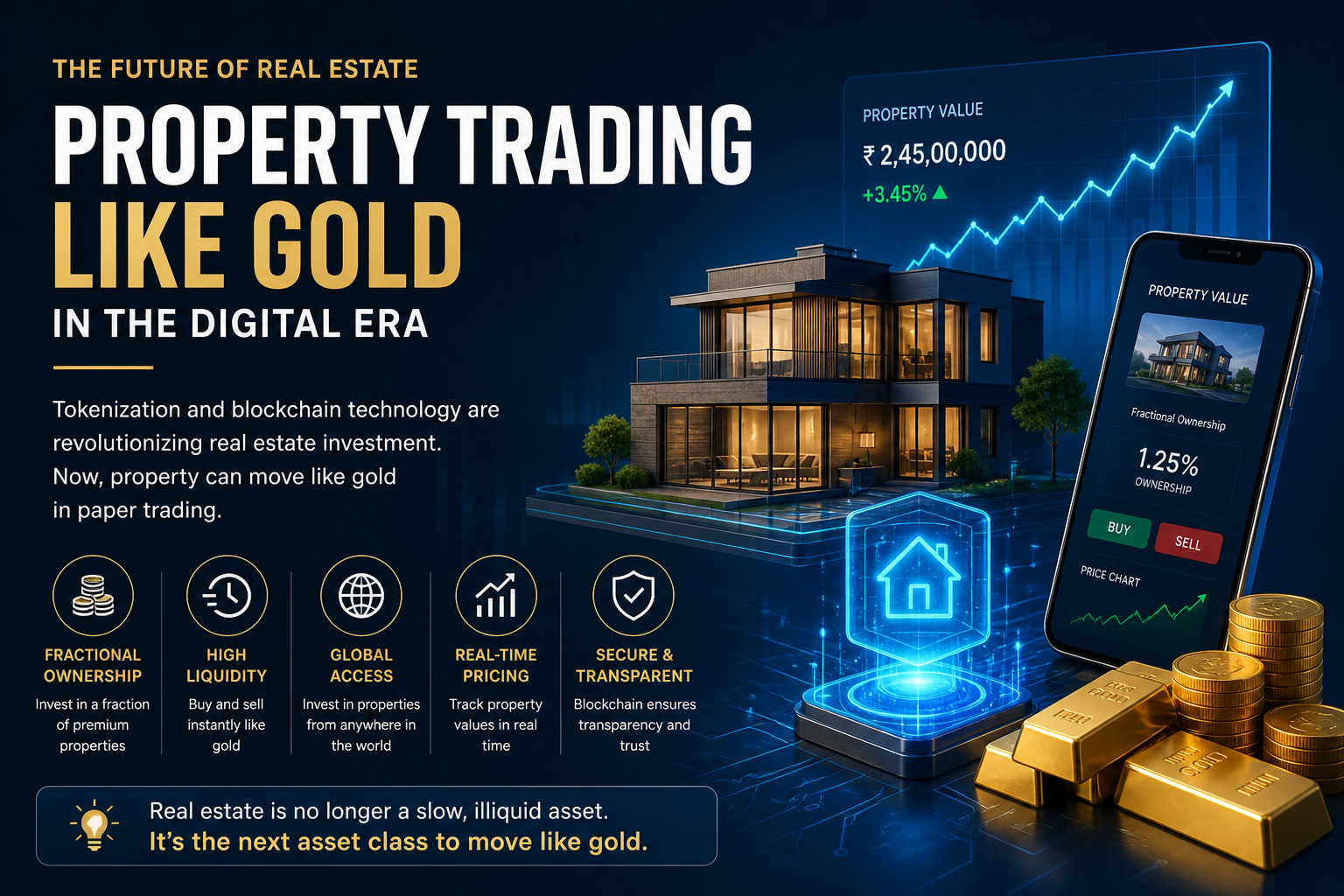
Tokenization allows real estate to behave like gold in paper trading.
Here’s how:
1. Fractional Ownership
Instead of buying an entire property, you can buy a small portion — just like buying grams of gold.
2. Easy Buying and Selling
No need to wait months. Transactions can happen quickly on digital platforms.
3. Real-Time Pricing
Property value can be tracked like stock or gold charts.
4. Global Investment Access
Anyone from anywhere can invest in properties across the world.
5. Improved Liquidity
Real estate becomes tradable instead of being locked for years.
Why This Shift Is Important
This transformation is not just innovation — it solves real problems.
- Small investors can enter the real estate market
- Large properties can attract global funding
- Investors get flexibility and faster returns
- Markets become more transparent and efficient
In simple terms, real estate becomes more accessible, flexible, and scalable.
Challenges That Still Exist
Even though the future looks promising, there are challenges:
- Regulatory uncertainty in many countries
- Legal acceptance of tokenized ownership
- Platform trust and security
- Market awareness
Governments and financial systems are still adapting to this new model.
The Future Vision
Imagine opening an app and seeing:
- Property prices moving like gold charts
- Buying shares in commercial buildings instantly
- Selling your investment anytime without legal delays
This is the direction real estate is heading toward.
Just like gold moved from physical storage to digital trading,
real estate is moving from ownership to tradability.
Conclusion
The evolution is clear.
Gold transformed into a fast, digital, tradable asset — and now real estate is following the same path.
With blockchain, tokenization, and digital platforms,
property will no longer be limited by size, location, or paperwork.
Instead, it will become:
- Fractional
- Liquid
- Globally tradable
And when that happens,
real estate will move just like gold in paper trading.